Get the world’s most fascinating discoveries delivered straight to your inbox.
You are now subscribed
Your newsletter sign-up was successful
Want to add more newsletters?
Join the club
Get full access to premium articles, exclusive features and a growing list of member rewards.
An account already exists for this email address, please log in.
'Staggering' first images from Vera C. Rubin Observatory show 10 million galaxies — and billions more are on the way
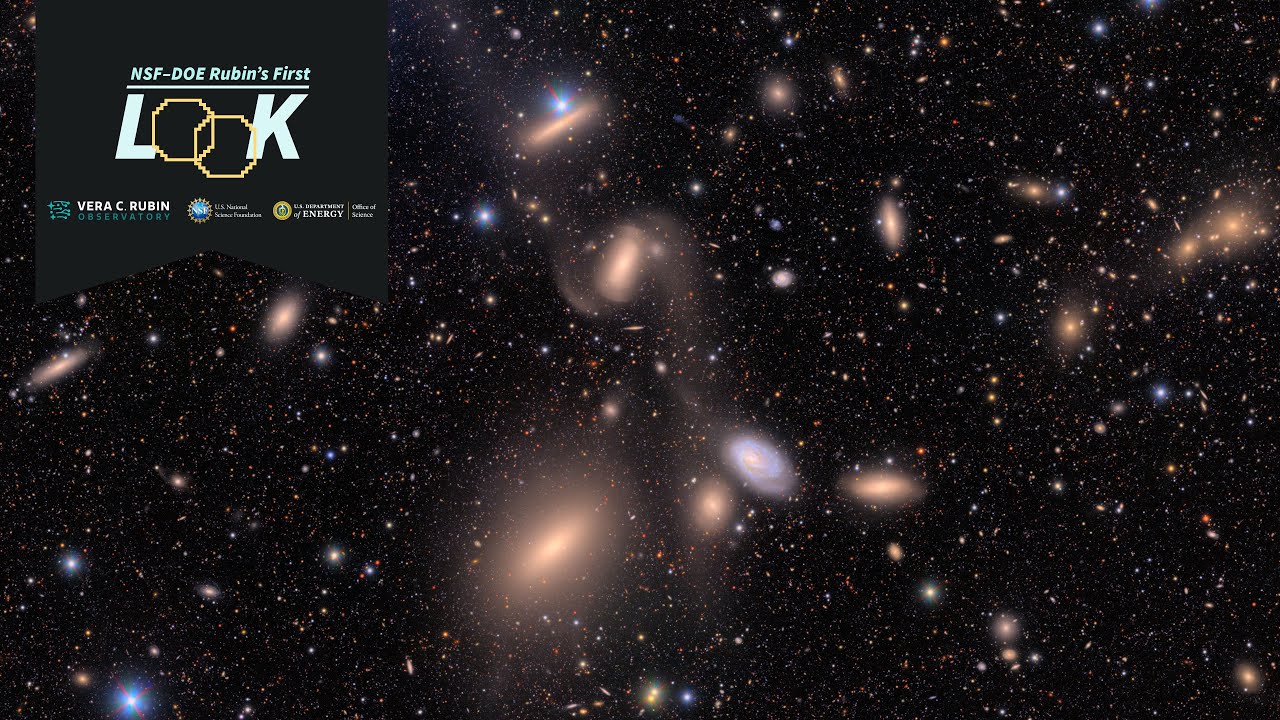
The first "stunning" images from the Vera C. Rubin Observatory were released this morning, capturing roughly 10 million galaxies, many of which have never been studied before.
After decades of preparation, the Vera C. Rubin Observatory released its first images to the world in a live stream on Monday (June 23). The photos, taken by the world's largest digital camera, are highly-detailed and show relatively large areas of the sky.
In a televised news conference, scientists from the observatory revealed new details about the images that far surpass the "sneak peek" images released earlier in the day. In fact, an awe-inspiring spiral galaxy image shared prior to the press conference on Monday only shows about 2% of the space cataloged in Rubin's first photo of the night sky, project scientists revealed.
The full image includes 10 million galaxies in and around the Virgo Cluster, many of which have never been seen before, Zeljko Ivezic, Project Scientist at Rubin and Deputy Director of the observatory's Large Synoptic Survey Telescope (LSST) construction project, said during the live stream.
The complete image is a whopping 3200 megapixels, which would need to be displayed on 400 ultra-high-definition TV screens for human eyes to resolve it — enough monitors to blanket an entire basketball court — Ivezic explained.
You can find all of the first-look images on the observatory's website, including a searchable and zoomable version of the full 3200-megapixel image.
"Staggering amount of data"
In the observatory's first year of operation, it will gather more data than all other existing optical observatories combined, according to a statement from the observatory.
This data will be freely available to scientists in hopes that it will lead to critical new discoveries about the universe, including the locations of previously unseen asteroids, insights into the properties of dark matter and dark energy — two invisible entities that make up a majority of the universe but remain poorly understood — and more.
Sign up for the Live Science daily newsletter now
Get the world’s most fascinating discoveries delivered straight to your inbox.
"I trust that the stunning images and staggering amount of data the observatory will produce will support exceptional scientific efforts around the world," said Michael Kratsios, director of the White House Office of Science and Technology Policy, in the conference.
A zoomed-out view of the Vera C. Rubin Observatory's first image of the Virgo Cluster, containing some 10 million galaxies.
(Image credit: NSF–DOE Vera C. Rubin Observatory)
During its planned 10 years of operation, Rubin will produce about 20 terabytes of data per night by taking high-resolution photographs of the night sky at 30-second intervals, according to the statement. By the end of its run, the observatory will have captured an estimated 40 billion celestial objects and taken trillions of measurements.
The Rubin team hopes that this data will advance understanding of mysterious cosmic phenomena. "Starting today, our ability to understand dark matter, dark energy and planetary defense will grow even faster than ever before," Brian Stone, chief of staff of the National Science Foundation, which operates the Observatory along with the U.S. Department of Energy, said in the conference.
A movie of the night sky
Once fully operational later this year, Rubin will continuously take photos of the night sky to capture every possible movement of the celestial objects it can see. It will collect about 1,000 images per night, covering the Southern sky every three or four nights. These images will then be stitched together to create an extremely detailed time-lapse movie of the universe.
The time-lapse will reveal the nightly movements of asteroids, comets, stars, supernovas, galaxies and possibly other cosmic phenomena that are as yet unknown, the statement noted.
In its first few nights of observations, for example, the Rubin Observatory pinpointed the locations of more than 2,000 previously unknown asteroids moving through our solar system. By the end of its mission, the observatory is expected to discover some 5 million new asteroids — about five times the number of all known asteroids discovered in the last 200 years, researchers said in the conference.
"The movie has started, the camera is running and we're going to see our cosmos unfold before us," said Chris Wright, Secretary for the Department of Energy, in the conference.
Constellations quiz: Can you name all the animals, objects and mythological figures hiding in the night sky?
Perri Thaler is an intern at Live Science. Her beats include space, tech and the physical sciences, but she also enjoys digging into other topics, like renewable energy and climate change. Perri studied astronomy and economics at Cornell University before working in policy and tech at NASA, and then researching paleomagnetism at Harvard University. She's now working toward a master's degree in journalism at New York University and her work has appeared on ScienceLine, Space.com and Eos.
You must confirm your public display name before commenting
Please logout and then login again, you will then be prompted to enter your display name.