Get the world’s most fascinating discoveries delivered straight to your inbox.
You are now subscribed
Your newsletter sign-up was successful
Want to add more newsletters?
Join the club
Get full access to premium articles, exclusive features and a growing list of member rewards.
An account already exists for this email address, please log in.
See the universe's rarest type of black hole slurp up a star in stunning animation
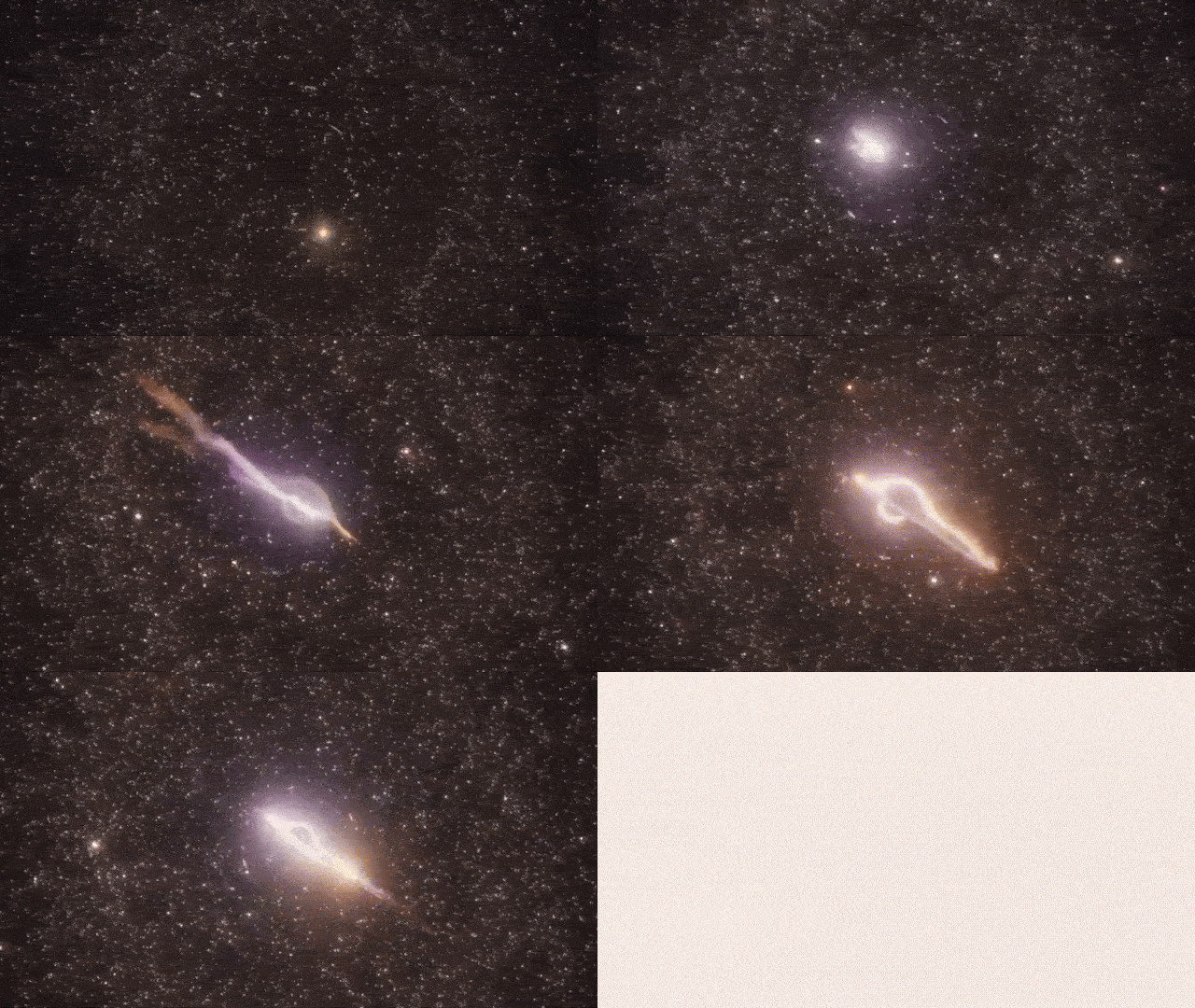
Astronomers believe they have spotted an elusive intermediate-mass black hole shredding a distant star, and they have re-created the stellar murder in a stunning new animation.
Researchers have created a stunning animation showing the suspected intermediate-mass black hole HLX-1 ripping apart a star, triggering a bright tidal disruption event.
Astronomers think they have detected an extremely rare type of "missing link" black hole chowing down on a helpless star at the edge of a distant galaxy — and they've shared a stunning animation showing what this superbright stellar massacre may have looked like.
Black holes come in a range of sizes, from primordial singularities smaller than the sun to supermassive black holes that are up to 40 billion times more massive than our home star and hold together galaxies such as the Milky Way. There are also medium-size versions, known as intermediate-mass black holes (IMBHs), which range from 100 to 100,000 solar masses. We know little about these medium-size objects, however, as they are incredibly hard to find.
In a study published April 11 in The Astrophysical Journal, researchers reported that they'd spotted another promising IMBH candidate, dubbed HLX-1, which is located around 40,000 light-years from the center of the galaxy NGC 6099 and more than 450 million light-years from Earth.
HLX-1 is located on the outskirts of NGC 6099 galaxy, more than 450 million light-years from Earth.
(Image credit: Science: NASA, ESA, CXC, Yi-Chi Chang (National Tsing Hua University); Image Processing: Joseph DePasquale (STScI))
By combining data from the Hubble Space Telescope and NASA's Chandra X-ray Observatory, the study team believes they have spotted a bright flash, or "tidal disruption event," caused by the black hole devouring a neighboring star. The researchers also used computer simulations to predict how this cosmic murder played out and produced an animation showing HLX-1 ripping apart — or "spaghettifying" — its stellar victim (see below).
Sign up for the Live Science daily newsletter now
Get the world’s most fascinating discoveries delivered straight to your inbox.
Astronomers first saw a bright source of X-rays coming from HLX-1 in images taken by Chandra in 2009. Researchers think this bright light was a tidal disruption event, which occurs when stars get ripped apart by black holes, generating a flash of radiation. The high-energy light coming from the suspected black hole peaked in 2012 and has gradually dimmed ever since.
However, as with many other IMBH candidates, it is not 100% certain that HLX-1 is a genuine IMBH. The light could also be caused by an accretion disk — a swirling ring of superhot matter surrounding the black hole's event horizon — that is fluctuating in size. The only way to tell which explanation is more likely is to monitor the light source. If it continues to dim without additional flare-ups, then it probably generated a tidal disruption event.
Researchers believe the X-ray light coming from HLX-1 is evidence of a tidal disruption event.
(Image credit: Artwork: NASA, ESA, Ralf Crawford (STScI))
In addition to being rare, IMBHs are important because of what they can tell us about other black holes. They "represent a crucial missing link in black hole evolution between stellar mass and supermassive black holes," study lead author Yi-Chi Chang, a researcher at the National Tsing Hua University in Taiwan, said in a statement.
One theory about IMBHs is that they may start as large stellar-mass black holes and eventually grow into supermassive black holes over billions of years. For this to happen, they may spend most of their lives on the outskirts of galaxies, like HLX-1, before they are catapulted into intergalactic space. Some researchers even suspect that a similar IMBH may circle the fringes of the Milky Way.
Harry is a U.K.-based senior staff writer at Live Science. He studied marine biology at the University of Exeter before training to become a journalist. He covers a wide range of topics including space exploration, planetary science, space weather, climate change, animal behavior and paleontology. His recent work on the solar maximum won "best space submission" at the 2024 Aerospace Media Awards and was shortlisted in the "top scoop" category at the NCTJ Awards for Excellence in 2023. He also writes Live Science's weekly Earth from space series.
You must confirm your public display name before commenting
Please logout and then login again, you will then be prompted to enter your display name.