Get the world’s most fascinating discoveries delivered straight to your inbox.
You are now subscribed
Your newsletter sign-up was successful
Want to add more newsletters?
Join the club
Get full access to premium articles, exclusive features and a growing list of member rewards.
An account already exists for this email address, please log in.
The next Carrington-level solar superstorm could wipe out 'all our satellites,' new simulations reveal
New ESA simulations suggest that a solar storm on par with the 1859 Carrington Event could wreak havoc on Earth-orbiting satellites — and it is a question of "when," not "if" this will happen, experts say.
Worrying new simulations show that a solar storm on par with the infamous Carrington Event could potentially wipe out every single satellite orbiting our planet, leaving us in a precarious and expensive predicament. And experts say such a powerful solar storm is inevitable and will hit our planet sooner or later.
On Sept. 1, 1859, British astronomer Richard Carrington observed a brilliant flash of light coming from a gigantic sunspot that was about the same size as Jupiter. He had witnessed the most powerful solar flare in recorded history, and it was followed by a major disturbance to Earth's magnetic field, known as a geomagnetic storm, which raged for almost a week and painted the skies with widespread auroras.
Now, a new set of simulations conducted by the European Space Agency (ESA) has revealed that if a similar event occurred today, the effects would be much more catastrophic due to our reliance on technologies — both on Earth and in space.
The simulations were part of a tabletop exercise carried out by researchers from multiple ESA departments at the European Space Operations Center in Darmstadt, Germany. The simulations were in preparation for the upcoming launch of ESA's Sentinel-1D radio imaging satellite, which is currently scheduled for Nov. 4.
In the hypothetical scenario, an X45 magnitude solar flare — around five times more powerful than the most intense solar flare of the current solar cycle — suddenly erupts from the sun, showering Earth with a wave of intense radiation without warning. Around 15 hours later, after another wave of radiation, a gigantic cloud of fast-moving plasma known as a coronal mass ejection (CME), hits our planet at more than 4.4 million mph (7.1 million km/h), triggering a Carrington-like geomagnetic storm.
Richard Carrington's sketch of the "monster" sunspot from 1859 revealed the dark patch was the size of Jupiter. In this image, his drawing has been superimposed onto a modern photo of the sun's surface.
(Image credit: Richard Carrington/ NASA Solar Dynamics Observatory/ SpaceWeather.com)
While the researchers' response to this scenario was focused on how they would protect Sentinel-1D, the simulations also demonstrated how the global constellation of orbiting spacecraft would fare in such an event.
"The immense flow of energy ejected by the sun may cause damage to all our satellites in orbit," Jorge Amaya, ESA's space weather modeling coordinator , said in a statement. "Satellites in low-Earth orbit are typically better protected by our atmosphere and our magnetic field from space hazards, but an explosion of the magnitude of the Carrington Event would leave no spacecraft safe."
Sign up for the Live Science daily newsletter now
Get the world’s most fascinating discoveries delivered straight to your inbox.
In the exercise, there were three main threats that satellites faced. First, the initial wave of radiation from the solar flare, which could permanently or temporarily disable any satellites too far from Earth's inner magnetic field. Second, a follow-up wave of radiation that scrambled navigation systems, increasing the likelihood of collisions. And third, the CME, which caused the upper atmosphere to swell outward as it soaked up the solar storm's energy.
The atmospheric swelling is perhaps the most dangerous aspect of this triple threat, as it could increase satellites' drag by up to 400%, pulling the spacecraft down to Earth, where they will either burn up in the atmosphere or crash to the planet's surface.
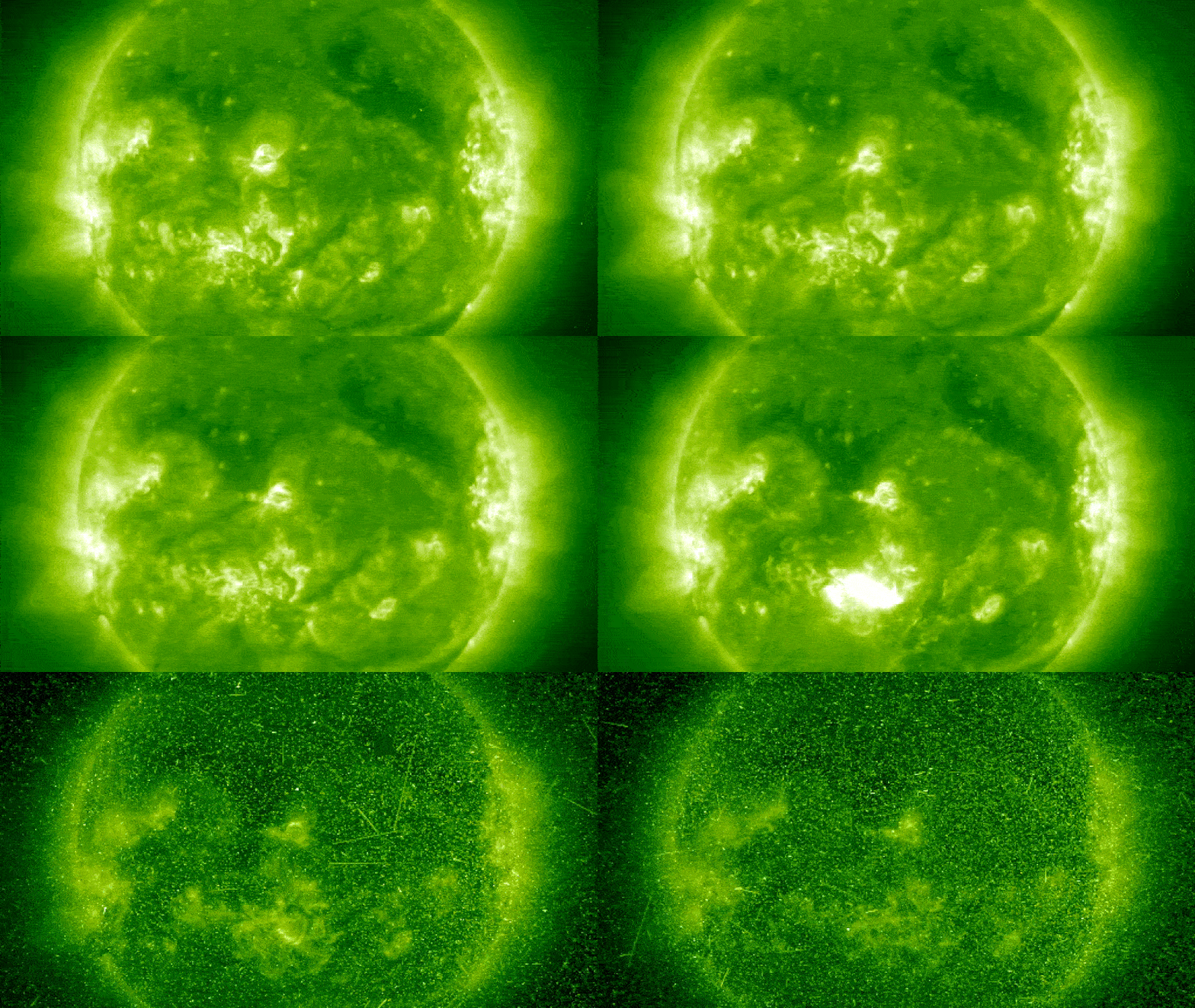
Solar flares release near-light-speed waves of intense radiation that hit satellites without warning. This ultraviolet wavelength footage shows this radiation hitting the Solar and Heliospheric Observatory (SOHO) spacecraft shortly after a solar flare in 2003.
But that was only a drop in the ocean compared with the costs of a Carrington-like storm. A 2013 study analyzing the possible impact of such an event on North American power grids revealed that the U.S. could incur damages of up to $2.6 trillion, while the Planetary Society noted the true global cost is "beyond the scale of our comprehension."
"When" not "if"
The reason that tabletop exercises like this are important is that another Carrington-like storm may not be far away.
"The key takeaway is that it's not a question of if this will happen but when," Gustavo Baldo Carvalho, a spacecraft operations expert who led the Sentinel-1D simulations, said in the statement.
Tabletop exercises play an important role in teaching experts how they should respond in worst-case scenarios.
(Image credit: ESA)
Experts think that a Carrington-level storm occurs every 500 years on average, putting the odds of such an event occurring this century at around 12%.
While the latest exercise is further proof that we are not currently equipped to deal with this type of extreme scenario, researchers hope that by continually training for this eventuality we will become better able to deal with it.
"Simulating the impact of such [an] event is similar to predicting the effects of a pandemic," Amaya said. "We will feel its real effect on our society only after the event, but we must be ready and have plans in place to react in a moment's notice."
But the longer we have to wait for the next megastorm, the more costly it will become, as the number of satellites orbiting our planet is predicted to rise by at least tenfold by 2050.
Harry is a U.K.-based senior staff writer at Live Science. He studied marine biology at the University of Exeter before training to become a journalist. He covers a wide range of topics including space exploration, planetary science, space weather, climate change, animal behavior and paleontology. His recent work on the solar maximum won "best space submission" at the 2024 Aerospace Media Awards and was shortlisted in the "top scoop" category at the NCTJ Awards for Excellence in 2023. He also writes Live Science's weekly Earth from space series.
You must confirm your public display name before commenting
Please logout and then login again, you will then be prompted to enter your display name.