Get the world’s most fascinating discoveries delivered straight to your inbox.
You are now subscribed
Your newsletter sign-up was successful
Want to add more newsletters?
Join the club
Get full access to premium articles, exclusive features and a growing list of member rewards.
An account already exists for this email address, please log in.
Enormous 'San Andreas fault' on Saturn's moon could help reveal signs of alien life
Huge "tiger stripe" fault lines seen on Saturn's moon Enceladus raise hopes that a "long-lived" ocean containing potential alien life may lurk beneath the moon's icy shell.
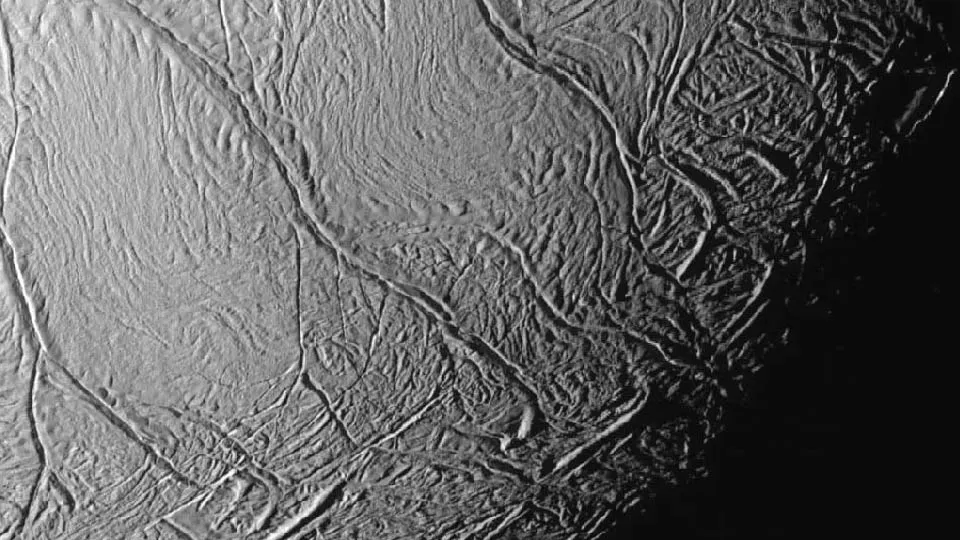
This close-up view of Saturn's moon Enceladus looks toward the moon's terminator (the transition from day to night) and shows a distinctive pattern of continuous, ridged, slightly curved and roughly parallel faults within the moon's southern polar latitudes. These surface features have been informally referred to by imaging scientists as "tiger stripes" due to their distinctly stripe-like appearance when viewed in false color.
New research has revealed the sliding side-by-side motion along distinctive "tiger stripes" on Saturn's moon Enceladus is linked to jets of ice crystals that erupt from its icy shell. The findings could help determine the characteristics of this icy moon of Saturn's subsurface ocean and, thus, if Enceladus is favorable to life.
The tiger stripes of Enceladus consist of four parallel line fractures in the moon's south pole that were first observed by NASA's Cassini spacecraft in 2005. "Cryovolcanism" in this region blasts out ice crystals believed to originate from Enceladus' buried ocean from these fractures, causing a broad plume of material to gather over the south pole of the Saturnian moon.
Both the brightness of this plume and the jets that create it seem to vary in a pattern that lines up with the near 33-hour orbit of Enceladus around Saturn, the solar system's second most massive planet. This has led scientists to theorize that the activity of the jets increases as tidal stress acts upon the tiger stripes.
However, this theory can't explain why the jets of Enceladus peak in brightness hours after tidal stresses are at their maximum or why there is a second smaller peak seen shortly after Enceladus' closest approach to Saturn. A new numerical simulation of Enceladus' tidal stresses and the motion of its tiger stripe fractures identifies a phenomenon similar to that seen at the San Andreas fault, corresponding with the pattern of jet activity.
"We developed a sophisticated numerical model to simulate tidally-driven strike-slip motion along Enceladus' faults. These models consider the role of friction, which causes the amount of slip on the faults to be sensitive to both compressional and shearing stresses," Alexander Berne, leader of the team behind the simulation and a PhD Candidate at the California Institute of Technology (Caltech), told Space.com.
"The numerical model was able to simulate slip along Enceladus's faults in a manner which matched observed variations in plume brightness as well as spatial variations in surface temperature, suggesting that the jets and plume brightness variations are controlled by strike-slip motion over Enceladus' orbit."
Sign up for the Live Science daily newsletter now
Get the world’s most fascinating discoveries delivered straight to your inbox.
The San Andreas fault in space
Berne and colleagues found that frictional mechanics control motion in interfaces along the tiger stripes of Enceladus where both sides of the fractures meet. This means that during Enceladus's orbital cycle, the tiger strips periodically slide and lock. This side-by-side, or "strike-slip," motion lines up with jet activity.
The correlation between strike-slip activity and jet brightness in the simulation led the team to hypothesize that variations in jet activity are controlled by the presence of 'pull-aparts' along the faults. These are bent sections of the fractures that open under broad strike-slip motion, allowing water to rise from the subsurface ocean through the icy shell to feed the cryovolcanic jets.
"A close terrestrial analogy is motion along pull-apart basin structures over large strike-slip faults subject to tectonic stresses. One example of such motion occurs over the Salton Basin – a large pull-apart located on the San Andreas fault, a strike-slip fault, in Southern California," Berne said. "Regional strike-slip motion causes localized crustal extension as well as volcanism over the Salton Basin. This process is similar to tidally-driven extension along pull-aparts at Enceladus, which may regulate the moon's cryovolcanic activity.
"Prior to conducting the research, we did not expect such a high correlation between modeled strike-slip motion and jet activity."
The "tiger stripes" of Enceladus as seen by the Cassini spacecraft in 2007.
(Image credit: Cassini imaging team/NASA)
The team's research suggests that the tiger stripes of Enceladus open differently than previously modeled.
"This finding was surprising since most past studies on the subject invoke broad opening along the tiger stripes, like opening and closing like an elevator door, as the primary mechanism regulating plume brightness variations," Berne said.
The Caltech researcher added that the team's models suggest that tides play a fundamental role in the evolution of Enceladus and its ocean on multiple timescales.
"On the orbital timescale, tides appear to regulate the amount of material flowing from a subsurface ocean through the tiger stripe fractures," Berne said. "At longer timescales, tides may cause frictional tiger stripes to fracture in a net right-lateral sense."
He continued by suggesting that this long-term right lateral motion may drive the formation of geologic features observed around the terrain of the southern pole of Enceladus. This includes a fracture that radiates away from the South Pole on the trailing Hemisphere of Enceladus.
Scientists have suggested that Enceladus, with its buried global ocean, could be a prime target for searching for life elsewhere in the solar system. This research and the team's model could provide extra support for that hypothesis.
"Understanding subsurface material transport pathways through pull-apart or broad rift zones is crucial for determining whether ice grains in Enceladus' jets are representative of the moon's potentially habitable global ocean. Our study provides a framework for understanding such transport pathways and their evolution over time," Berne said.
"Evidence for the long-term influence of tides on the evolution of Enceladus, which also heat the interior, implies that the moon's ocean is long-lived, which has implications for the potential evolution of life in the interior."
At the moment, the team's conclusion is based upon a computer simulation and thus needs to be confirmed with actual observations.
"Geophysical measurements at Enceladus using radar would allow us to confirm or refute the hypotheses laid out in our paper. More broadly, such observations of the movement of Enceladus' surface over time can provide key constraints on the dynamics of the core and the crust, as well as the extent to which these processes have been active over time," Berne concluded. "We aim to continue to investigate ways we can use geophysical measurements to better understand the conditions which may enable life to form and evolve on Enceladus."
The team's research was published on Monday (April 29) in the journal Nature Geoscience.
Robert Lea is a science journalist in the U.K. who specializes in science, space, physics, astronomy, astrophysics, cosmology, quantum mechanics and technology. Rob's articles have been published in Physics World, New Scientist, Astronomy Magazine, All About Space and ZME Science. He also writes about science communication for Elsevier and the European Journal of Physics. Rob holds a bachelor of science degree in physics and astronomy from the U.K.’s Open University