Gravity can turn itself into light, but only if space-time behaves in just the right way, a research team has found.
Under normal circumstances, you cannot get something from nothing. Specifically, the Standard Model of particle physics, the reigning theory that explains the subatomic zoo of particles, usually forbids the transformation of massless particles into massive ones. While particles in the Standard Model constantly change into each other through various reactions and processes, the photon — the massless carrier of light — cannot normally change into other particles. But if the conditions are just right, it is possible — for example, when a photon interacts with a heavy atom, it can spontaneously split off to become an electron and a positron, both of which are massive particles.
With this well-known example in hand, a team of theoretical physicists, writing in a paper posted March 28 to the preprint database arXiv, asked if gravity itself could transform into other particles. We normally think of gravity through the lens of general relativity, where bends and warps in space-time influence the motion of particles. In that picture, it would be very difficult to imagine how gravity could create particles. But we can also view gravity through a quantum lens, picturing the gravitational force as carried by countless invisible particles called gravitons. While our picture of quantum gravity is far from complete, we do know that these gravitons would behave like any other fundamental particle, including potentially transforming.
To test this idea, the researchers studied the conditions of the extremely early universe. When our cosmos was very young, it was also small, hot and dense. In that youthful cosmos, all forms of matter and energy were ramped up to unimaginable scales, far greater than even our most powerful particle colliders are capable of achieving.
The researchers found that in this setup, gravitational waves — ripples in the fabric of space-time generated by collisions between the most massive cosmic objects — play an important role. Normally, gravitational waves are exceedingly weak, capable of nudging an atom through a distance less than the width of its own nucleus. But in the early universe, the waves could have been much stronger, and that could have seriously influenced everything else.
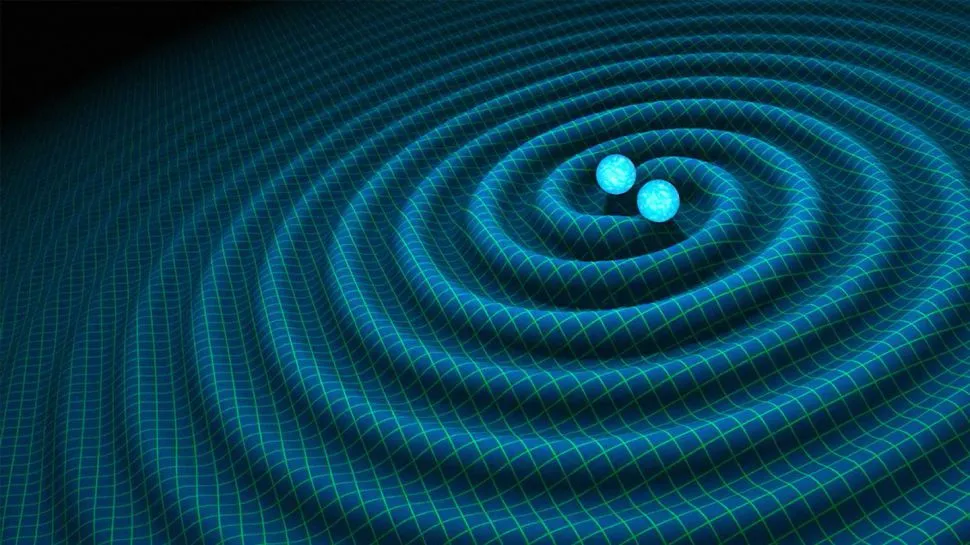
Artist impression of gravitational waves.
(Image credit: R. Hurt/Caltech-JPL)
Those early waves would have sloshed back and forth, amplifying themselves. Anything else in the universe would have gotten caught up in the push and pull of the waves, leading to a resonance effect. Like a kid pumping their legs at just the right time to send a swing higher and higher, the gravitational waves would have acted as a pump, driving matter into tight clumps over and over again.
The gravitational waves could also affect the electromagnetic field. Because the waves are ripples in space-time itself, they don't limit themselves to interactions with massive objects. As the waves continue to pump, they can drive radiation in the universe to extremely high energies, causing the spontaneous appearance of photons: gravity generating light itself.
Sign up for the Live Science daily newsletter now
Get the world’s most fascinating discoveries delivered straight to your inbox.
The researchers found that in general, this process is rather inefficient. The early universe was also expanding, so the standard patterns of gravitational waves would not have lasted long. However, the team found that if the early universe contained enough matter that the speed of light was reduced (the same way light travels more slowly through a medium such as air or water), the waves could have stuck around long enough to really get things going, generating floods of extra photons.
Physicists do not yet fully understand the complicated, tangled physics of the early universe, which was capable of achieving feats never observed since. This new research adds one more strand to the rich tapestry: the capability for gravity to create light. That radiation would presumably then go on to influence the formation of matter and the evolution of the universe, so working out the full implications of this surprising process could lead to new revolutions in our understanding of the earliest moments of the cosmos.
Paul M. Sutter is a research professor in astrophysics at SUNY Stony Brook University and the Flatiron Institute in New York City. He regularly appears on TV and podcasts, including "Ask a Spaceman." He is the author of two books, "Your Place in the Universe" and "How to Die in Space," and is a regular contributor to Space.com, Live Science, and more. Paul received his PhD in Physics from the University of Illinois at Urbana-Champaign in 2011, and spent three years at the Paris Institute of Astrophysics, followed by a research fellowship in Trieste, Italy.