













Oldest Fungus Fossils May Rewrite Our View of How Life Made the Leap to Land

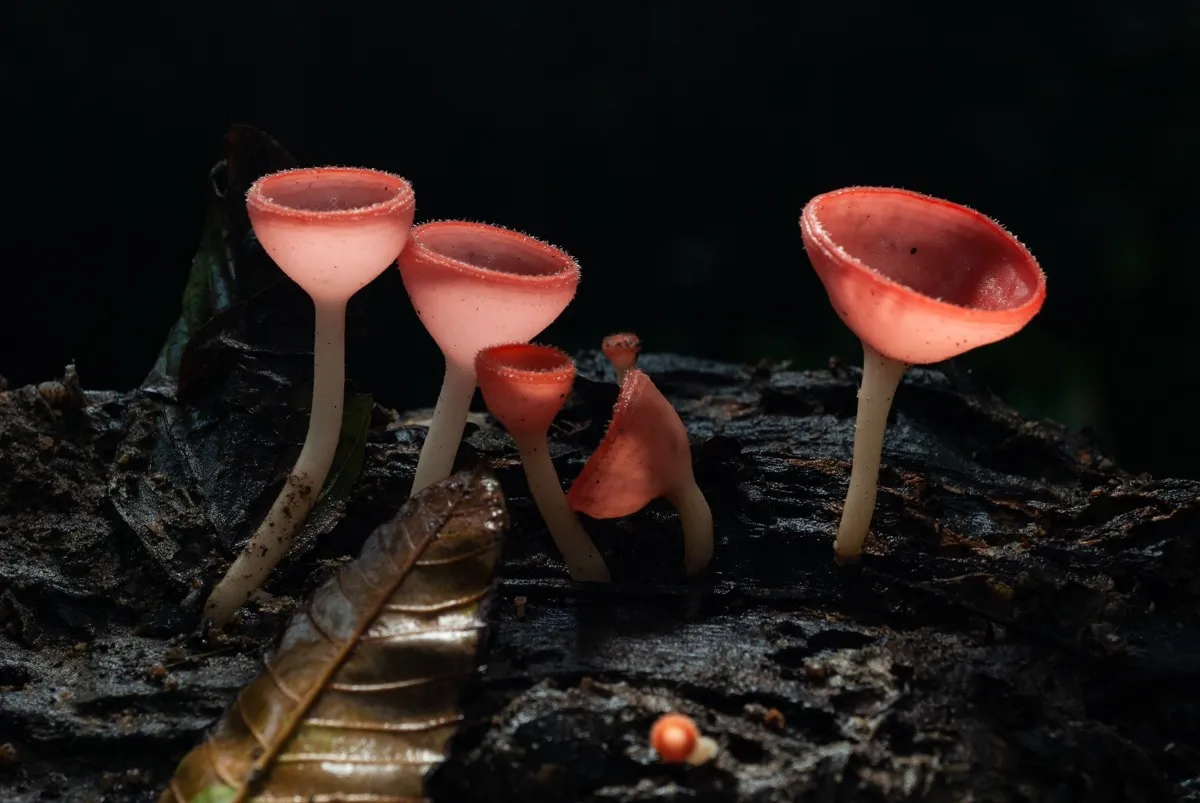
Miniature fungi found fossilized in Canada's Northwest Territories are likely a billion years old, new research finds.
If the research is correct, the fossil fungi would be the first from that time period ever discovered to have a complex, branching structure, according to a news article on the discovery published in the journal Nature, which also published the research paper reporting the discovery on May 22. Scientists already thought that fungi originated about a billion years ago, but these original fungi were thought to have been only single-celled species.
"This is reshaping our vision of the world because those groups are still present today," study author Corentin Loron, a doctoral candidate at the University of Liege in Belgium, told Agence France Press (AFP). "Therefore, this distant past, although very different from today, may have been much more 'modern' than we thought." [Gallery: Oldest Living Things in the World]
In addition, the findings might indicate that fungi made the leap from the oceans to land long before plants, which appear to have come ashore some 470 million years ago. "The fungi were probably colonizing the land before the plants," Loron told The New York Times.
First fungus?
The fossils were found in shale that was once a shallow-water estuary. The researchers used uranium-lead dating of tiny minerals called detrital zircons within the shale to determine the age of the fossils. Zircons are tough minerals that can survive a lot of geological change — the oldest ever dated, from the Jack Hills of Australia, are 4.4 billion years old. Using a separate dating technique, the researchers also dated organic matter in the shale. These two methods put the age of the fossils between 1 billion and 900 million years old.
The fossils look like itsy-bitsy balloons. Skinny filaments, arranged in a branching structure, terminate in spherical spores (serving the same purpose as seeds in plants). The spores are tiny, just a few hundred nanometers across, and the filaments are just a few dozen micrometers long. The researchers dubbed the species Ourasphaira giraldae.
Chemistry questions
Most provocatively, the researchers claim to have found evidence that the fossils once contained chitin, the fibrous stuff that makes up fungal cell walls. They used infrared light on the fossils and analyzed the patterns of light waves that reflected back. Those patterns matched what is seen in modern-day chitin. [Microscopic Worlds Gallery: Fascinating Fungi]
Get the world’s most fascinating discoveries delivered straight to your inbox.
Before this discovery, the oldest known fungi fossils dated back 450 million years, Loron and his colleagues wrote in Nature. Those fungi left fossilized spores in rocks found in Wisconsin. The newly discovered ancient fungus may have been a land-based species that was washed into the estuary, the researchers wrote, or it may have been a marine dweller.
Researchers will likely want further confirmation of the fossils' identity. Carnegie Institution for Science geochemist George Cody told The New York Times that the infrared patterns could have been made by something other than chitin.
But, he said, "I don't have any doubt that they're fossils, and that alone is fascinating."
- In Images: The Oldest Fossils on Earth
- Tiny Grandeur: Stunning Photos of the Very Small
- Microscopic Worlds Gallery: Fascinating Fungi
Originally published on Live Science.

Stephanie Pappas is a contributing writer for Live Science, covering topics ranging from geoscience to archaeology to the human brain and behavior. She was previously a senior writer for Live Science but is now a freelancer based in Denver, Colorado, and regularly contributes to Scientific American and The Monitor, the monthly magazine of the American Psychological Association. Stephanie received a bachelor's degree in psychology from the University of South Carolina and a graduate certificate in science communication from the University of California, Santa Cruz.