













How Hungry Pitcher Plants Get the Poop They Need

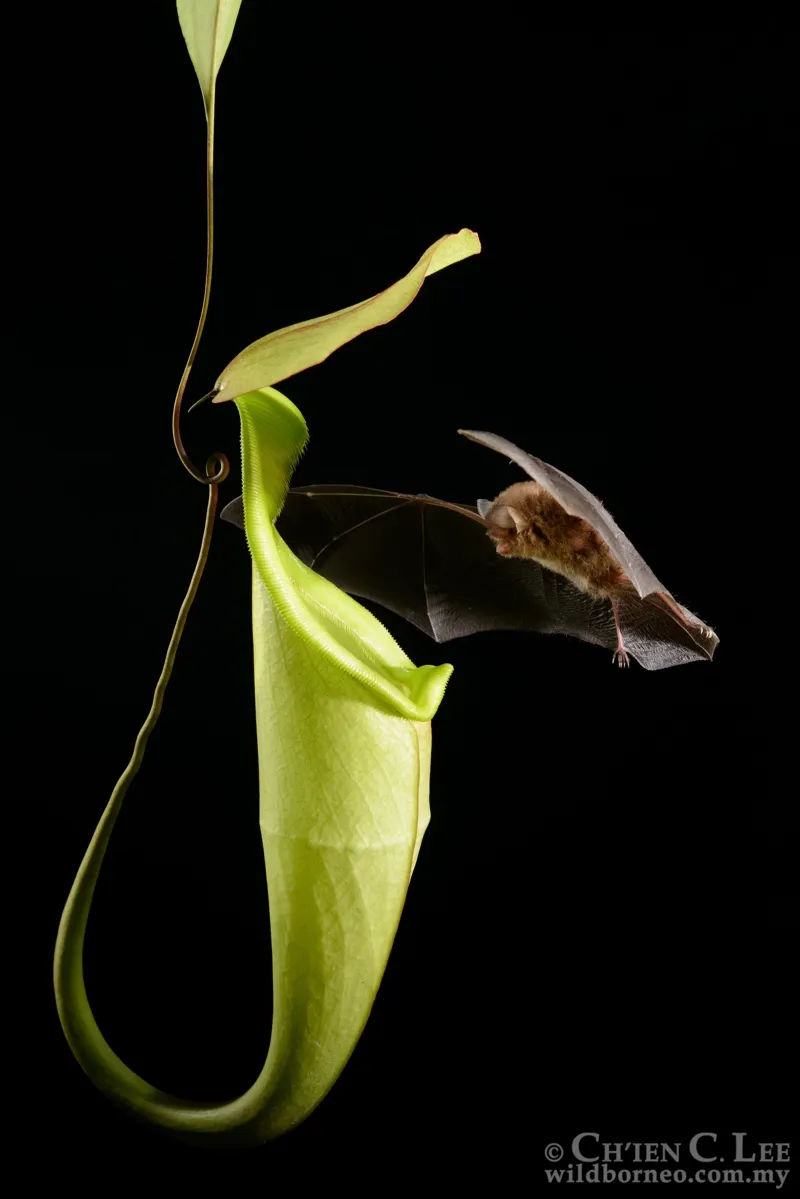
Pitcher plants that "eat" bat poop have come up with a unique way to attract their meal tickets, new research finds: The plants are shaped to stand out against a bat's echolocation cries.
The pitcher plant Nepenthes hemsleyana grows in the peat forests of Borneo and is a common roost for bats of the species Kerivoula hardwickii. Researchers had previously found that the bats and the pitcher plants have a mutually beneficial relationship: The plants provide a comfy roost with few parasites and an ideal microclimate, and the bats poop in the plants. Bat guano is rich in nitrogen, a crucial plant nutrient.
The discovery explained how N. hemsleyana can survive, given that its closest carnivorous plant relatives capture seven times as many insects as it does, said Michael Schöner of Ernst-Moritz-Arndt-University of Greifswald in Germany, who co-authored both the study on the mutually beneficial relationship and new research on the plants' alluring shape. [See Cool (and Gross) Images of Carnivorous Plants]
"One-third of the nitrogen which is gained by the pitcher plants is arriving from the bat species," Schöner told Live Science. Another pitcher plant in Borneo, Nepenthes lowii, relies on shrew poop for the same purpose.
Echo attraction
Schöner and his colleagues from the Universiti Brunei Darussalam and Friedrich-Alexander-Universität Erlangen-Nürnberg wondered if something similar might be happening in the forests of Borneo. During fieldwork, the researchers often had trouble even finding the pitcher plants in the dense forest. They wondered how the bats managed.
"When these bats are flying in this dense vegetation and trying to find the pitchers, they will get echoes from every single leaf that is present," Schöner said.
Get the world’s most fascinating discoveries delivered straight to your inbox.
To test whether the plants were particularly reflective of echoes, the researchers used an artificial bat head and microphone to play echolocation calls at pitcher plants and measure the reflected echoes. Results showed that, indeed, a dish-shaped structure at the opening of the N. hemsleyana plant bounced back the bats' cries.
Mutual relationship
But just because the structure makes a good echo, that doesn't mean the bats are really searching for this echo, Schöner said. So the researchers recruited some real bats and let them loose in a tented area. Inside the tent was a bundle of dense shrubbery surrounding a pitcher plant.
In some cases, they left the pitchers as is; in others, the researchers removed, enlarged or modified the reflective leaf structure. They found that bats preferred to approach enlarged or normal pitcher plants over plants without the reflective structure. When it came time to pick a roost, the bats went for the unmodified plants, perhaps because the enlarged plant structures didn't register as a safe haven.
"At the moment, we cannot say for sure that the plants have evolved the structure for the bats," Schöner said — only that the bats use the structure in a mutually beneficial way. It's likely, however, that evolution did drive the development of these sound reflectors, he said.
This is the first time plants have been found to possess a bat-attracting feature for a purpose other than pollination. It's also the first example of a structure like this outside of Central or South America, Schöner said. Unfortunately, the peat forests where these plants and bats coexist are being destroyed by deforestation to clear the way for timber farms and palm oil.
"When we are destroying such ecosystems … we are also destroying such wonderful mutualism between the bats and the pitcher plants," Schöner said.
The research is detailed today (July 9) in the journal Current Biology.
Follow Stephanie Pappas on Twitterand Google+. Follow us @livescience, Facebook& Google+. Original article on Live Science.

Stephanie Pappas is a contributing writer for Live Science, covering topics ranging from geoscience to archaeology to the human brain and behavior. She was previously a senior writer for Live Science but is now a freelancer based in Denver, Colorado, and regularly contributes to Scientific American and The Monitor, the monthly magazine of the American Psychological Association. Stephanie received a bachelor's degree in psychology from the University of South Carolina and a graduate certificate in science communication from the University of California, Santa Cruz.