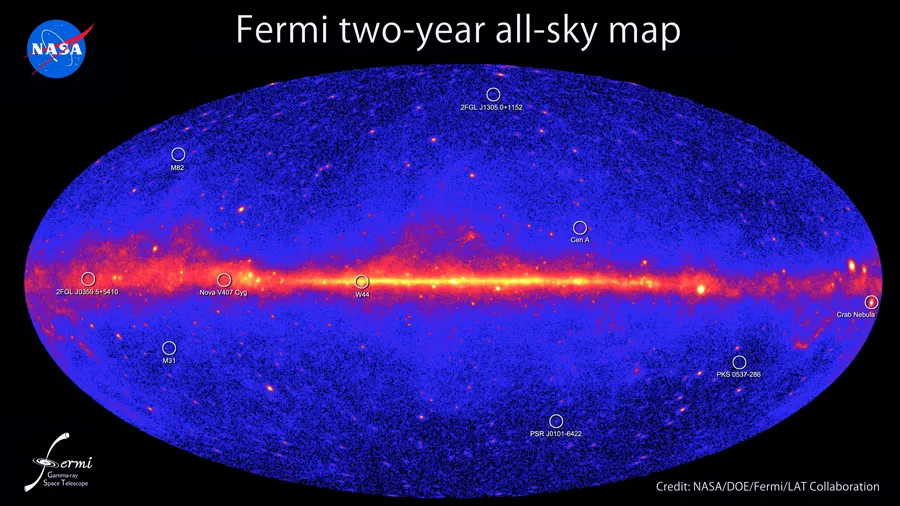
This all-sky image, constructed from two years of observations by NASA's Fermi Gamma-ray Space Telescope, shows how the sky appears in gamma-ray light.
Gamma rays are a form of electromagnetic radiation, as are radio waves, infrared radiation, ultraviolet radiation, X-rays and microwaves. Gamma rays can be used to treat cancer, and gamma-ray bursts are studied by astronomers.
Electromagnetic (EM) radiation is transmitted in waves or particles at different wavelengths and frequencies. This broad range of wavelengths is known as the electromagnetic spectrum. The spectrum is generally divided into seven regions in order of decreasing wavelength and increasing energy and frequency. The common designations are radio waves, microwaves, infrared (IR), visible light, ultraviolet (UV), X-rays and gamma rays.
Gamma rays fall in the range of the EM spectrum above soft X-rays. Gamma rays have frequencies greater than about 10^19 cycles per second, or hertz (Hz), and wavelengths of less than 100 picometers (pm), or 4 x 10^9 inches. (A picometer is one-trillionth of a meter.)
Gamma rays and hard X-rays overlap in the EM spectrum, which can make it hard to differentiate them. In some fields, such as astrophysics, an arbitrary line is drawn in the spectrum where rays above a certain wavelength are classified as X-rays and rays with shorter wavelengths are classified as gamma-rays. Both gamma rays and X-rays have enough energy to cause damage to living tissue, but almost all cosmic gamma rays are blocked by Earth's atmosphere.
Discovery of gamma rays
Gamma rays were first observed in 1900 by French chemist Paul Villard when he was investigating radiation from radium, according to the Australian Radiation Protection and Nuclear Safety Agency (ARPANSA). A few years later, New Zealand-born chemist and physicist Ernest Rutherford proposed the name "gamma rays," following the order of alpha rays and beta rays — names given to other particles that are created during a nuclear reaction — and the name stuck.
Gamma-ray sources and effects
Gamma rays are produced primarily by four different nuclear reactions: fusion, fission, alpha decay and gamma decay.
Nuclear fusion is the reaction that powers the sun and stars. It occurs in a multistep process in which four protons, or hydrogen nuclei, are forced under extreme temperature and pressure to fuse into a helium nucleus, which comprises two protons and two neutrons. The resulting helium nucleus is about 0.7 percent less massive than the four protons that went into the reaction. That mass difference is converted into energy, according to Einstein's famous equation E=mc^2, with about two-thirds of that energy emitted as gamma-rays. (The rest is in the form of neutrinos, which are extremely weakly interacting particles with nearly zero mass.) In the later stages of a star's lifetime, when it runs out of hydrogen fuel, it can form increasingly more massive elements through fusion, up to and including iron, but these reactions produce a decreasing amount of energy at each stage.
Sign up for the Live Science daily newsletter now
Get the world’s most fascinating discoveries delivered straight to your inbox.
Another familiar source of gamma rays is nuclear fission. Lawrence Berkeley National Laboratory defines nuclear fission as the splitting of a heavy nucleus into two roughly equal parts, which are then nuclei of lighter elements. In this process, which involves collisions with other particles, heavy nuclei, such as uranium and plutonium, are broken into smaller elements, such as xenon and strontium. The resulting particles from these collisions can then impact other heavy nuclei, setting up a nuclear chain reaction. Energy is released because the combined mass of the resulting particles is less than the mass of the original heavy nucleus. That mass difference is converted to energy, according to E=mc^2, in the form of kinetic energy of the smaller nuclei, neutrinos and gamma rays.
Other sources of gamma rays are alpha decay and gamma decay. Alpha decay occurs when a heavy nucleus gives off a helium-4 nucleus, reducing its atomic number by 2 and its atomic weight by 4. This process can leave the nucleus with excess energy, which is emitted in the form of a gamma ray. Gamma decay occurs when there is too much energy in the nucleus of an atom, causing it to emit a gamma ray without changing its charge or mass composition.
Artist impression of gamma ray burst.
(Image credit: NASA)
Gamma-ray therapy
Gamma rays are sometimes used to treat cancerous tumors in the body by damaging the DNA of the tumor cells. However, great care must be taken, because gamma-rays can also damage the DNA of surrounding healthy tissue cells.
One way to maximize the dosage to cancer cells while minimizing the exposure to healthy tissues is to direct multiple gamma-ray beams from a linear accelerator, or linac, onto the target region from many different directions. This is the operating principle of CyberKnife and Gamma Knife therapies.
Gamma Knife radiosurgery uses specialized equipment to focus close to 200 tiny beams of radiation on a tumor or other target in the brain. Each individual beam has very little effect on the brain tissue it passes through, but a strong dose of radiation is delivered at the point where the beams meet, according to Mayo Clinic.
Gamma-ray astronomy
One of the more interesting sources of gamma rays are gamma-ray bursts (GRBs). These are extremely high-energy events that last from a few milliseconds to several minutes. They were first observed in the 1960s, and they are now observed somewhere in the sky about once a day.
Gamma-ray bursts are "the most energetic form of light," according to NASA. They shine hundreds of times brighter than a typical supernova and about a million-trillion times as bright as the sun.
According to Robert Patterson, a professor of astronomy at Missouri State University, GRBs were once thought to come from the last stages of evaporating mini black holes. They are now believed to originate in collisions of compact objects such as neutron stars. Other theories attribute these events to the collapse of supermassive stars to form black holes.
In either case, GRBs can produce enough energy that, for a few seconds, they can outshine an entire galaxy. Because Earth's atmosphere blocks most gamma-rays, they're seen only with high-altitude balloons and orbiting telescopes.
Jim Lucas is a contributing writer for Live Science. He covers physics, astronomy and engineering. Jim graduated from Missouri State University, where he earned a bachelor of science degree in physics with minors in astronomy and technical writing. After graduation he worked at Los Alamos National Laboratory as a network systems administrator, a technical writer-editor and a nuclear security specialist. In addition to writing, he edits scientific journal articles in a variety of topical areas.