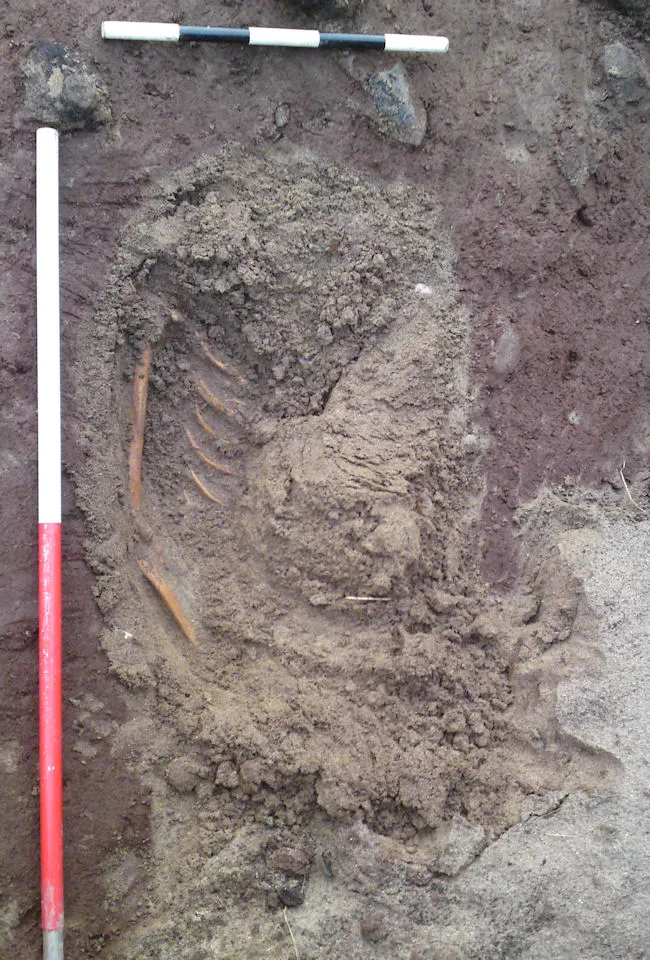
A series of storms that hit Scotland's Shetland Islands over the holidays revealed what archaeologists believe could be 2,000-year-old human remains.
Police were initially called to the scene when storms eroded a cliff at Channerwick and exposed the skeleton, but officials soon determined that they wouldn't have to open a homicide investigation.
Local archaeologist Chris Dyer said the ancient skeleton looked as if it were contemporary with the remains of Iron Age structures revealed nearby. Researchers then identified evidence of one or possibly two more burials at the site, but another storm caused a further chunk of the cliff to crumble, covering up the discovery.
"The original burial now lies under several tons of fallen bank, and the Iron Age structures have also disappeared from view," Dyer said in a statement from the Shetland Amenity Trust.
Nature is known to reveal human history. For instance, remains of hominids — a juvenile male and adult female who lived nearly 2 million years ago — were discovered in the far reaches of a limestone cave system that had eroded over time. "We are looking at very eroded and denuded portions of this cave system, where nature has exposed what had once been the deep reaches," said researcher Daniel Farber, an earth scientist at the University of California at Santa Cruz, in 2011 at the time the discovery was announced.
In addition, melting patches of ice that had been in place for thousands of years in the mountains of the Canadian High Arctic revealed a treasure trove of ancient hunting tools.
Regarding the new finding, officials have not planned further archaeological work at the site, but said a small piece of bone was recovered and will be analyzed using radiocarbon dating to confirm the skeleton's age. (This method relies on the level of radioactive carbon, which is naturally occurring and decays at a predictable rate into nonradioactive carbon, to estimate the age of organic materials.)
Sign up for the Live Science daily newsletter now
Get the world’s most fascinating discoveries delivered straight to your inbox.
For the science geek in everyone, Live Science offers a fascinating window into the natural and technological world, delivering comprehensive and compelling news and analysis on everything from dinosaur discoveries, archaeological finds and amazing animals to health, innovation and wearable technology. We aim to empower and inspire our readers with the tools needed to understand the world and appreciate its everyday awe.