













500-year-old gold dental bridge is earliest known oral care of its kind in Scotland — and it likely held a fake tooth
Archaeologists discovered the 20-karat-gold dental wire in the lower jaw of a middle-aged man who lived around 500 years ago in Scotland.

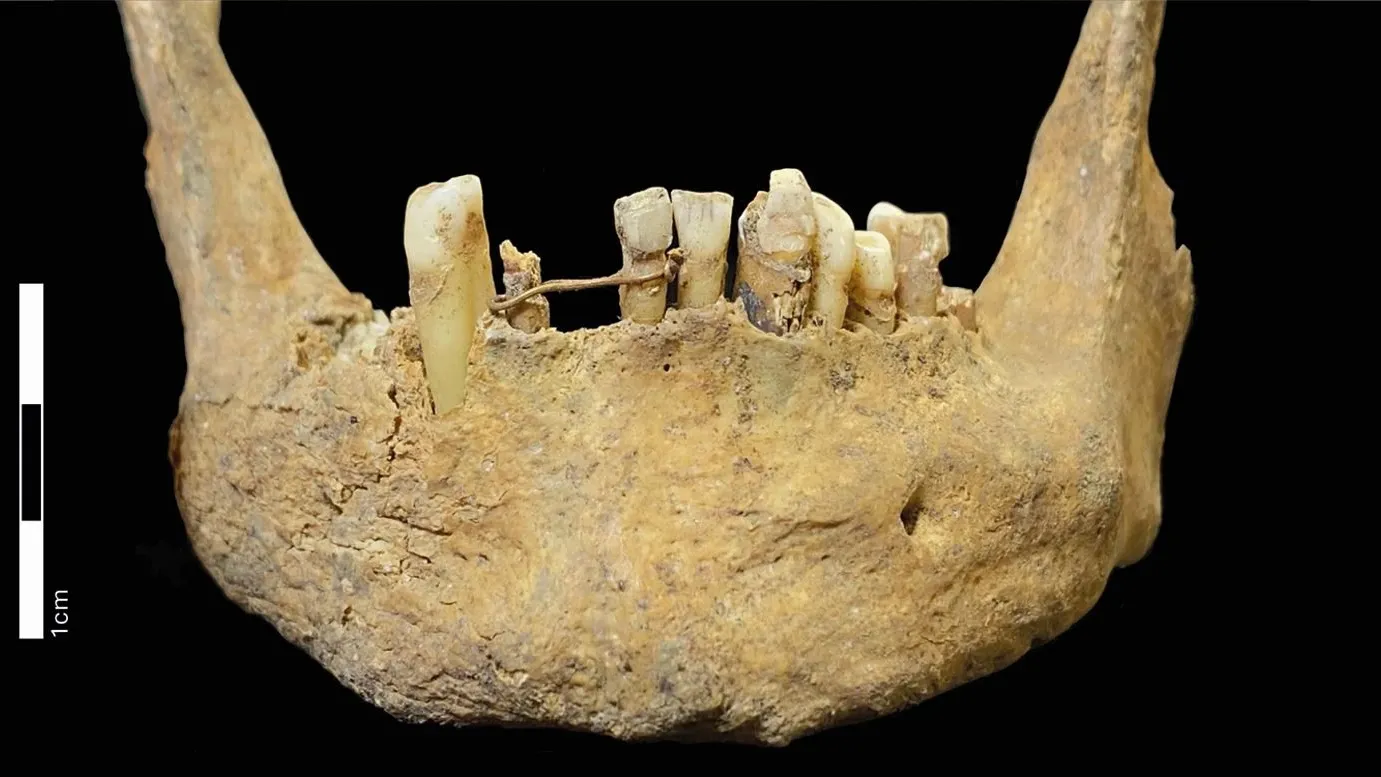
A man's lower jaw recovered from a medieval church in Aberdeen reveals the oldest known use of a dental bridge in Scotland, a new study finds. The gold wire, called a ligature, was installed around two teeth about 500 years ago to span the gap created by a lost tooth.
"The application of the ligature would likely have caused some discomfort during the procedure," Rebecca Crozier, a bioarchaeologist at the University of Aberdeen and co-author of the new study on the jawbone, told Live Science in an email. But the man, who was middle-aged when he died between 1460 and 1670, "would have most likely gotten used to the presence of the wire over time and probably stopped noticing it," she said.
In a study published April 24 in the British Dental Journal, Crozier and colleagues described a lower jawbone discovered as part of an excavation at the St. Nicholas East Kirk in Aberdeen, Scotland. The church, which was likely built in the 11th century and used until the Protestant Reformation in the late 16th century, contained over 900 burials and thousands of individual human bones. Although the wired jawbone was not found as part of a complete burial, the researchers could tell from the bone's shape and the wear on the individual's teeth that it was likely from a middle-aged man.
The lower jaw preserved nine teeth, as well as evidence that one of the man's incisors — the lower right central one — had been lost during life. The man had hardened plaque on all of his teeth, cavities on three teeth, and periodontal disease from receding gums, demonstrating poor oral health. Although bad teeth were not unusual in the late medieval period, the gold wire installed around two tooth roots was noteworthy, the researchers wrote.
A 20-karat-gold wire encircled the lower right lateral incisor and the lower left central incisor, spanning the gap caused by the loss of the lower right central incisor. The wire was looped around one tooth root and was secured by a twisted knot around the other tooth root.
"The wire had been rubbing against the root of one of the anchoring teeth for some time," Crozier said. "The wire was either holding in place the actual lost tooth or a prosthetic (fake) tooth."
Dentistry was not organized as a profession until the 19th century, the researchers wrote in the study, but barbers, healers and even jewelers practiced semiskilled dental procedures long before then, as dental fillings date back at least 13,000 years.
Get the world’s most fascinating discoveries delivered straight to your inbox.
In medieval Europe, securing loose teeth using wire was a well-known treatment described in several medical treatises. A recent discovery in France showed later evidence of this: An aristocratic 17th-century woman had gold ligatures around multiple teeth in her upper jaw.
RELATED STORIES
"The underlying reasons for undergoing this procedure were likely multifaceted," the researchers wrote. While the ligature may have helped the man regain some chewing functionality, he probably underwent treatment for the sake of his appearance.
In this time period, a person's appearance and perceived health were linked to their moral character, so people who could afford it sought out dental treatments. In the case of the Scotsman, it is likely that the jeweler who made the gold wire also installed it, the researchers wrote.
"It is very difficult to talk about individual experiences of pain or discomfort in someone that died hundreds of years ago," Crozier said, but "the unstable ligatured tooth would have made actions such as biting into something hard or firm like an apple quite problematic."
Dittmar, J.M., Crozier, R., Cameron, A., Mann, B., Oxenham, M.F. (2026). Restorative dentistry in Early Modern Scotland: archaeological evidence of the use of a gold ligature. British Dental Journal 240: 555-559. https://doi.org/10.1038/s41415-025-9107-3
See how much you know about gemstones with our gold and gems quiz!

Kristina Killgrove is a staff writer at Live Science with a focus on archaeology and paleoanthropology news. Her articles have also appeared in venues such as Forbes, Smithsonian, and Mental Floss. Kristina holds a Ph.D. in biological anthropology and an M.A. in classical archaeology from the University of North Carolina, as well as a B.A. in Latin from the University of Virginia, and she was formerly a university professor and researcher. She has received awards from the Society for American Archaeology and the American Anthropological Association for her science writing.
You must confirm your public display name before commenting
Please logout and then login again, you will then be prompted to enter your display name.