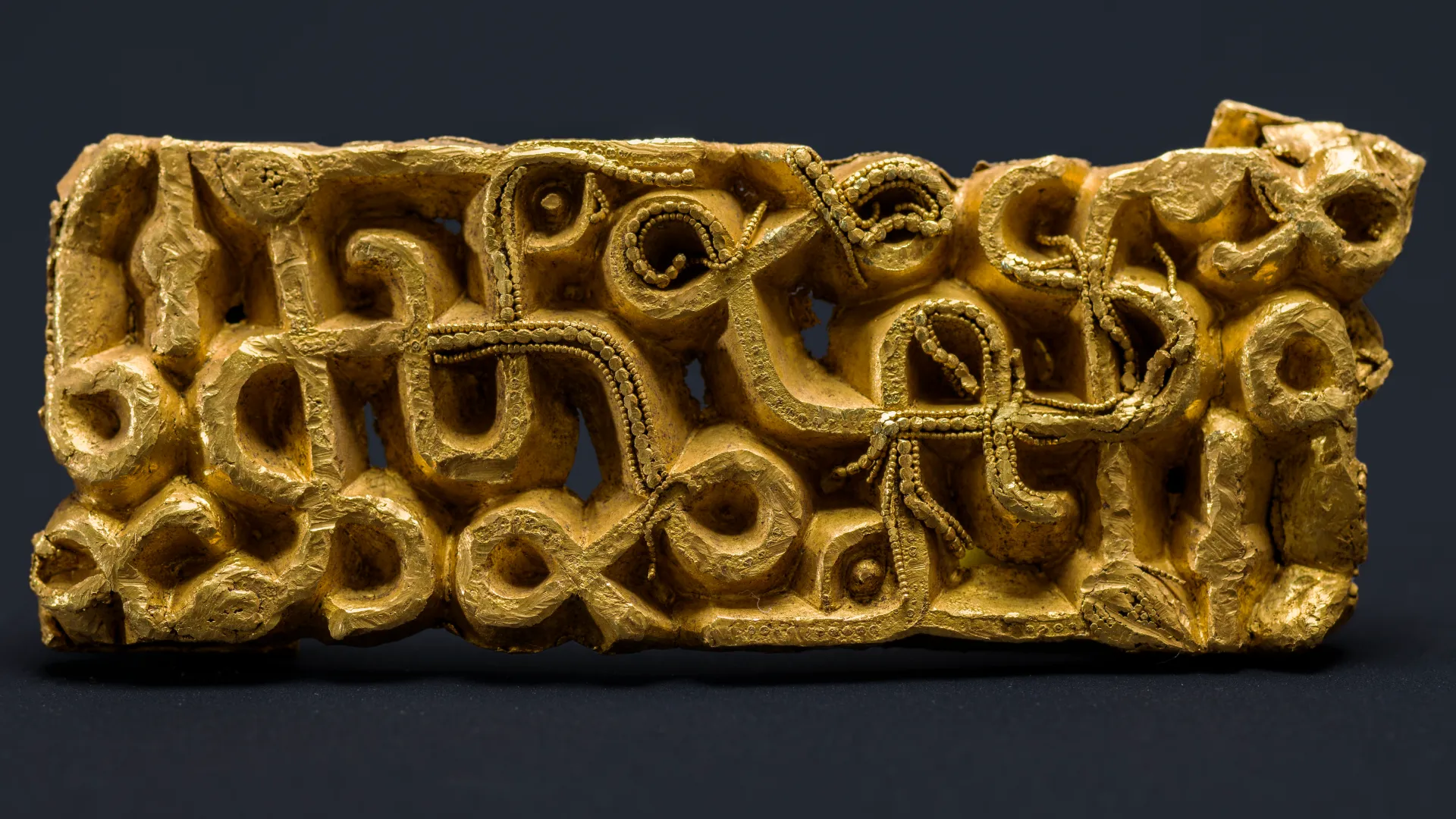
A man went out on a morning walk in southwest Norway and stumbled upon a surprise: an elite warrior's sword scabbard that was purposefully buried 1,500 years ago. The rare gold object, which was richly decorated with serpentine animals, was probably an offering to the gods at a time of famine and societal turmoil, researchers say.
"I saw a mound in the ground under a tree and poked at it with a stick," the hiker said in a translated statement from the University of Stavanger in Norway. "Suddenly, I saw something that glittered. I didn't quite understand what I had found."
The sixth-century gold artifact, which is about 2.4 inches (6 centimeters) long and weighs 1.2 ounces (33 grams), once adorned the scabbard of an elite warrior's sword. Only 17 others have been discovered to date in Northern Europe, and most were found in hoards with other objects.
"The odds of finding something like this are minimal," Håkon Reiersen, an archaeologist at the University of Stavanger Archaeological Museum, said in the statement. The scabbard fitting is worn, suggesting its owner used it a lot before disposing of it.
"Whoever wore the sword it was on was probably the leader in this area in the first half of the 6th century and had a warrior retinue of loyal men attached to him," Reiersen said.
During the sixth century, southern Norway experienced a significant population decline due to volcanic eruptions, a lengthy cold snap and bubonic plague pandemics. One of the power centers at the time was located at Hove, where a large farm complex and numerous gold artifacts have been discovered, suggesting the people who lived there were elite.
"By sacrificing such magnificent objects to the gods, the leaders at Hove confirmed their status and power," Reiersen said.
Sign up for the Live Science daily newsletter now
Get the world’s most fascinating discoveries delivered straight to your inbox.
The newly discovered gold scabbard ornament, which was found northeast of Hove, is very rare and displays hallmarks of a skilled artisan, Siv Kristoffersen, a professor emerita at the University of Stavanger Archaeological Museum, said in a separate translated statement.
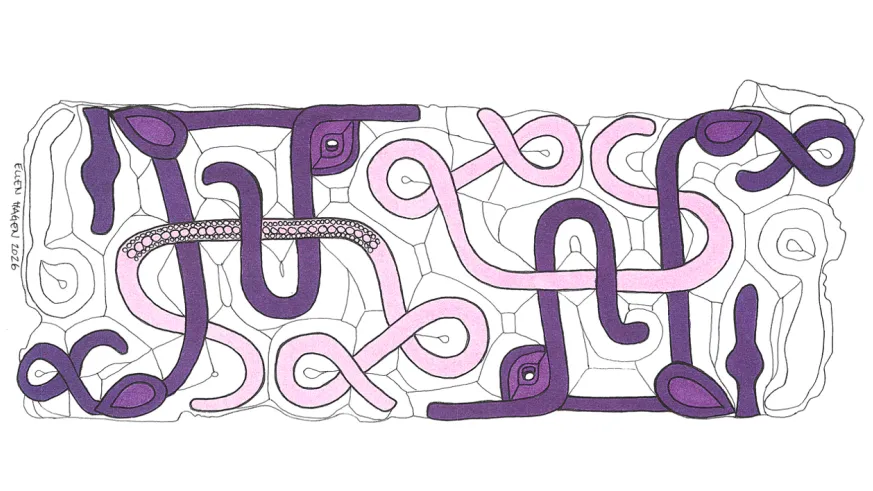
A drawing of the decoration on the gold sword scabbard revealing two animals (in purple) and a ribbon (in pink).
(Image credit: Ellen Hagen/University of Stavanger Archaeological Museum)
Although the scabbard decoration appears at first glance to be a series of curving lines, Kristoffersen noted that the middle of the design includes two animal figures in profile facing each other, but "it is possible that this should be interpreted as a human head with an animal body — a mixed motif that occurs often in this design style." These ribbon-shaped creatures were commonly used in the first half of the sixth century in Norway.
"The filigree ornamentation places the object among the finest works from the period," Kristoffersen said, referring to the triple, beaded gold threads. "This must have been a magnificent sword."
The scabbard ornament is part of a rare and mysterious group of objects sometimes found in Scandinavia that include spiral rings; gold, disc-shaped pendants; and these harmonica-shaped weapon ornaments. Experts think the groups of artifacts were deposited on purpose as "sacrificial" or "killed" objects that were offered to the gods to ask for protection from natural disasters.
Given the gold scabbard ornament's proximity to Hove, its location may have been a ritual center that Hove's leaders could access. "The new find is therefore another piece of the puzzle that shows that there was a center of power around Hove from 200 to 550 A.D.," Reiersen wrote in another translated statement.
The object will go on display at the University of Stavanger Archaeological Museum, the museum's director, Kristin Armstrong-Oma, said, as soon as experts have finished studying it. "This allows us to further research the find itself and the ornamentation and find new answers about the power elite that ruled here at this time," she said.
Kristina Killgrove is a staff writer at Live Science with a focus on archaeology and paleoanthropology news. Her articles have also appeared in venues such as Forbes, Smithsonian, and Mental Floss. Kristina holds a Ph.D. in biological anthropology and an M.A. in classical archaeology from the University of North Carolina, as well as a B.A. in Latin from the University of Virginia, and she was formerly a university professor and researcher. She has received awards from the Society for American Archaeology and the American Anthropological Association for her science writing.
You must confirm your public display name before commenting
Please logout and then login again, you will then be prompted to enter your display name.