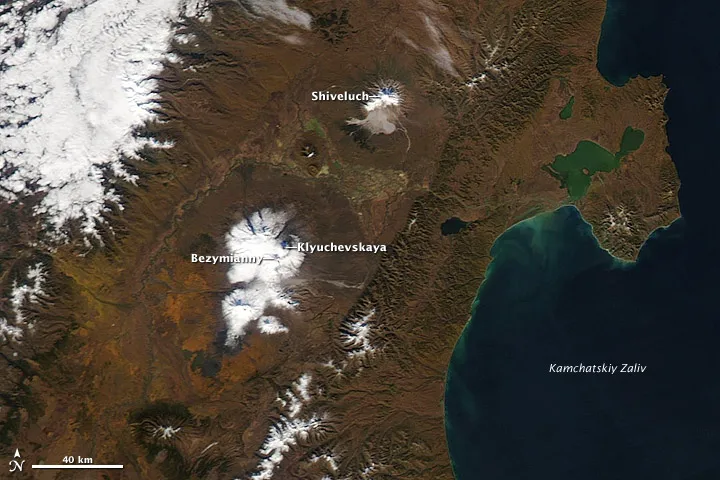
NASA's Aqua satellite captured this image on Oct. 1, 2012, which shows the brown fall colors of Siberia's taiga forest. Only 11 days earlier, the area appeared green from overhead.
Within the span of only 11 days, fall has swept through Siberia's taiga forests, changing leaves from green to brown, as seen in these images captured by NASA's Aqua satellite. The first one was taken on Sept. 20, and the second on Oct. 1.
The forests carpet the slopes and valleys between Bezymianny, Klyuchevskaya and Shiveluch, which are all active volcanoes on Russia's Kamchatka Peninsula. Common tree species in the area include Erman's birch, Japanese stone pine and Dahurian larch.
Autumn's colors come from pigments in leaves that are normally masked by chlorophyll, the green pigment that allows plants to harness the sun's energy during photosynthesis. The arrival of cooler temperatures and shorter days causes trees to begin shuttling nutrients to their roots for the winter, leading to the breakdown of chlorophyll and the unmasking of other leaf pigments.
The range and intensity of autumn colors is strongly affected by the weather. Both low temperatures and bright sunshine destroy chlorophyll. The brightest autumn colors occur when dry, sunny days are followed by cool, dry nights. While a slight drought can amplify bright fall foliage, too much of a drought can hurt the display. For that reason, leaf peepers in the United States can expect a spotty season for colorful fall foliage, due to drought gripping much of the country.
NASA's Aqua satellite captured this image of Siberia's green taiga forests on Sept. 20, 2012. But the green didn't stick around for much longer.
(Image credit: NASA Earth Observatory)
NASA's Aqua satellite captured this image on Oct. 1, 2012, which shows the brown fall colors of Siberia's taiga forest. Only 11 days earlier, the area appeared green from overhead.
For the science geek in everyone, Live Science offers a fascinating window into the natural and technological world, delivering comprehensive and compelling news and analysis on everything from dinosaur discoveries, archaeological finds and amazing animals to health, innovation and wearable technology. We aim to empower and inspire our readers with the tools needed to understand the world and appreciate its everyday awe.