Get the world’s most fascinating discoveries delivered straight to your inbox.
You are now subscribed
Your newsletter sign-up was successful
Want to add more newsletters?
Join the club
Get full access to premium articles, exclusive features and a growing list of member rewards.
An account already exists for this email address, please log in.
'We all screamed when it happened': Bright-green fireball meteor caught exploding over famous Viking raid site in UK
Photographers caught a spectacular emerald-green fireball meteor streaking above Lindisfarne in northeast England, where Viking raiders famously killed and robbed Christian monks in the eighth century.
A photographer snapped a bright-green fireball streaking across the starry sky above an iconic castle and famous Viking raid site in northeast England, after a meteor spectacularly broke apart upon entering Earth's atmosphere.
On Monday (April 13), shortly after midnight local time, a meteor exploded above the North Sea, off the east coast of England. The space rock, which was traveling around 20,000 mph (32,000 km/h), was on the small side, likely weighing around 0.4 ounces (12 grams), according to the BBC — but it made a big impression.
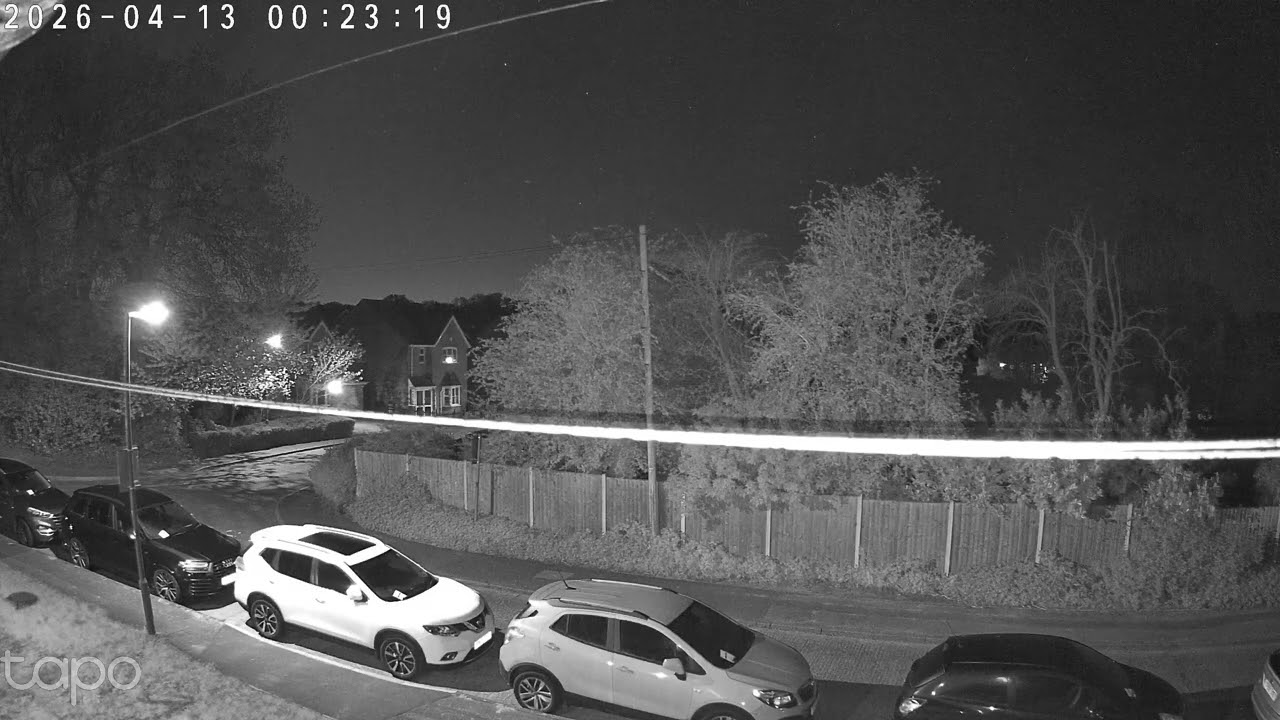
At least 230 people — from across the U.K., as well as parts of Belgium, the Netherlands and Germany — reported seeing the fireball to the American Meteor Society, a nonprofit that tracks global meteor sightings. The streaking light was also captured by multiple doorbell cameras (see below) and lasted up to seven seconds, according to witness reports.
Photographer Ian Sproat saw the fireball from Lindisfarne, also known as "Holy Island" — a small landmass off the coast of Northumberland that gets cut off from the mainland at high tide. This was the site of a brutal Viking raid in 793, in which attackers ransacked a monastery and killed or enslaved many of the Christian monks who lived there.
AMS event #2685-2026 caught from Epsom GB - YouTube
Sproat and his friends were attempting to photograph the starry band of the Milky Way stretching over Lindisfarn Castle (built in the 16th century, long after the historic raid), when the fireball blazed overhead, allowing him to capture a time-lapse image of the meteor.
"We all screamed when it happened," Sproat told Spaceweather.com. "I was so excited!"
"Fireball season"
Fireball meteors occur when falling space rocks suddenly split apart from the strain of friction with the atmosphere, releasing energy in the form of bright light. They can have multiple potential hues, based on the chemical composition of the rock itself. In this case, the meteor's green glow is likely the result of magnesium and nickel, according to Spaceweather.com.
Sign up for the Live Science daily newsletter now
Get the world’s most fascinating discoveries delivered straight to your inbox.
Occasionally, fragments of these exploding space rocks survive to reach the ground and become meteorites. However, even if small pieces of the latest meteor remained intact (which is unlikely), they would have landed in the ocean.
The fireball was captured on multiple doorbell and security cameras, including this one in Warsop, Nottinghamshire.
Some fireballs also trigger loud sonic booms that can be heard for miles around, but no such noise was reported during the latest event.
The emerald explosion Monday is one of several similar events seen across the globe in recent months, some of which have sent space rocks crashing through the roofs of some people's houses. March was particularly eventful: There were at least 10 major fireballs in the U.S. last month, which is the highest total for that month since 2012, according to an X post from AccuWeather.com. This included a cannonball-size meteor crashing through a roof in Texas, and a rare daytime eruption over Ohio.
It is not uncommon to see more fireballs this time of year. The number of fireballs between February and April, also known as "fireball season," can rise by between 10% and 30% compared with the rest of the year, according to NASA. This is likely due to Earth's position relative to the sun and the rest of the solar system.
However, researchers are still not entirely sure how or why this happens. (A similar trend likely occurs in the Southern Hemisphere between September and November, but this is harder to prove because there are fewer people there to witness the fireballs.)
Harry is a U.K.-based senior staff writer at Live Science. He studied marine biology at the University of Exeter before training to become a journalist. He covers a wide range of topics including space exploration, planetary science, space weather, climate change, animal behavior and paleontology. His recent work on the solar maximum won "best space submission" at the 2024 Aerospace Media Awards and was shortlisted in the "top scoop" category at the NCTJ Awards for Excellence in 2023. He also writes Live Science's weekly Earth from space series.
You must confirm your public display name before commenting
Please logout and then login again, you will then be prompted to enter your display name.