Get the world’s most fascinating discoveries delivered straight to your inbox.
You are now subscribed
Your newsletter sign-up was successful
Want to add more newsletters?
Join the club
Get full access to premium articles, exclusive features and a growing list of member rewards.
An account already exists for this email address, please log in.
A giant 'shadow' has been creeping across Mars for 50 years — and scientists aren't sure why
A dark patch in Mars' Utopia Planitia region has grown significantly since it was first photographed in 1976. Scientists have a loose understanding of what it is, but they can't properly explain its gradual growth.
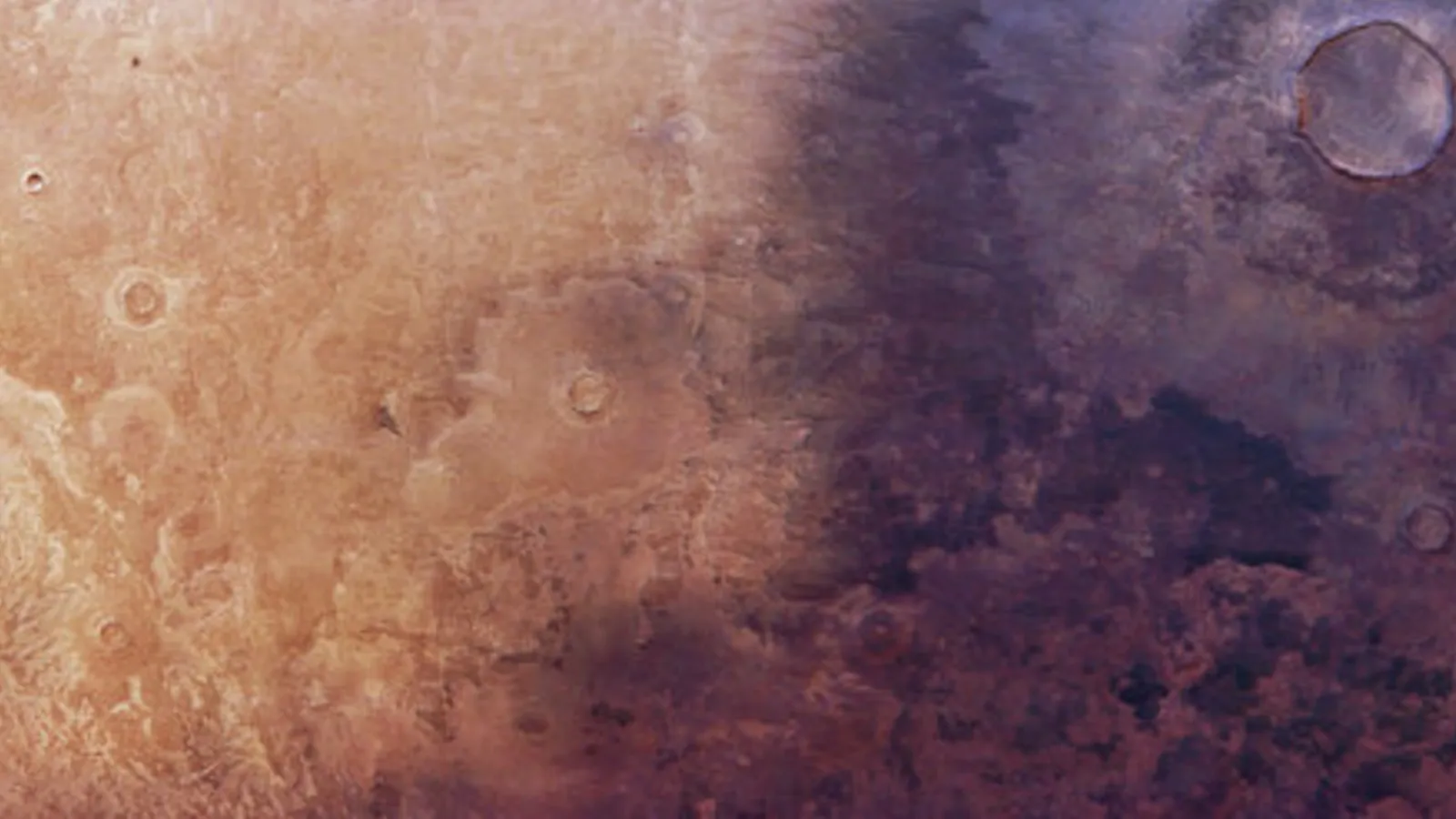
A section of Mars' Utopia Planitia covered with dark volcanic materials is slowly expanding across the Red Planet's surface. And experts are not sure why.
A massive dark patch lurking within a giant Martian crater has been creeping across the Red Planet's surface since the feature was first spotted 50 years ago, new photos reveal — and scientists are unsure exactly why this is happening.
The shadowy structure is a patch of ground covered with ash and volcanic rocks, such as olivine and pyroxene, from ancient eruptions that occurred millions of years ago, before Mars was considered geologically dead. It is located in Utopia Planitia, a roughly 2,000-mile-wide (3,300 kilometers) plain in Mars' northern hemisphere.
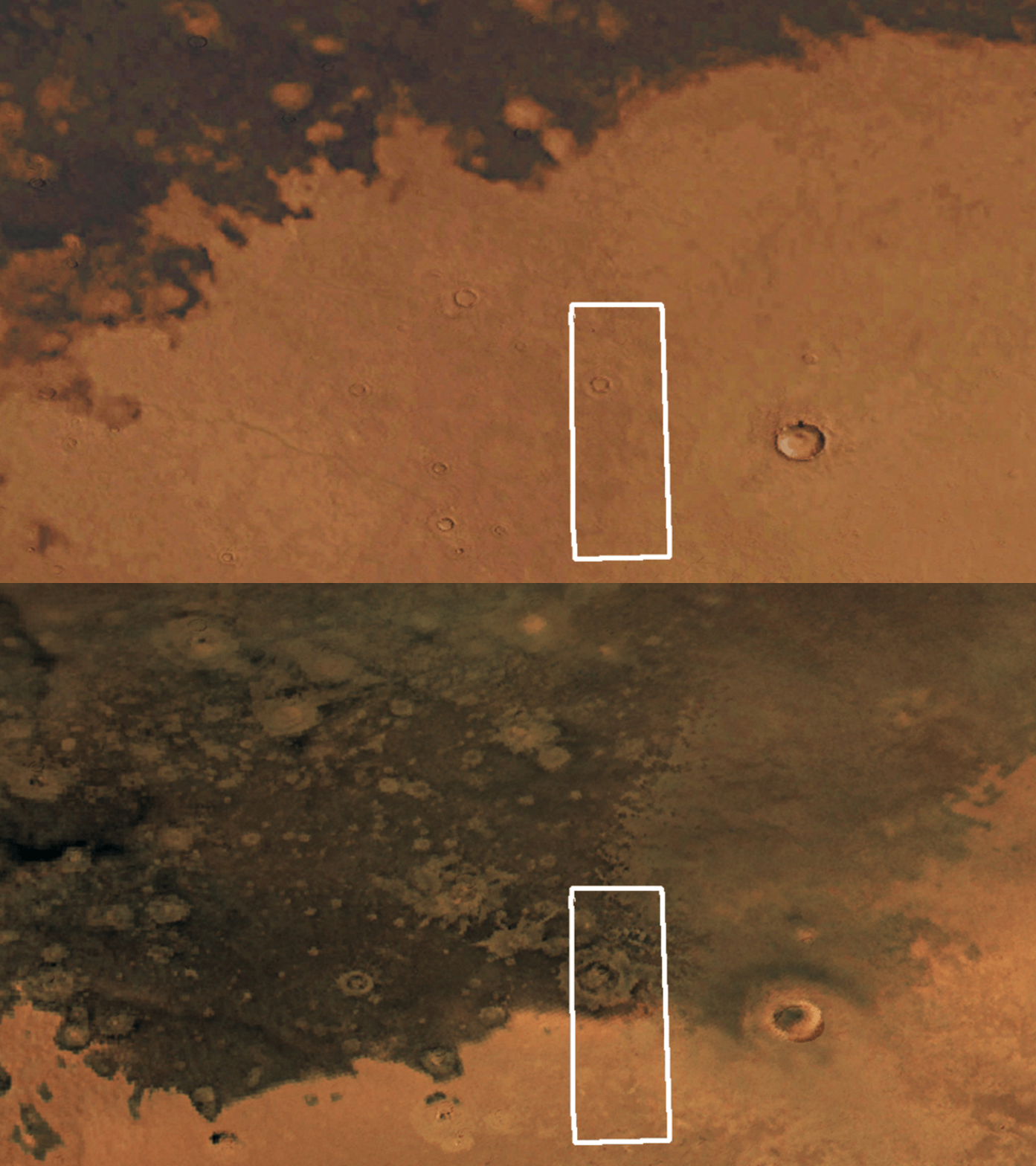
NASA's Viking probes first photographed the blackened ground in 1976, shortly after arriving at the Red Planet. Since then, several photos have shown that this feature is expanding across the surrounding landscape; these include new images from the European Space Agency's (ESA) Mars Express orbiter, which were captured in 2024 and released April 15.
It is unclear how large the shadowy feature is. However, sections of the patch's southern boundary have moved farther south by at least 200 miles (320 km), based on the latest photos from ESA. This suggests the dark terrain has been expanding by around 4 miles (6.5 km) per year.
Scientists are confident that the movement of the dark patch has something to do with Martian winds, which are known to scour the surface and kick up ash and dust.
Aerial photos show just how much the dark patch has expanded since 1976. The white box shows the area captured in greater detail by ESA's Mars Express orbiter in 2024 (seen at the top of this article).
(Image credit: NASA)
"The spread of the ash over the last 50 years has two possible explanations: either it has been picked up and moved about by Martian winds, or the ochre dust that previously covered the dark ash has been blown away," ESA representatives wrote in a statement.
However, there is currently no clue as to which hypothesis is correct, they added.
Sign up for the Live Science daily newsletter now
Get the world’s most fascinating discoveries delivered straight to your inbox.
Utopia Planitia
Utopia Planitia is one of the largest and flattest plains on Mars. The smallest white box shows roughly where its dark "shadow" is located.
(Image credit: NASA/USGS; ESA/DLR/FU Berlin)
This region of Mars has been of great interest to scientists over the past half century. In 1976, the Viking 2 lander touched down in Utopia Planitia and carried out a series of "biological experiments" until its demise in 1980.
Utopia Planitia is home to several large cracks in the ground, known as grabens, which are one of Mars' most unusual features and could also help provide clues to any tectonic activity that once rocked the Red Planet, according to ESA.
Harry is a U.K.-based senior staff writer at Live Science. He studied marine biology at the University of Exeter before training to become a journalist. He covers a wide range of topics including space exploration, planetary science, space weather, climate change, animal behavior and paleontology. His recent work on the solar maximum won "best space submission" at the 2024 Aerospace Media Awards and was shortlisted in the "top scoop" category at the NCTJ Awards for Excellence in 2023. He also writes Live Science's weekly Earth from space series.
You must confirm your public display name before commenting
Please logout and then login again, you will then be prompted to enter your display name.