Get the world’s most fascinating discoveries delivered straight to your inbox.
You are now subscribed
Your newsletter sign-up was successful
Want to add more newsletters?
Join the club
Get full access to premium articles, exclusive features and a growing list of member rewards.
An account already exists for this email address, please log in.
City-size 'cosmic butterfly' carved into Mars' surface contains traces of ancient water
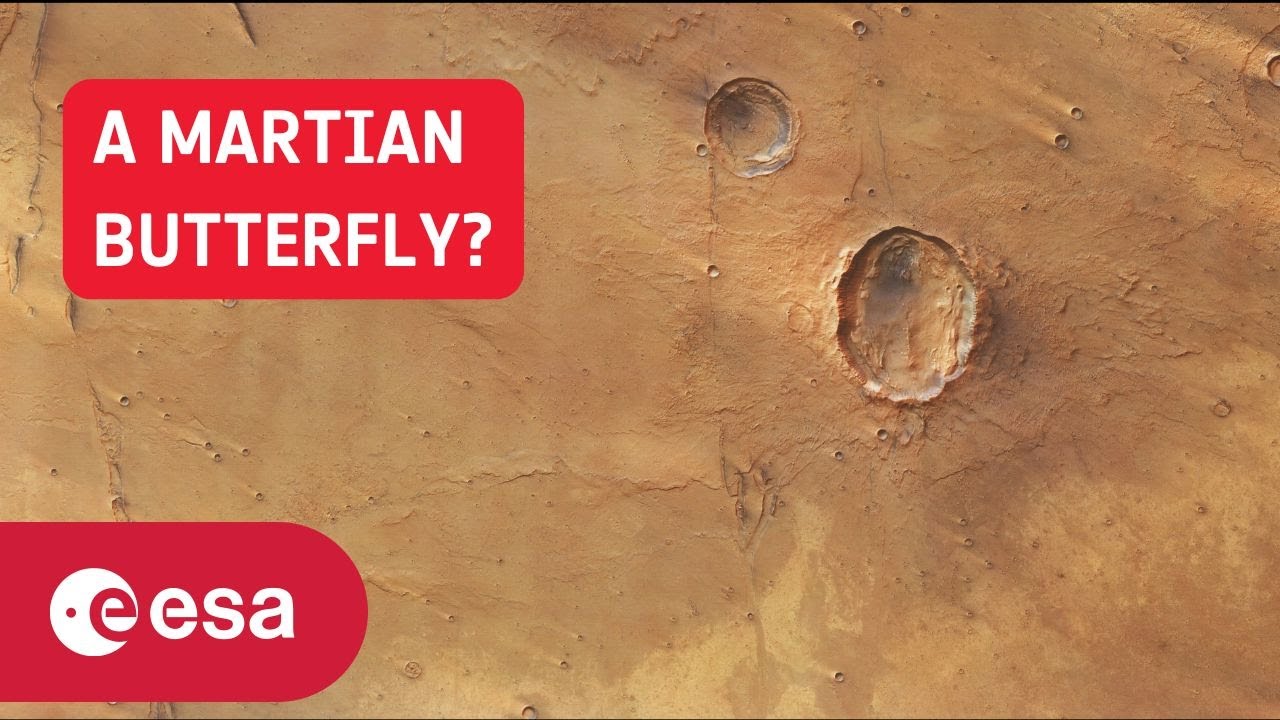
The European Space Agency has released new images of a rare "butterfly" crater on the Red Planet. The bug-like structure sports a pair of smooth, rocky wings, which were likely "fluidized" by buried Martian ice.
The European Space Agency has released new computer generated images of a "butterfly" crater on Mars, which were created using data collected by the Mars Express orbiter.
A giant, city-size "butterfly" that was carved into the surface of Mars millions of years ago just got a new photo op thanks to European Space Agency (ESA) scientists. The beautiful Martian bug, which sports a pair of smooth rocky wings, is a stunning reminder of the Red Planet's violent and watery past, experts say.
The so-called butterfly is an asymmetrical impact crater, created when a hefty asteroid smashed into Mars in the distant past at an unusually low angle. It is located in the Idaeus Fossae region — an extremely uneven and previously volcanic region in Mars' northern lowlands — and is around 12.4 miles (20 kilometers) from east to west and 9.3 miles (15 km) from north to south. This makes the crater almost large enough to fit the island of Manhattan across its floor.
The latest images of the oval crater, which remains unnamed, were digitally created using topographical data collected by ESA's Mars Express orbiter, which has been scanning the Red Planet since 2003. The data was also used to create a short video that calls the crater a "cosmic butterfly" and shows what it would look like if you were to circle it in a helicopter (see below).
"The collision caused two distinct lobes of material to be flung outwards to the crater's north and south, creating two outstretched 'wings' of raised ground," ESA representatives wrote in a statement describing the butterfly. This uneven impact also sculpted the crater's floor into an "irregular," walnut-like shape, they added.
Craters like this are commonly known as butterflies because of their rounded shape and rocky wings, and they are exceedingly rare. However, this is not the first one to be spotted on Mars.
In 2006, around three years into the Mars Express orbiter's mission, the ESA spacecraft snapped a butterfly crater in the Hesperia Planum region in Mars' southern highlands. This crater is much more elongated than the Idaeus Fossae crater and arguably has a much more bug-like appearance. (Mars' southern highlands and northern lowlands lie on either side of a geographical anomaly that "splits" the planet near the equator.)
Sign up for the Live Science daily newsletter now
Get the world’s most fascinating discoveries delivered straight to your inbox.
Studying these anomalous craters helps scientists better understand the angle and force of the impacts that formed them. It can also reveal clues about the hidden layers of Mars' surface and what conditions existed when the collisions occurred, according to Live Science's sister site Space.com.
In the latest case, the ESA team noticed that the wings of the butterfly are much smoother than its bobbly, walnut-like floor. This suggests that this material has been "fluidized," meaning that it has been mixed with water. This most likely happened when Martian ice buried beneath the crater was melted by the impact and released into the resulting explosion, ESA representatives wrote.
It is currently unclear exactly when the newly imaged insect crater was formed or how large and fast the meteor that birthed it was. However, fragments of the space rock could potentially remain within the crater.
The Mars Express orbiter has been scanning the surface of Mars since 2003. This image shows the varying topography of the new butterfly crater. (Greens, blues and yellows represent depressions in the landscape, while reds and oranges represent elevated terrain.)
(Image credit: ESA/DLR/FU Berlin)
Animals on Mars
This is not the first time that scientists have found animal impostors lurking on Mars' surface.
NASA's various Mars rovers have found multiple rocks that bear a striking similarity to living creatures, including a turtle poking its head out from its shell, which was snapped by Perseverance in August, and a coral-like structure photographed by the Curiosity rover in 2022.
In September 2024, the Mars Express orbiter also helped to reveal a hidden dog-shaped blob lurking beneath Mars' North Pole.
These animal associations are often made due to pareidolia — a psychological phenomenon in which the human mind perceives a familiar pattern, such as a face or image, in random objects or structures.
Harry is a U.K.-based senior staff writer at Live Science. He studied marine biology at the University of Exeter before training to become a journalist. He covers a wide range of topics including space exploration, planetary science, space weather, climate change, animal behavior and paleontology. His recent work on the solar maximum won "best space submission" at the 2024 Aerospace Media Awards and was shortlisted in the "top scoop" category at the NCTJ Awards for Excellence in 2023. He also writes Live Science's weekly Earth from space series.
You must confirm your public display name before commenting
Please logout and then login again, you will then be prompted to enter your display name.