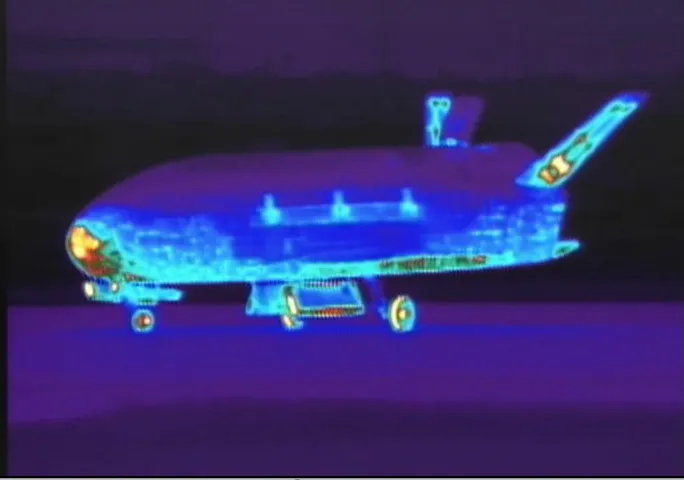
The U.S. Air Force's robotic X-37B space plane came back to Earth today (June 16) after 15 months in orbit on a mystery mission, and its much-anticipated landing was caught on video.
Designed to be launched like a satellite and land like an airplane, the second X-37B Orbital Test Vehicle, built by Boeing for the United States Air Force’s Rapid Capabilities Office, is an affordable, reusable space vehicle.
(Image credit: Boeing)
The first part of the 80-second video was apparently shot in infrared light. It shows the X-37B space plane cruising in for an automated landing, its belly and nose glowing a bright orange-yellow, presumably from the heat generated during re-entry to Earth's atmosphere.
The video switches over to visible wavelengths about 35 seconds in, after the space plane has touched down, and shuts off shortly after the X-37B rolls to a stop on the runway. [Photos: Air Force's 2nd Secret X-37B Mission]
The X-37B, also known as Orbital Test Vehicle-2 (OTV-2), launched on March 5, 2011, from Florida's Cape Canaveral Air Force Station. Its flight was the second-ever mission for the X-37B program; the first was flown by OTV-2's sister ship, OTV-1.
OTV-1 blasted off in April 2010 and stayed aloft for 225 days, well below the supposed 270-day orbital limit for the space plane. But OTV-2 smashed that limit, zipping around our planet for 469 days before finally coming down today.
Just what OTV-2 was doing up there for so long remains a mystery. Details of the vehicle's mission are classified, as are its payloads. The secrecy has spurred speculation — notably from China — that the X-37B may be a space weapon of some sort, but Air Force officials have long insisted that the spacecraft is simply testing out technologies for future satellites.
Sign up for the Live Science daily newsletter now
Get the world’s most fascinating discoveries delivered straight to your inbox.
The X-37B looks like NASA's recently retired space shuttle, but it's far smaller. The X-37B is 29 feet (8.8 meters) long and 15 feet (4.5 m) wide, with a payload bay about the size of a pickup truck bed. For comparison, two X-37B vehicles could fit inside the payload bay of a space shuttle.
The Boeing-built X-37B autonomously landed at Vandenberg Air Force Base in California on June 16, 2012 after a successful 469-day mission.
(Image credit: Boeing)
The 11,000-pound (5,000-kilogram) space plane's orbital longevity is enabled by its solar array, which generates power after deploying from the payload bay.
The X-37B is built by Boeing, though NASA originally used the vehicle as an experimental test bed until funding for the project ran out in 2004. The space plane then passed to the Defense Advanced Research Projects Agency, and it was ultimately turned over to the Air Force in 2006.
Michael was a science writer for the Idaho National Laboratory and has been an intern at Wired.com, The Salinas Californian newspaper, and the SLAC National Accelerator Laboratory. He has also worked as a herpetologist and wildlife biologist. He has a Ph.D. in evolutionary biology from the University of Sydney, Australia, a bachelor's degree from the University of Arizona, and a graduate certificate in science writing from the University of California, Santa Cruz.