













Navy Plans Flying Submarine
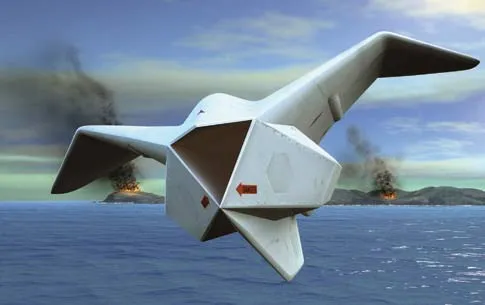
Lockheed Martin’s Skunk Works, famed for the U-2 and Blackbird spy planes that flew higher than anything else in the world in their day, is trying for a different altitude record: an airplane that starts and ends its mission 150 feet underwater.
The Cormorant, a stealthy, jet-powered, autonomous aircraft that could be outfitted with either short-range weapons or surveillance equipment, is designed to launch out of the Trident missile tubes in some of the U.S. Navy’s gigantic Cold War–era Ohio-class submarines. These formerly nuke-toting subs have become less useful in a military climate evolved to favor surgical strikes over nuclear stalemates, but the Cormorant could use their now-vacant tubes to provide another unmanned option for spying on or destroying targets near the coast.
This is no easy task. The tubes are as long as a semi trailer but about seven feet wide—not exactly airplane-shaped. The Cormorant has to be strong enough to withstand the pressure 150 feet underwater—enough to cave in hatches on a normal aircraft—but light enough to fly. Another challenge: Subs survive by stealth, and an airplane flying back to the boat could give its position away.
The Skunk Works’s answer is a four-ton airplane with gull wings that hinge around its body to fit inside the missile tube. The craft is made of titanium to resist corrosion, and any empty spaces are filled with plastic foam to resist crushing. The rest of the body is pressurized with inert gas. Inflatable seals keep the weapon-bay doors, engine inlet and exhaust covers watertight.
The Cormorant does not shoot out of its tube like a missile. Instead an arm-like docking “saddle” guides the craft out, sending it floating to the surface while the sub slips away. As the drone pops out of the water, the rocket boosters fire and the Cormorant takes off. After completing its mission, the plane flies to the rendezvous coordinates it receives from the sub and lands in the sea. The sub then launches a robotic underwater vehicle to fetch the floating drone.
The Defense Advanced Research Projects Agency (Darpa) is funding tests of some of the Cormorant’s unique systems, including a splashdown model and an underwater-recovery vehicle. The tests should be completed by September, after which Darpa will decide whether it will fund a flying prototype.
- Military Sensor Hears Through Walls
- Military Mulls Use of 'Star Trek' Weapons
- The Military's Walrus: An Unlikely Flying Machine
- Futuristic Spy Plane Maneuvers Like a Bird
- Like a Hawk, Robotic Plane Rides Thermals
- Military Tests Miniature Spy Plane
Get the world’s most fascinating discoveries delivered straight to your inbox.