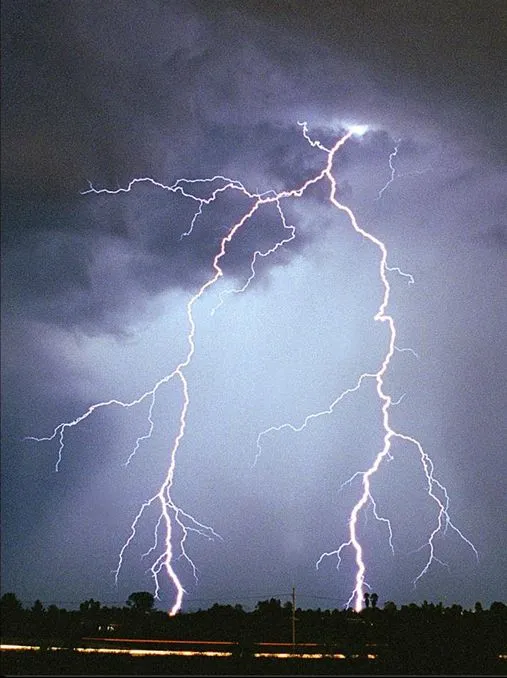
Lightning not only zaps the Earth, but it affects our local space environment with flashes from both ends of the electromagnetic spectrum - radio waves and gamma rays, new research shows.
"We see lightning in the visible, but that's not the only frequency that is emitted during a strike," said James Green from NASA's Goddard Space Flight Center.
It has been know for a long time that radio waves accompany lightning - this is why radio reception can be so bad during a thunderstorm.
Green and his colleagues found that some of these radio waves travel into space and clear out a "safe zone" for satellites in between the radiation belts. These belts, which are shaped like donuts around the Earth's equator, consist of high-energy charged particles - ions and electrons - that travel along our planet's magnetic field lines.
Green described how lightning sweeps up our space neighborhood in a NASA teleconference Tuesday. Also presented was recent work by David Smith of the University of California, Santa Cruz, on terrestrial gamma-ray flashes that shoot into space during a lighting strike. These TGFs may inject high-energy electrons into the belts.
"We're finding that lightning is tied in multiple ways to the radiation belts," Smith said.
Sign up for the Live Science daily newsletter now
Get the world’s most fascinating discoveries delivered straight to your inbox.
Two belts and a leaky bucket
The radiation belts were discovered in 1958 by James Van Allen, using the Explorer probes. Above the equator, the inner belt extends from an altitude of 400 miles (650 kilometers) out to about 4,000 miles. The outer belt spans from 8,000 miles to about 40,000 miles. They're like nested donuts, with a slot, or safe zone, between.
Since the belts' discovery, scientists have pondered two questions: what makes them and why are there two?
The first question has been known for some time. The high-energy particles in the belts come partly from cosmic rays that collide with the upper atmosphere, causing a splash of secondary particles. The other dominant source is geomagnetic storminess that boils off the Sun.
These storms can pour so many particles into the magnetosphere that the slot will fill up and the two belts will become one, researchers learned recently.
This is where the effect of the lightning comes in. Radio waves from high-latitude strikes - like in Europe and North America - can travel into the slot and interact with the particles, altering their direction toward Earth.
"We have found that lightning drives particles into the atmosphere," Green said. "The particles literally rain down."
Green called the slot a "leaky bucket," which empties itself of high-energy particles within a few weeks after a geo-magnetic storm.
The research has importance for engineers determining where to position satellites.
"The multi-billion-dollar Global Positioning System satellites skirt the edge of the safe zone," said Green, who is the lead author of the paper about the research published in the Journal of Geophysical Research. "Without the cleansing effect from lightning, there would be just one big radiation belt, with no easily accessible place to put satellites."
Gamma rays may refill bucket
These space-clearing radio waves have kilometer-long wavelengths. In 1994, gamma rays - with wavelengths a trillionth that of the radio - were found to be associated with lightning. According to Smith, many mysteries still surround these millisecond flashes of gamma rays, the highest-energy radiation there is.
Using data from the Reuven Ramaty High Energy Solar Spectroscopic Imager satellite, Smith and colleagues have found that about 50 TGFs go off each day. But if the flashes are narrowly beamed -- so that only those heading toward the detector are noted -- then the true rate may be 500 to 5,000 per day.
Researchers are interested in determining whether TGFs are related to other upper atmosphere lightning phenomena, like blue jets and sprites. This could tell them what happens to the high-energy electrons that are believed to be the cause of the gamma rays.
If TGFs are generated at the top of a cloud, like a blue jet, the electrons will be absorbed in the atmosphere. But if the TGFs originate 30 miles up, like sprites do, then the electrons will feed into the radiation belts.
Michael Schirber began writing for LiveScience in 2004 when both he and the site were just getting started. He's covered a wide range of topics for LiveScience from the origin of life to the physics of Nascar driving, and he authored a long series of articles about environmental technology. Over the years, he has also written for Science, Physics World, andNew Scientist. More details on his website.