













Underwater Cave Full of Ancient Bones to Be Mapped in 3D

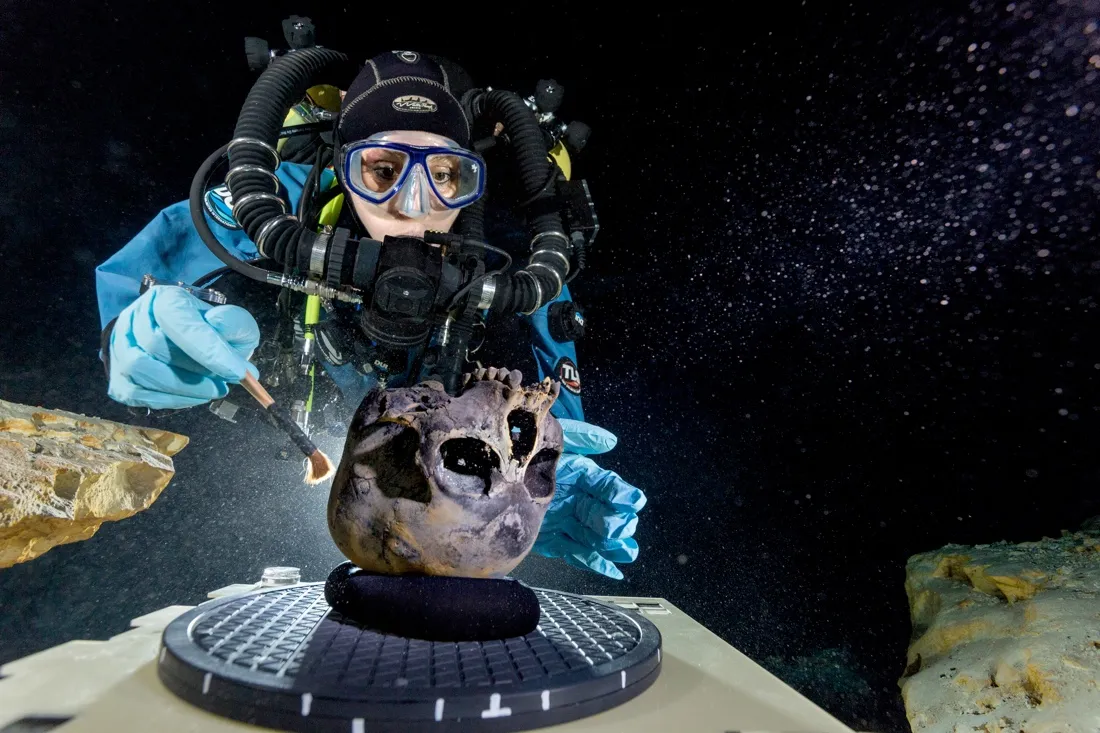
The bones of ground sloths, saber-toothed cats and other creatures of the Ice Age have been discovered in a deep underwater cavern on Mexico's Yucatan Peninsula, but the exploration of the site is actually happening on the surface, hundreds of miles away, in a lab in San Diego.
Spelunkers first discovered the cave, called Hoyo Negro, seven years ago, but it was accessible only to specially trained cave divers. Now, a technique that combines photos to create 3D maps is providing a way for archaeologists to get a good look inside, without making the dangerous descent into the depths of the cave.
"If we can document all the artifacts, make a photo map of the bottom of the pit and create a 3D visualization that puts the archaeologists and paleontologists there — without ever getting wet — those discoveries and interpretations are made possible," Dominique Rissolo, a visiting scholar at the University of California, San Diego (UCSD), said in a statement. [See Photos of the Underwater Cave]
So far, explorers in this cave have discovered a human skeleton from the Ice Age, and remains of gomphotheres (ancient elephant-like animals), prehistoric ground sloths and saber-toothed cats. Archaeologists think Hoyo Negro holds more remains and could provide valuable insight into Native American history; they just need a way to get their hands on the bones.
Hoyo Negro — which, appropriately, means "Black Hole" — is part of the underwater labyrinth known as the Sac Actun cave system. The cave is more than 100 feet (30 meters) deep, and divers get only an hour of bottom time on each dive, further complicating the exploration of the site.
But researchers at the UCSD's Center of Interdisciplinary Science for Art, Architecture and Archaeology (CISA3) have come up with a solution: By tracking and lining up features in a series of photos of the cave taken by divers, researchers can create what are called 3D structure-from-motion models.
The imaging technique can even be used to create models of the artifacts in the cave. The dive team brought a a small mount into the cave and photographed the skull of the skeleton discovered there. Then, back on the surface, scientists at CISA3 stitched together the photos and created a 3D model for archaeologists to study.
Get the world’s most fascinating discoveries delivered straight to your inbox.
"The in-depth post-expedition analysis happens digitally, in the form of 3D models that can be studied interactively and collaboratively, as well as precise physical replicas created on CISA3's 3D printers," Falko Kuester, director of CISA3, said in a statement. "Meanwhile, the original artifacts can remain undisturbed where they were originally discovered."
Even though the underwater cavern was discovered in 2007, the first study detailing what the cave holds was not published until this year. The biggest discovery is a 13,000-year-old skeleton of a Paleoamerican teenage girl that might provide some insight into the genetic history of Native Americans.
The archaeologists studying the site nicknamed the skeleton Naia, and believe she probably fell to her death while collecting water during the Pleistocene age, long before the cave filled with water.
Scientists analyzed DNA from Naia's teeth and discovered that her genes came from an Asian lineage only seen before in Native Americans. The DNA supports the theory that Native Americans descended from a group of Siberians who entered America by crossing a land bridge that used to exist over the Bering Strait.
The team of researchers and divers exploring the cave are now considering ways to use acoustic mapping and imaging sensors to help create even more detailed visualizations of Hoyo Negro.
Follow Kelly Dickerson on Twitter. Follow us @livescience, Facebook & Google+. Original article on Live Science.
