Get the world’s most fascinating discoveries delivered straight to your inbox.
You are now subscribed
Your newsletter sign-up was successful
Want to add more newsletters?
Join the club
Get full access to premium articles, exclusive features and a growing list of member rewards.
An account already exists for this email address, please log in.
13,000-year-old butchered bones of long-tusked beast found in Chile give more evidence of early first Americans
Archaeological excavations in the Lake Tagua Tagua basin in central Chile have revealed stone tools and animal bones with cut marks dated to 13,000 years ago.
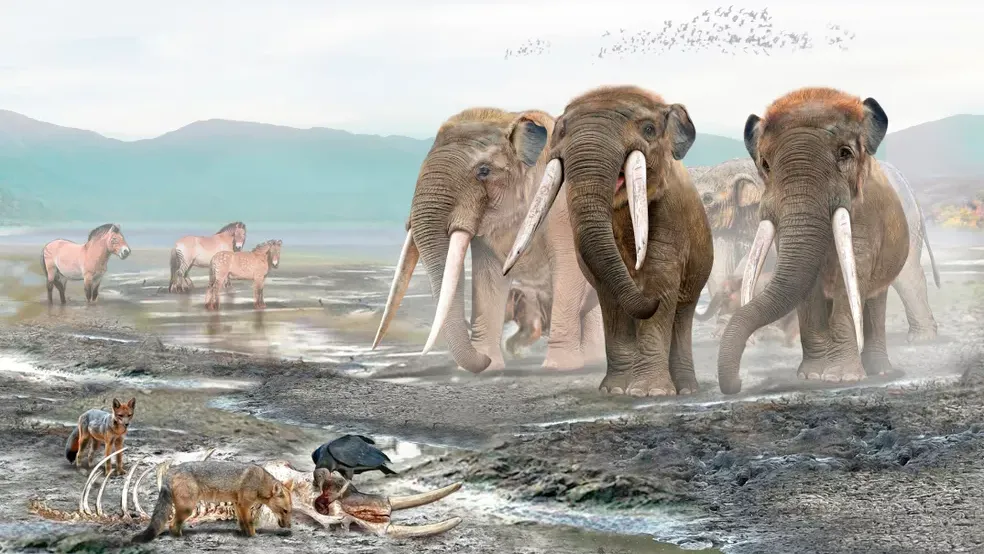
Bones from extinct elephant-like creatures discovered along the shore of Lake Tagua Tagua in central Chile bear human-made cut marks and were found alongside stone tools, revealing that some of the first humans to live there were killing and eating these animals 13,000 years ago, new research shows.
Archaeological excavations carried out over the past two years in the basin of the ancient lake revealed a large concentration of megafauna remains and stone tools, according to a Sept. 24 statement from the Catalan Institute for Human Palaeoecology and Social Evolution (IPHES-CERCA). Several bones from gomphotheres, an extinct group of tusked mammals related to modern elephants, displayed clear cut marks, suggesting that Indigenous people butchered the animals at the site.
The animal bones and artifacts date to around 12,000 to 13,000 years ago, according to the statement, which means they provide further evidence of early human occupation in southern South America as hunter-gatherers repeatedly visited the ancient lake shore.
The earliest confirmed archaeological site in South America is Monte Verde, which dates to about 14,500 years ago and is also located in Chile. Other early Indigenous sites on the continent include Huaca Prieta in Peru and Arroyo Seco in Argentina, both of which are around 14,000 years old.
Project co-director Carlos Tornero during fieldwork, next to the remains of the extinct elephant relative documented in the new excavation area.
(Image credit: "First Human Steps in South America, Walking Among Gonfoteriums" Project Team)
Archaeologists had previously discovered the remains of other animals in the Lake Tagua Tagua basin, including now-extinct American horses and deer species, some of which also show evidence of cut marks and burning that suggest ancient humans were cooking and eating them.
The well-preserved assemblage of animal bones, plant remains and stone tools that archaeologists have unearthed constitute "a record with no known parallels currently in South America," IPHES-CERCA representatives said in the statement, providing key information about when people first arrived in the Americas and the earliest Americans' exploitation of the continents' megafauna before the animals went extinct.
Now that the research team has completed their fieldwork, they will study the samples of sediment and remains they've excavated over the past few years.
Sign up for the Live Science daily newsletter now
Get the world’s most fascinating discoveries delivered straight to your inbox.
According to the statement, the analyses will help narrow down when humans first lived in the Lake Tagua Tagua basin and help figure out how humans were killing, butchering and eating the animals they encountered as some of the first people to reach the Southern Cone of South America.
How much do you know about the first people to reach the Americas? Find out with our First Americans quiz!
Kristina Killgrove is a staff writer at Live Science with a focus on archaeology and paleoanthropology news. Her articles have also appeared in venues such as Forbes, Smithsonian, and Mental Floss. Kristina holds a Ph.D. in biological anthropology and an M.A. in classical archaeology from the University of North Carolina, as well as a B.A. in Latin from the University of Virginia, and she was formerly a university professor and researcher. She has received awards from the Society for American Archaeology and the American Anthropological Association for her science writing.
You must confirm your public display name before commenting
Please logout and then login again, you will then be prompted to enter your display name.