













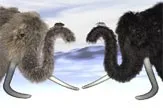
Museum dioramas typically portray mammoths as having shaggy brown coats, but some of the hairy beasts might have been blonde, raven-haired or red-bodied in real life, thanks to a gene that controls hair color in humans and other mammals.
By examining DNA extracted from a mammoth bone frozen in Siberian permafrost and comparing it with sequences from other mammoth remains, researchers have concluded that the wooly creatures probably carried two versions of Mc1r, a gene whose protein product helps determine hair color in several mammals, including humans, mice, horses and dogs.
The two versions differed by three amino acids, or DNA "letters." One would have been partially active and the other fully active.
Mammoths with the partially active version of Mc1r would likely have had light-colored coats, the researchers say, while those with the active version would have had dark hair.
If the mammoth gene works the same way that it does for humans and other mammals, the lighter animals might have had yellow or reddish hair, while the dark ones might have been black or brown.
The finding, led by Holger Rompler of the University of Leipzig in Germany, is detailed in the July 7 issue of the journal Science.
Unlike humans, the hair of mammoths probably would not have grayed with age, Rompler told LiveScience.
Get the world’s most fascinating discoveries delivered straight to your inbox.
"Most mammals don't gray with age," Rompler said. "We don't really know why humans do."
Mammoths died out about 10,000 years ago. Scientists are not yet sure whether nature alone was behind their demise or if humans hunted them to extinction. Some scientists have proposed using mammoth DNA to revive the beasts.
- The Ugliest Animals
- Wild Kingdom Proposed for U.S.
- Ancient Mammoth and Camel Bones Found in Kansas
- Pleistocene Park Could Solve Mystery of Mammoth's Extinction
- Wildest Dragons of All Time