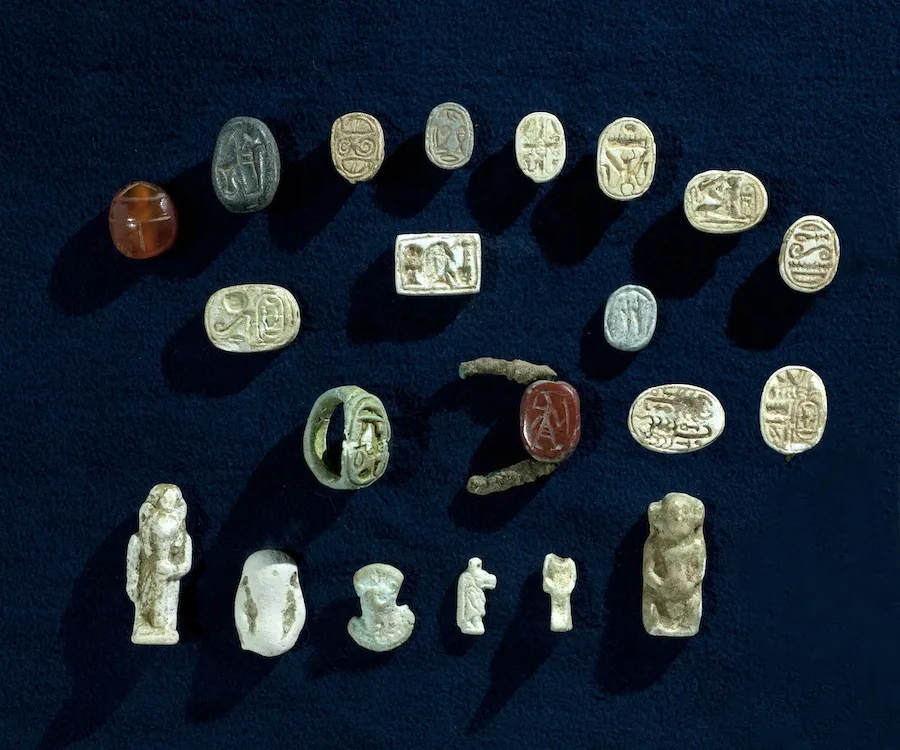
In an underground cave in Israel, archaeologists have unearthed 3,000-year-old Egyptian artifacts that had been spared by tomb robbers.
Inspectors with the Israel Antiquities Authority's (IAA) Unit for the Prevention of Antiquities Robbery say they found pickaxes and other signs of looting in a cave near Kibbutz Lahav in southern Israel.
Upon further investigation, the excavators discovered a hoard of ancient artifacts. IAA officials say they don't yet know how the cave was used or why these objects were placed there, but they found several intact ceramic pots; jewelry made of bronze, shells and faience; oil lamps; small amulets; alabaster jars; cosmetic vessels; and Egyptian scarab seals that date back to the 15th and 14th centuries B.C. [In Photos: Amazing Egyptian Artifacts]
A ring unearthed during the excavation is inlaid with a seal showing an Egyptian warrior holding a shield and sword.
(Image credit: Unit for the Prevention of Antiquities Robbery of the Israel Antiquities Authority)
"During this period, Canaan was ruled by Egypt," Daphna Ben-Tor, curator of Egyptian archaeology at the Israel Museum, explained in a statement from the IAA.
"The names of kings appeared on some of the seals," Ben-Tor added. "Among other things, we can identify a sphinx lying opposite the name of the pharaoh Thutmose, who reigned from about 1504-1450 B.C. Another scarab seal bears the name of Amenhotep, who reigned from about 1386-1349 B.C. Still another scarab depicts Ptah, the principal god of the city of Memphis."
The announcement was timed just before Passover, the Jewish holiday celebrating the biblical story of the Israelites leaving slavery in Egypt. There's no solid archaeological evidence to back the Exodus as a historical event, and these newfound artifacts don't offer new insights on that front. But from these findings, historians could potentially "learn about the great influence of the Egyptian administration and culture on the inhabitants of the Land of Israel during the Late Bronze and Iron Age periods," Eitan Klein, an archaeologist with the IAA, told Live Science.
Megan has been writing for Live Science and Space.com since 2012. Her interests range from archaeology to space exploration, and she has a bachelor's degree in English and art history from New York University. Megan spent two years as a reporter on the national desk at NewsCore. She has watched dinosaur auctions, witnessed rocket launches, licked ancient pottery sherds in Cyprus and flown in zero gravity. Follow her on Twitter and Google+.