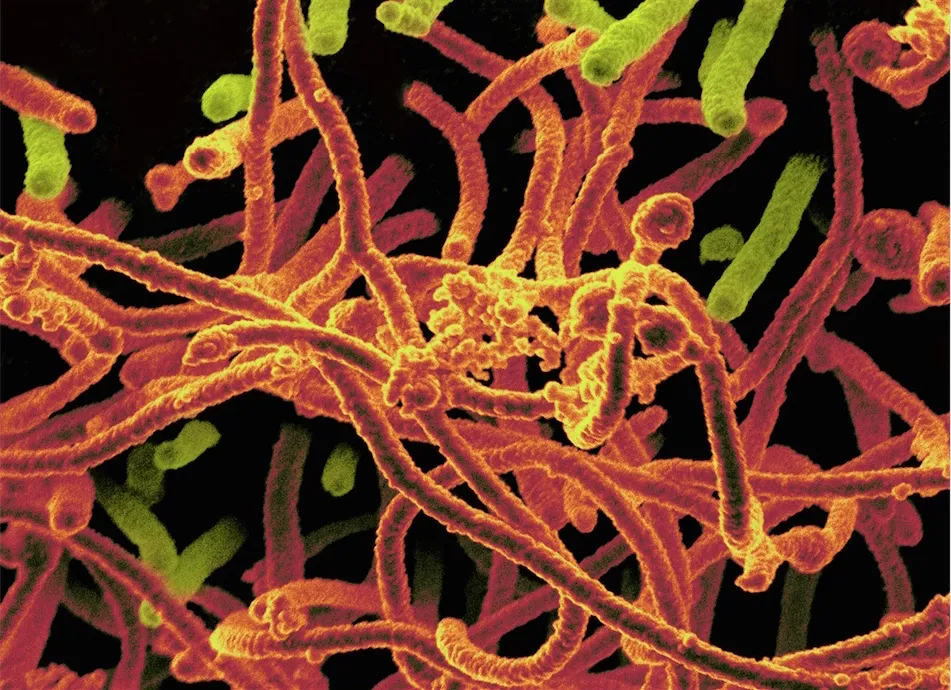
The Ebola virus that is causing the current outbreak in West Africa is not mutating as quickly as earlier reports had suggested, a new study finds. This finding helps allay fears that the virus could change into a more infectious or deadly form, the researchers said.
In the study, published online today (March 26) in the journal Science, researchers compared virus samples from people in Africa who became infected with Ebola up to nine months apart. They found that the viruses' genetic sequences were almost identical, meaning that the virus had undergone relatively few mutations — or changes in the genetic sequence — over that time period, the researchers said
"We do not see any evidence that the virus is mutating any more rapidly than has been reported in previous outbreaks," said Thomas Hoenen, a postdoctoral fellow in virology at the National Institutes of Health and one of the researchers on the study. [5 Things You Should Know About Ebola]
Latest Videos From
The new results are welcome news, experts said. In a 2014 study published in the journal Science, researchers had suggested that the Ebola virus in the West African epidemic was mutating twice as fast as other Ebola virus strains. In that study, researchers compared viral samples that were taken from people who became infected only three months apart, a relatively short time period, Hoenen said.
That finding "was surprising to us, so we wanted to look at a data set that goes over a much longer period of time," Hoenen told Live Science.
In the new study, the researchers compared viral samples collected from patients who were infected in Guinea in March 2014, Sierra Leone in June 2014 and Mali in November 2014.
The researchers found that the samples from March and November differed by only 20 nucleotide sout of 19,000. (Nucleotides hold the "letters" of the genetic code — for example, guanine (G) or adenine (A)).
None of the mutations that the researchers observed in the study will increase the severity or change the transmissibility of Ebola, the researchers said.
Researchers have been studying Ebola's mutation rate in part because the virus is an RNA virus, meaning it uses RNA, rather than its cousin DNA, for its genetic material. RNA viruses generally have higher mutation rates than DNA viruses, said Angela Rasmussen, a research assistant professor of microbiology at the University of Washington, who was not involved in the new study.
"[RNA viruses] don't have proofreading capabilities," like DNA viruses do, Rasmussen said. "If they make a mistake, they can't identify that and go back and fix it."
The new study suggests that the Ebola virus's mutation rate in West Africa is fairly similar to that of other RNA viruses, such as rhinovirus, the virus that causes the common cold, Rasmussen said.
The new study brought Rasmussen "a sense of relief," she told Live Science.
"It doesn't appear to be a supervirus," she said. "It basically indicates that our drugs and vaccines that were developed for Central African strains will probably still be effective against West African strains."
The Ebola outbreak in West Africa has now sickened more than 25,000 people and killed more than 10,300 people since it began, according to the Centers for Disease Control and Prevention. Several drug and vaccination trials are underway to help treat and prevent the disease.
Follow Laura Geggel on Twitter @LauraGeggel. Follow Live Science @livescience, Facebook & Google+. Original article on Live Science.