













What Is Classical Mechanics?
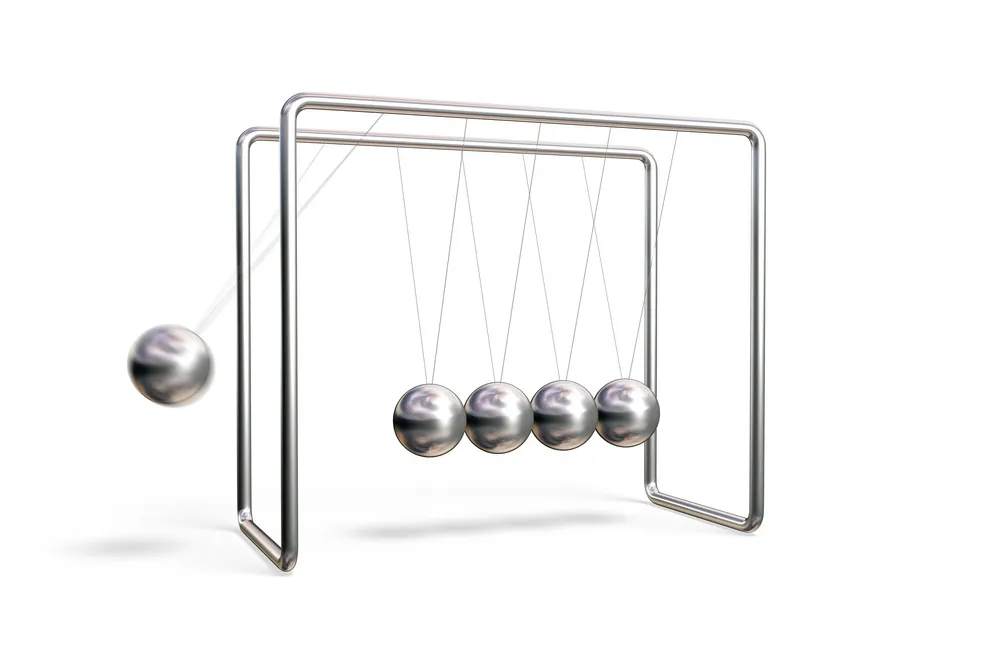
Using just a few equations, scientists can describe the motion of a ball flying through the air and the pull of a magnet, and forecast eclipses of the moon. The mathematical study of the motion of everyday objects and the forces that affect them is called classical mechanics. Classical mechanics is often called Newtonian mechanics because nearly the entire study builds on the work of Isaac Newton. Some mathematical laws and principles at the core of classical mechanics include the following:
- Newton's First Law of Motion: A body at rest will remain at rest, and a body in motion will remain in motion unless it is acted upon by an external force.
- Newton's Second Law of Motion: The net force acting on an object is equal to the mass of that object times its acceleration.
- Newton's Third Law of Motion: For every action, there is an equal and opposite reaction.
- Newton's Law of Universal Gravitation: The pull of gravity between two objects will be proportional to the masses of the objects and inversely proportional to the square of the distance between their centers of mass.
- Law of Conservation of Energy: Energy cannot be created nor destroyed, and instead changes from one form to another; for example, mechanical energy turning into heat energy.
- Law of Conservation of Momentum: In the absence of external forces such as friction, when objects collide, the total momentum before the collision is the same as the total momentum after the collision.
- Bernoulli's Principle: Within a continuous streamline of fluid flow, a fluid's hydrostatic pressure will balance in contrast to its speed and elevation.
Classical mechanics accurately describes the behavior of most "normal" objects. According to "The Dynamic Chemistry E-textbook" from the University of California, Davis Department of Chemistry, to be considered "normal," objects should be "larger than a molecule and smaller than a planet," close to room temperature and going at speeds significantly slower than the speed of light.
Old science with a new name
Although it is the oldest branch of physics, the term "classical mechanics" is relatively new. Soon after 1900, a series of revolutions in mathematical thinking gave birth to new fields of inquiry: relativistic mechanics for phenomena relating to the very fast, and quantum mechanics for phenomena relating to the very small.
The equations developed prior to 1900 were still perfectly suitable for describing objects of everyday sizes and speeds. However, because this older branch of physics existed alongside two new ones, it needed a new name. The term "classical mechanics" was coined to loosely label the set of equations that describe reality at scales where quantum and relativistic effects are negligible.
In 1687, Newton published "Philosophiæ Naturalis Principia Mathematica" (Mathematical Principles of Natural Philosophy) which described how bodies move under the influence of external forces. This work unified mathematical reasoning with relatively new ideas about motion here on the Earth's surface, and the most ancient of all fields of scientific inquiry: astronomy.
Ancient through medieval times
The ancient civilizations of Mesopotamia, Egypt and the Indus Valley all demonstrated an understanding of the motion of the sun, moon and stars; they could even predict the dates of eclipses by the 18th century B.C. As E.C. Krupp described in his book "Echoes of the Ancient Skies" (Dover, 2003), "The stars and planets were often a target of worship, believed to represent their gods." Such supernatural explanations by definition lacked evidence, but the records of observation laid the foundation for generations of observers. Celestial mechanics thusly became the study of how things move about the heavens.
The ancient Greeks were the first to consistently seek natural (as opposed to supernatural) explanations. As Charles Singer wrote in his book "A Short History of Science to the Nineteenth Century" (Dover, 2011), "Philosophers like Thales (624-545 B.C.) rejected non-naturalistic explanations for natural phenomena and proclaimed that every event had a natural cause." The myriad explanations involving, for example, "bodily humors" and "cosmic shells surrounding Earth," were indeed naturalistic, but most were fantastically wrong. A particularly tenacious set of wrong ideas centered on motion, which for nearly 2000 years built on the work of Aristotle (384-322 B.C.). This work, dubbed "the theory of impetus," would undergo major revisions in the sixth, 12th and 14th centuries A.D. Terrestrial mechanics thusly became the study of how things move and interact on the Earth's surface.
Get the world’s most fascinating discoveries delivered straight to your inbox.
The Renaissance
By the 16th century, scholars began to notice that the theory of impetus was ill suited for describing many phenomena — in particular, projectiles flung from catapults and cannons. According to the theory, a projectile should fly through the air until it runs out of impetus, whereupon it should fall straight to the ground. In reality, the path of a projectile is a very specific curve. To make sense of these observations, according to Bernard Cohen in "The Birth of a New Physics" (Norton, 1985), scientists began to think about gravity pulling on objects with uniform acceleration. In his 1638 publication, "Dialogues Concerning Two New Sciences," Galileo Galilei (1564-1642) published the first mathematical proof that uniform acceleration would cause projectiles to move in parabolic trajectories that matched observations, thus showing that terrestrial mechanics are governed by mathematics.
Similarly, and also in the 16th century, celestial mechanics was shown to have extremely strong ties to mathematics. According to David S. Landes in "Revolution in Time" (Belknap, 1983), Tycho Brahe (1546-1601) was one of the first astronomers to use clocks capable of counting minutes and seconds, along with quadrants and sextants, to track the movements of celestial objects (the telescope had not yet been adapted from the naval spyglass). Johannes Kepler (1571-1630) based his three laws of planetary motion, on Brahe's data for the motion of Mars. The first of these laws, published in his 1609 work, "Astronomia Nova," showed that planets move in elliptical paths around the sun.
The great unification
Seventy years later, Newton built on the work of Galileo and Kepler to show that the elliptical movements of the celestial realm and parabolic movements of the terrestrial realm could be explained by one elegant mathematical law, his Law of Universal Gravitation. In addition, he formalized the laws of motion by describing them in the language of mathematics.
Using Newton's laws, scientists could manipulate symbolic math with algebra and calculus (also co-invented by Newton) to learn about phenomena not yet observed. Classical mechanics grew throughout the 18th and 19th centuries to describe everything from optics, fluids and heat to pressure, electricity and magnetism.
Robert Coolman is a graduate researcher at the University of Wisconsin-Madison, finishing up his Ph.D. in chemical engineering. He writes about math, science and how they interact with history. Follow Robert @PrimeViridian. Follow us @LiveScience, Facebook & Google+.
Additional resources
- Learn more about motion, forces and energy at The Physics Classroom.
- Practical Physics provides lessons and teaching resources and activities for classrooms.
- ChemWiki: The Dynamic Chemistry E-textbook is a collaborative project by the chemistry department at the University of California, Davis.
Robert Coolman, PhD, is a teacher and a freelance science writer and is based in Madison, Wisconsin. He has written for Vice, Discover, Nautilus, Live Science and The Daily Beast. Robert spent his doctorate turning sawdust into gasoline-range fuels and chemicals for materials, medicine, electronics and agriculture. He is made of chemicals.