Live Science Plus


How Evolving Traits Helped Humans Survive Unstable World

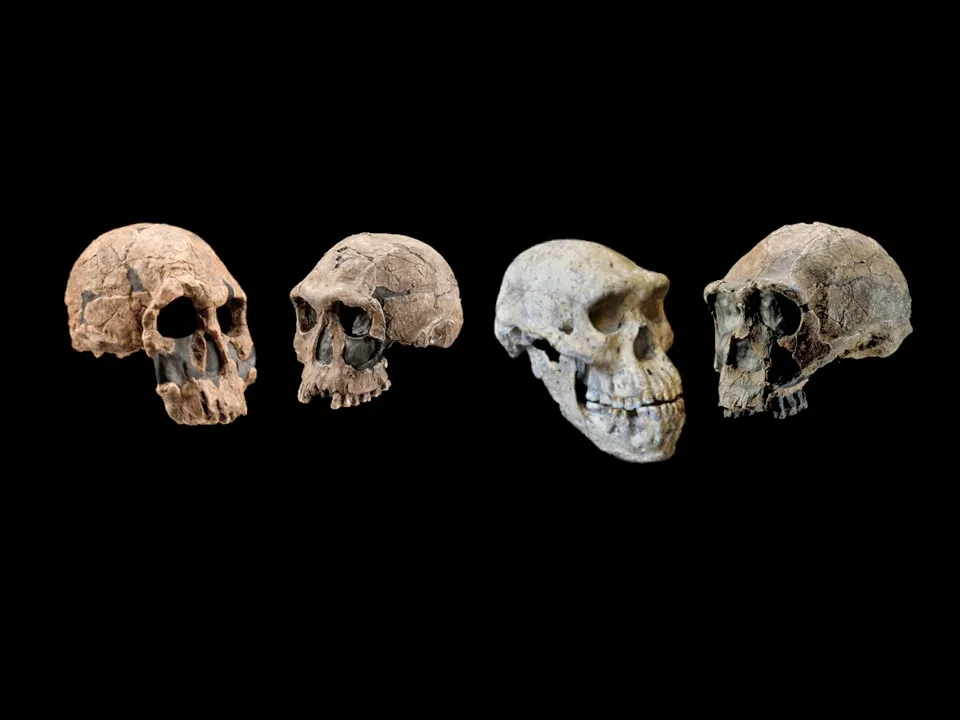
Three different human species may have walked the Earth at the dawn of the human lineage, dividing up their environment in slightly different ways, and the ancestors of modern humans may have survived because oftraits such as large brains that helped them adapt to unstable, shifting landscapes, researchers say.
Moreover, the defining features of the human lineage may not have evolved together gradually at once, but piecemeal in stages over millions of years, scientists added.
Modern humans, Homo sapiens, are the only living members of the human lineage, the genus Homo, which is thought to have arisen in Africa more than 2 million years ago. Many now-extinct human species were thought to once roam the planet, such as Homo erectus, the first to regularly keep the tools it made. [Gallery: See Photos of Humans' Closest Ancestor]

Many traits unique to the human lineage were long thought to have originated between 2.4 million and 1.8 million years ago in Africa. These include a large brain and body, long legs, reduced differences between the sexes, increased meat-eating, prolonged maturation periods, increased social cooperation and tool making.
However, recent fossil evidence suggests these traits did not arise together as a single package. Instead, key human features evolved piecemeal at separate times, with some emerging substantially earlier and some later than previously thought. For instance, recent findings suggest long legs, a feature once considered unique to humans, developed in earlier ancestors, the genus Australopithecus, between 3 million and 4 million years ago, and stone tools about 2.6 million years old may predate the origin of Homo.
A dynamic birthplace
Scientists have long suggested that human evolution was linked to the onset of global cooling and the spread of a stable or progressively arid savanna grasslands in Africa. However, recent studies hint that early Homo may have evolved in a far more diverse environment, with the birthplace of humanity dominated from 2.5 million to 1.5 million years ago by an unstable climate, shifting intensity of annual wet and dry seasons, and varied landscapes.
Get the world’s most fascinating discoveries delivered straight to your inbox.
This changeable landscape may have driven the human lineage to embrace versatility. An increase in average brain size is seen with the rise of Homo, which probably improved talents for thinking and socializing. That in turn explains the increased presence of tools that accompany early human fossils.
"Unstable climate conditions favored the evolution of the roots of human flexibility in our ancestors," study co-author Richard Potts, a paleoanthropologist and curator of anthropology and director of the Human Origins Program at the Smithsonian's National Museum of Natural History, said in a statement. "The narrative of human evolution that arises from our analyses stresses the importance of adaptability to changing environments, rather than adaptation to any one environment, in the early success of the genus Homo."
At the same time, early Homo saw incisor and molar teeth growing smaller, and chemical analysis of fossils hints that early Homo shifted to a more diverse diet that included more meat and tough plants. This diversity in diet and the extra calories it could provide, together with tool use and social cooperation, might help explain the increase in average body size seen with early Homo.
"Taken together, these data suggest that species of early Homo were more flexible in their dietary choices than other species,"study co-author Leslie Aiello, a paleoanthropologist and president of the Wenner-Gren Foundation in New York,said in a statement. "Their flexible diet — probably containing meat — was aided by stone tool-assisted foraging that allowed our ancestors to exploit a range of resources."
Three early human species?
The researchers suggest these dynamic environments favored evolutionary diversity. Based on fossil evidence, they suggest maybe three distinct species of early Homo coexisted and overlapped geographically in East Africa between 2.4 million and 1.5 million years ago. [See Photos of Amazing Human Ancestor Fossils]
"Evolution is a complicated bush, not a straight line," Aiello told Live Science. "There were many species of early human in the time period between about 2.4 million and 1.5 million years ago."
The scientists can tell these species apart "based on differences in the shape of their skulls, especially their face and jaws," lead study author Susan Antón, a paleoanthropologist at New York University,said in a statement. "The differences in their skulls suggest early Homo divvied up the environment, each utilizing a slightly different strategy to survive."
These early human species include Homo erectus, the most likely ancestors of Homo sapiens. The researchers currently dub the other two species the 1470 group, traditionally classified as Homo rudolfensis, which had a relatively tall, flat face, and the 1813 group, traditionally classified as Homo habilis, which had a more primitive face, whose roof of the mouth was more rounded toward the back of the head. (The 1470 and 1813 groups get their names from the numbers assigned key fossils defining each lineage.)
Early Homo erectus was 20 percent bigger in brain and 15 percent larger in body than both 1470 and 1813 groups. "Homo erectus was the species that we think had the evolutionary adaptability for the changing environments of the time, and because of this was the species that thrived while the others ultimately went to extinction," Aiello said.
Fossil skulls suggest human brains grew larger and more complex between 200,000 and 800,000 years ago. At the same time, the level of diversity and innovation of human tools increased, and signs of cooperative food-sharing are seen around hearths and shelters, developments that would help the human lineage survive uncertain environments. Ultimately, human flexibility was likely essential to Homo expanding out of Africa, with Homo erectus reaching what is now the nation of Georgia starting about 1.8 million years ago.
Fossils and archaeological finds dating between 2.5 million and 1.5 million years ago that scientists could discover in the future might help shed light on the evolution of early Homo. In the meantime, to learn more about human evolution, scientists can do more research on the biology of modern humans and other living animals. This will help develop and test models involving the intricate relationships between brain and body size, diet, mortality and other factors "to help us interpret the fossil and archaeological evidence that we now have," Aiello said.
The scientists detailed this research online today (July 3) in the journal Science.
Follow Live Science @livescience, Facebook & Google+. Original article on Live Science.