















Fear Makes Scary Scents Stronger

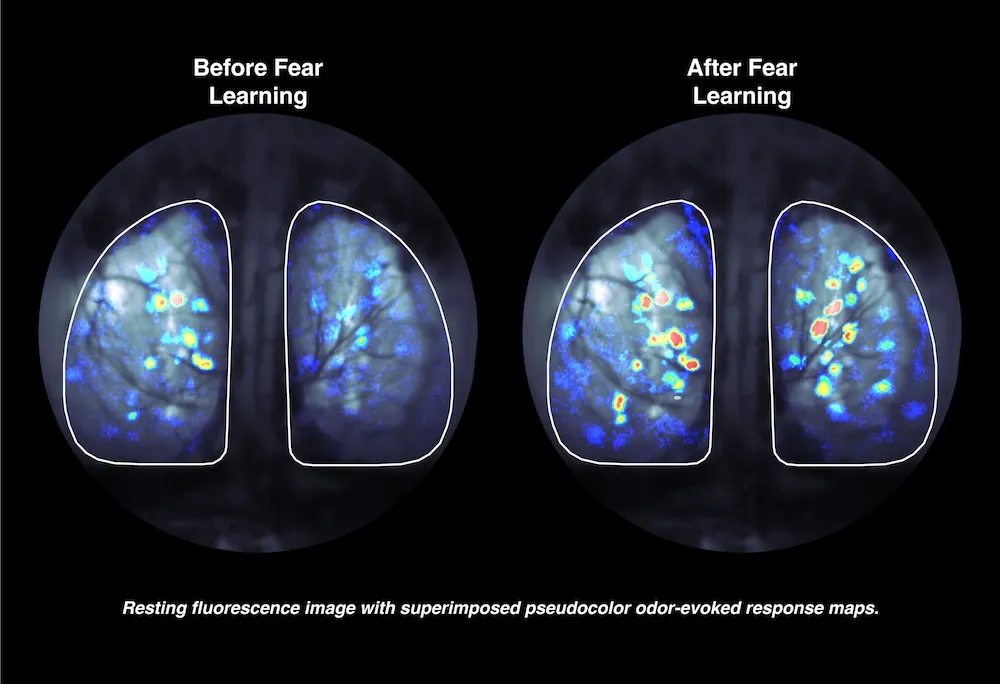
The nose may really "know" when it comes to danger, according to a new study that found that odors associated with electric shocks in mice trigger a sensory-cell reaction much stronger than for non-fearful odors.
The finding was surprising, said study researcher John McGann, a neuroscientist at Rutgers University in New Jersey. The sensory neurons are at the very beginning of the circuit that enables the perception of smell, far outside of conscious control, and yet they "learn" to tune into scary smells.
"The effects of learning can happen not just on behavior, but on sensory processing," McGann told LiveScience. [Tip of the Tongue: The 7 (Other) Flavors Humans May Taste]
Learning fear
Researchers have long known that associative learning — the talent of associating one stimulus with another — changes processing in the brain so that, for example, the ability to differentiate between one type of scent and another becomes more sensitive. But most people tend to think that the sensory nerves that sit in the nose and directly contact the chemicals that make up scents are one-trick ponies. A smell comes along; the neurons duly note it and inform the brain; and the brain does the hard work of remembering what that scent means.
Not so, the new study reveals. The sensory neurons adapt, too.
"The earlier we look the earlier we find influences of learning," McGann said.
Get the world’s most fascinating discoveries delivered straight to your inbox.
The researchers used relatively new techniques to spy on mouse olfactory (smell) sensory neurons. They used mice that had been genetically engineered to have olfactory sensory neurons that fluoresce when active. The fluorescence provides colorful evidence the neurons are releasing neurotransmitters, the chemical signals these cells use to communicate.
The researchers placed these mice in metal-floored enclosures and pumped in two smells, both simple one-chemical esters. One smelled rather fruity, the other a bit like nail polish remover. For each mouse, one of the smells presaged an unpleasant electrical shock to the feet from the enclosure floor.
After the mice had learned to associate the smell with the shock, the researchers anesthetized them and exposed them to the smells again, watching under a microscope to see how their olfactory neurons responded compared with unfamiliar smells.
Priming the nose
They found that scary smells had a large effect: The neurons released far more neurotransmitters when exposed to the shock-associated scent. It was as if the mice had been exposed to the smell at four times the concentration than they really were, McGann said.
"The circuit became hypersensitive to that odor," he said.
The finding makes sense, McGann said. Becoming hypersensitive to the scent of danger could save a mouse's life, particularly if that sensitivity gets the rodent out of the path of, say, a hungry cat. But it's also exciting and unexpected, he said, because the finding shows that even basic sensory neurons respond to learning in this way.
The aural equivalent, McGann said, would be like having a microphone that automatically turned up the volume in response to important sounds.
Of course, researchers don't know whether the ears or eyes have similarly adaptable nerve cells. Nor do they know whether smells can be associated with emotions other than fear. Those are harder experiments, McGann said.
"We know how to scare a mouse," he said. "It's harder to know how to make a mouse really, really happy."
Another outstanding question is whether human noses have the same responses to scary smells — and if our other sensory systems act the same way. It's possible, McGann said. Some people with post-traumatic stress disorder (PTSD) are hypersensitive to stimuli that remind them of their trauma. Such sensitivity could very well start at the most primitive levels.
"Maybe, and I emphasize the maybe, that's analogous to what's happening in these mice," McGann said.
The researchers now plan to test whether they can reverse the sensory learning by training the mice not to associate the scary smell with a shock anymore. They also plan to "get a little bit more into the nuts and bolts" in the brain to find out how the neurons change their behavior, McGann said.
The researchers report their findings Friday (Dec. 13) in the journal Science.
Follow Stephanie Pappas on Twitter and Google+. Follow us @livescience, Facebook & Google+. Original article on LiveScience.

Stephanie Pappas is a contributing writer for Live Science, covering topics ranging from geoscience to archaeology to the human brain and behavior. She was previously a senior writer for Live Science but is now a freelancer based in Denver, Colorado, and regularly contributes to Scientific American and The Monitor, the monthly magazine of the American Psychological Association. Stephanie received a bachelor's degree in psychology from the University of South Carolina and a graduate certificate in science communication from the University of California, Santa Cruz.