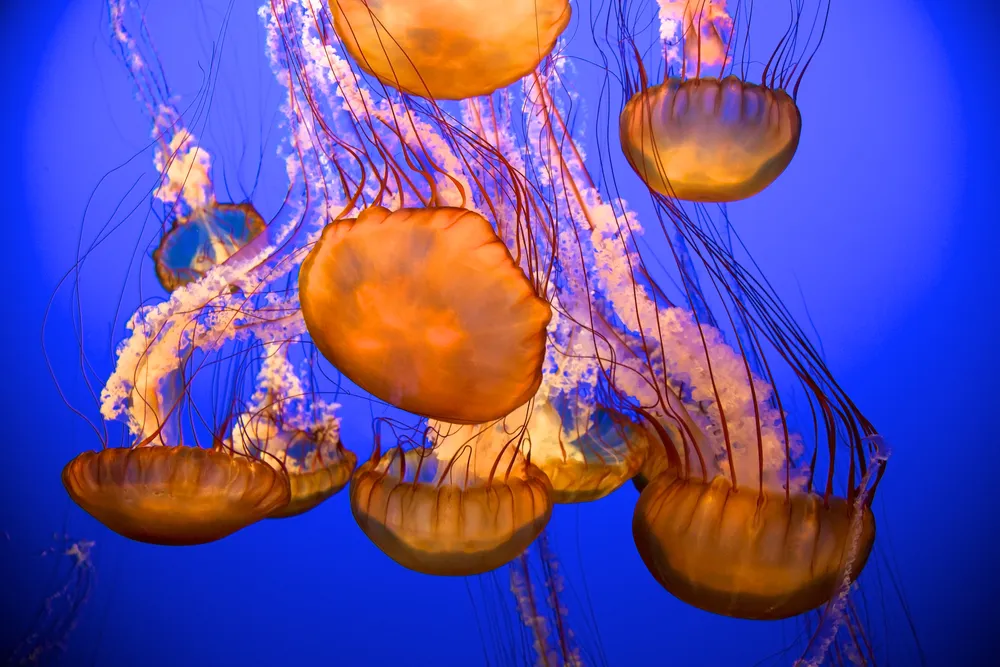
In 2000, a bloom of sea tomato jellyfish in Australia was so enormous — it stretched for more than 1,000 miles from north to south — that it was even visible from space. It was certainly a bloom that Australian jellyfish researcher Lisa-ann Gershwin won't forget.
While most blooms are not quite that big, Gershwin's survey of research on jellyfish from the last few decades indicate that populations are most likely on the rise, and that this boom is taking place in an ocean that is faced with overfishing, acid rain, nutrient pollution from fertilizers and climate change, among other problems. There have been many reports about jellyfish numbers increasing in the past few years; some researchers think it is part of a larger trend, while others say it may be just a numerical fluke. Most agree, however, that more data is needed before coming to a definitive conclusion.
Gershwin, a research scientist with the Commonwealth Scientific and Industrial Research Organisation who specializes in jellyfish, recently wrote about her findings in a book called "Stung! On Jellyfish Blooms and the Future of the Ocean" (University Of Chicago Press, 2013). The book, which is aimed at a general audience and is not peer-reviewed, details dozens of studies that Gershwin read and concludes it's possible that ocean conditions are ripe for a jellyfish takeover. [Image Gallery: Jellyfish Rule!]
Latest Videos From
"What we see in the areas that are the most damaged from numerous different disturbances, we see these jellyfish bloom problems," Gershwin told LiveScience.
In the Sea of Japan, for example, jellyfish are drifting in from China, where reports indicate the country is facing massive overfishing and pollution, as well as coastal construction where jellyfish polyps (or young) can find a home, Gershwin said.
Some researchers say that overfishing removes other species that compete for the same food jellyfish eat, such as plankton. Gershwin thinks that overfishing, climate change and a combination of other factors are clearing the way for a jellyfish takeover. Jellyfish are said to prefer warmer oceans; no direct link has been found for why acidification would benefit them, according to a 2008 paper in the journal Limnology and Oceanography, but some researchers say jellyfish increase in abundance in acidic conditions.
"The jellyfish seem to be the ones that are flourishing in this while everything else is suffering," Gershwin said.
The trouble with tracking jellyfish, however, is it's hard to estimate populations on sight. Given the creatures are underwater, there are few records right now — let alone from the past few decades — indicating the extent of jellyfish populations and how they are changing. Gershwin acknowledges that more "good, brilliant, innovative, creative scientists" are required to find the links between jellyfish population increases and their causes.
Boom-and-bust, or not so much?
In one 2012 analysis of jellyfish population reports dating back to the 19th century, researchers publishing in the journal Proceedings of the National Academy of Sciences unveiled a 20-year cycle in jellyfish abundance. Another paper published that year in the journal Hydrobiologia, however, tracked jellyfish increases at the most surveyed "large marine ecosystem" locations since 1950.
The paucity of data means it is difficult to draw any conclusions about what is happening, jellyfish researcher Steven Haddock, of Monterey Bay Aquarium Research Institute in California, told LiveScience.
"It's not to say climate change isn't happening. It's not to say jellyfish [population increase] is not happening," Haddock said. "But I think there are so many causes that would come before climate change that it doesn't seem that productive. It sounds to me like scary rhetoric to try to get funding, or to get people all excited about it."
Scientists will need at least a decade's more work before drawing any definitive conclusions about population numbers, Rob Condon, a marine scientist at Dauphin Island Sea Laboratory in Alabama who headed the cycle paper, told LiveScience in a previous interview.
Haddock encourages anyone interested in jellyfish to submit sightings to his group, JellyWatch.org, to help move the research along. Gershwin, meanwhile, worries that waiting may make it too late to stop the invasion, if it is indeed happening.
"We're conducting this enormous global experiment, damaging the oceans, and the ocean is our life support system," she said.
"As crazy as it sounds, I think humanity needs a rethink," Gershwin added. "We need to really think about how important is that life support system, how important is food from the ocean to us. Are we comfortable polluting it and poisoning it and wiping it off the face of the Earth? Is that the result we want for our future and our kids and our grandkids?"
Follow Elizabeth Howell @howellspace. Follow us @livescience, Facebook & Google+. Original article on LiveScience.