Physicists have measured an extremely rare particle decay inside the world's largest atom smasher — a discovery that bolsters the leading model of particle physics and leaves little room for undiscovered particles beyond this theory.
Inside the Large Hadron Collider (LHC), a 17-mile-long (27 kilometers) circular tunnel under France and Switzerland, particles are sped up to near the speed of light and then smashed together. The collisions give rise to an array of pedestrian particles, as well as some exotic rarities. It is one of these rare particles, called B-sub-s, that physicists recently measured.
B-sub-s particles are made of two flavors of quarks: bottom quarks and anti-strange quarks (the antimatter counterparts to strange quarks). They last only a very short while after being created inside the LHC, quickly decaying into lighter particles. Now, physicists say they've observed B-sub-s particles decaying into two particles called muons (cousins of electrons). [Beyond Higgs: 5 Elusive Particles That May Lurk in the Universe]
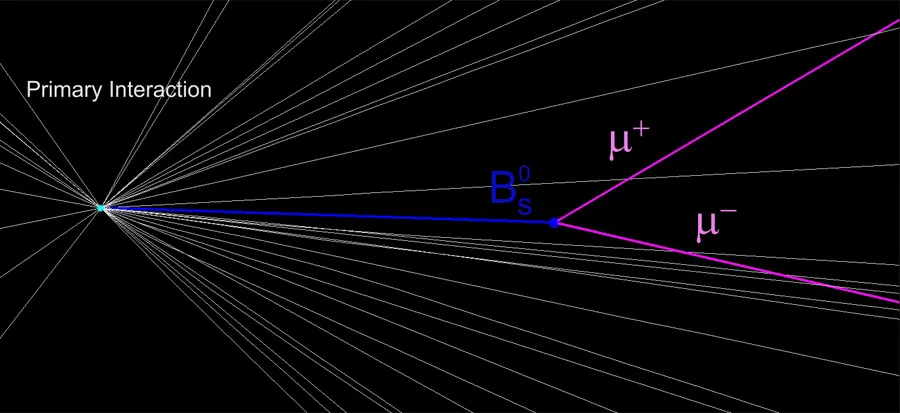
This diagram illustrates the collision of two protons inside the Large Hadron Collider, creating a spray of other particles, including a B_s meson (blue) that decays into two muons (purple).
(Image credit: LHCb)
This decay process had been predicted by the dominant particle physics theory, called the Standard Model, and was expected to occur only about three times in every billion decays. Two experiments at LHC — the CMS (Compact Muon Solenoid) and LHCb (LHCbeauty) projects — have now measured enough of these decays to find that the process does, indeed, happen at almost exactly that rate.
"This is a victory for the Standard Model," CMS physicist Joel Butler of the Fermi National Accelerator Laboratory in Batavia, Ill., said in a statement. "But we know the Standard Model is incomplete, so we keep trying to find things that disagree with it."
Some scientists had been hoping that LHC would measure this specific decay process happening slightly more or less often than the Standard Model predicts, which could indicate that there are undiscovered particles interfering in some way.
Particles beyond the Standard Model would be a welcome find, physicists say, because the model currently has no way of explaining dark matter or many other mysteries of nature. Some physicists suspect the universe is inhabited by more particles than the theory describes — such as a panoply of particles predicted by an idea called supersymmetry — but so far, these particles have been elusive.
Sign up for the Live Science daily newsletter now
Get the world’s most fascinating discoveries delivered straight to your inbox.
"This is the place to look for new physics," said LHCb physicist Sheldon Stone of Syracuse University. "Small deviations from the predicted rate would firmly establish the presence of new forces or particles."
So far, the LHC's observations closely match the expectations of the Standard Model, but there's still some wiggle room for new physics. In the future, researchers hope to compare the B-sub-s to muon decay to the decay of another particle, called B-sub-d, which has a bottom quark and an anti-down quark.
The latter particle is expected to decay into two muons even more rarely than the B-sub-s, so physicists will have to wait for more data before they can study this process.
The LHC is currently shut down for upgrades but should restart at a higher energy in 2015, which will enable even more collisions to occur and, in turn, produce more data for researchers to analyze.
LHC researchers announced their new findings today (July 19) at the EPS-HEP conference in Stockholm, Sweden.
Clara has a bachelor's degree in astronomy and physics from Wesleyan University, and a graduate certificate in science writing from the University of California, Santa Cruz. She has written for both Space.com and Live Science.