














El Reno Tornado Had Rare Anticyclonic Companion

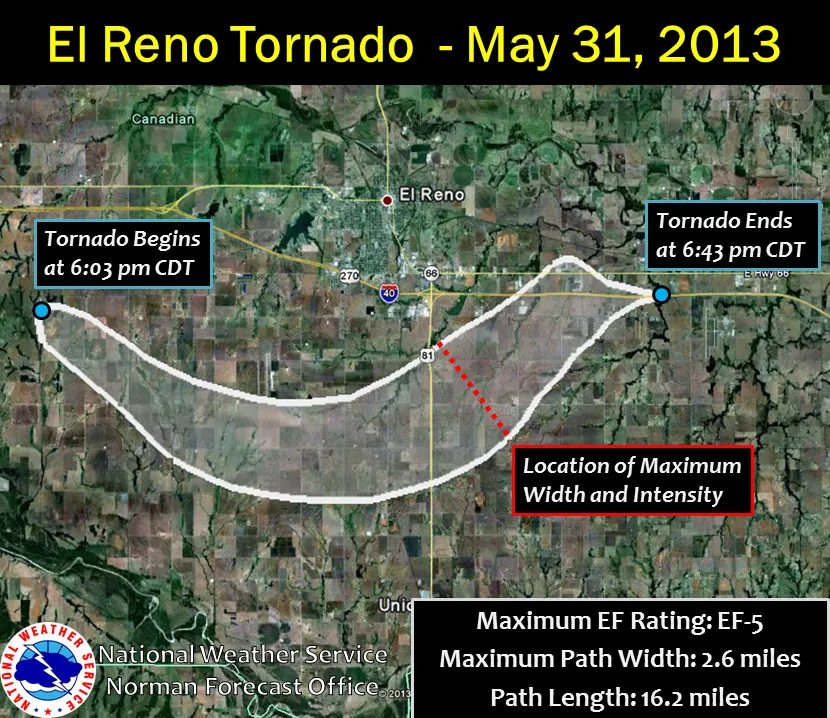
As if the massive EF5 tornado that hit El Reno, Okla., last week weren't already noteworthy — it ranks as the widest tornado on record, at 2.6 miles (4.2 kilometers) across — it was also accompanied by a rare anticyclone twister that formed 3 miles (4.8 km) to the southeast, reports the Washington Post's Capital Weather Gang blog.
Anticyclonic tornadoes are ones that spin clockwise instead of the usual counterclockwise (in the Northern Hemisphere, that is). These usually only form as waterspouts or twisters generated by non-supercell storms (those that don't have a rotating updraft), the Capital Weather Gang notes.
The blog quotes an explanation of the tornado's formation from The Weather Channel's Greg Forbes, who explains that the tornadoes form like eddies at the side of a stream, only the stream in this case is a jet of air. The eddies on either side of the stream or jet turn in different directions. In the case of the tornadoes, the updraft from the storm spins the eddies up into twisters, though it generally only does this for the counterclockwise-flowing one. Forbes says that occasionally the stream of air is so strong that the anticyclone tornado spins up too.
The anticyclonic tornado was detected by the mobile Doppler units deployed by tornado researcher Joshua Wurman, of the Center for Severe Weather Research. Another cyclonic-anticyclonic tornado pair was amazingly also spotted in the El Reno area back in 2006, the blog notes.
Follow Andrea Thompson @AndreaTOAP, Pinterest and Google+. Follow OurAmazingPlanet @OAPlanet, Facebook and Google+.
Get the world’s most fascinating discoveries delivered straight to your inbox.

Andrea Thompson is an associate editor at Scientific American, where she covers sustainability, energy and the environment. Prior to that, she was a senior writer covering climate science at Climate Central and a reporter and editor at Live Science, where she primarily covered Earth science and the environment. She holds a graduate degree in science health and environmental reporting from New York University, as well as a bachelor of science and and masters of science in atmospheric chemistry from the Georgia Institute of Technology.