














Unique Animals Found at East Coast Methane Seep

While surveying the seafloor last fall, a research vessel spotted bubbles rising from the depths.
Now, another ship has gone back to investigate, and found a variety of life on the seafloor surrounding a methane seep, according to an update from researchers with the National Oceanic and Atmospheric Administration (NOAA).
On May 8, the NOAA ship Ron Brown deployed an unmanned sub named Jason to the seafloor offshore Virginia. The sub came upon patches of white bacteria that can harness energy by breaking down methane and are a dead giveaway that leaking natural gas is likely to be found nearby. It encountered the seep at a depth of 1 mile (1.6 kilometers), the vehicle's deepest dive.
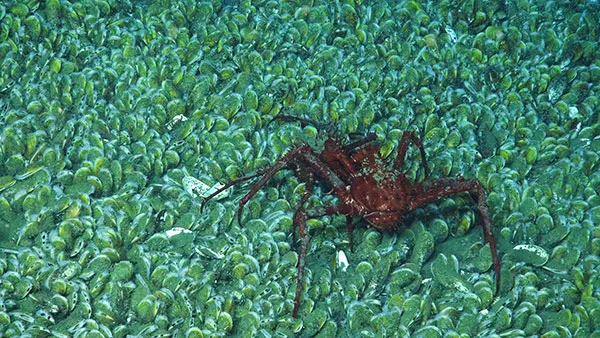
Moving closer to the site of the bubbles, the sub encountered large beds of mussels, which survive through their symbiotic relationship with the methane-eating bacteria, according to a mission update from the researchers, who are part of the Deepwater Canyons Project. This project continues until 2014 and involves mapping the submarine canyons that run from North America's continental shelf into the Atlantic Ocean basin, and are little-explored.
The submarine snapped photos of a spider crab and other unidentified fish surrounding the methane seep. The vehicle also took samples of soil and live mussels that scientists will later analyze in order to better understand life from the abyss. [Photos: Unique Life Found at East Coast Gas Seep]
The seafloor was mapped last fall by the NOAA ship Okeanos Explorer using multibeam sonar, which produces detailed images of the seafloor by calculating the amount of time and distance it takes for sound waves to travel from the ship to the seafloor and back. During that time, the ship and its instruments mapped 5,970 square miles (15,460 square km) of seafloor, an area larger than Connecticut, according to a NOAA release. The expedition found 40 gas seeps off the East Coast.
Email Douglas Main or follow him on Twitter or Google+. Follow us @OAPlanet, Facebook or Google+. Original article on LiveScience's OurAmazingPlanet.
Get the world’s most fascinating discoveries delivered straight to your inbox.
