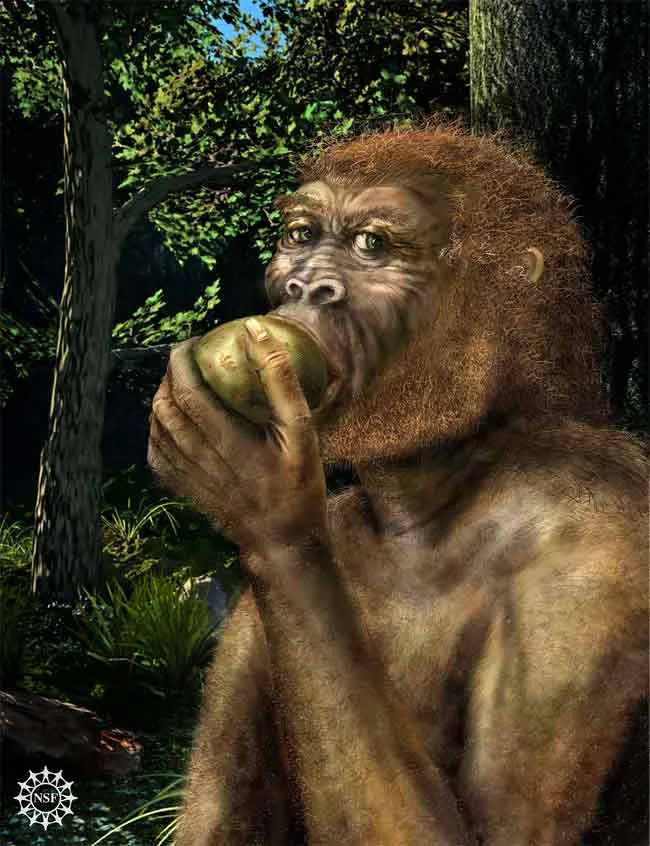
An early human with a big mouth made for chomping strangely preferred to eat soft, squishy fruits, new dental analyses suggest.
The finding — the big guy's teeth showed only light wear — might force scientists to downgrade everything they thought they knew about hominids' diets. For starters, the findings could cause this hominid, Paranthropus boisei, to relinquish rights to its long-held moniker, the Nutcracker Man, in the eyes of anthropologists.
The Nutcracker Man lived from about 2.3 million years ago to 1.2 million years ago, before vanishing from the fossil record. He boasted a huge jaw with massive chewing muscles and flat, tough teeth whose crushing power could obliterate the roots and nuts of his home on the African savanna.
Latest Videos From
"It's got big crests on top of its skull for giant chewing muscles. It has big flat teeth with really thickened enamel on those teeth," said lead researcher Peter Ungar of the University of Arkansas in Fayetteville. "And we thought of it for the last 50 years almost as an extreme hard-object specialist."
But like many SUVs, the Nutcracker Man rarely pushed its equipment to the limits, it turns out.
"This was always thought of as the quintessential Nutcracker," said anthropologist Matt Sponheimer of the University of Colorado at Boulder, who was not involved in the current study. "This study and other recent studies are suggesting that perhaps we didn't know nearly as much about the diets of early hominids as we thought we did."
The study, funded by the National Science Foundation, is detailed in the most recent issue of the journal PLoS ONE.
Tooth clues
The researchers used powerful microscopes to examine patterns of wear on the teeth of P. boisei, comparing the patterns with those from other primates that eat different types of food. A lifetime of chewing will leave behind marks on an organism's teeth, for instance, parallel scratches from leaf-eating or deep pits resulting from a diet of nuts and seeds.
The micro-images revealed light, wispy scratches etched into P. boisei's teeth that looked more similar to the marks on the teeth of modern-day fruit eaters than with those found on modern-day primates' teeth. "It looks more like they were eating Jell-O," Ungar said.
The seeming overbuilt eating features of P. boisei could have been used as a fallback, for tough times when yummy figs and other soft foods were unavailable, the researchers suggest.
The explanation fits with a phenomenon called Liem's paradox, in which animals avoid eating the very foods they are adapted for when alternatives are in supply.
"If you give a gorilla a choice of eating fruit or a leaf, it will take the fruit every time," Ungar said. "But if you look at a gorilla's skull, its sharp teeth are adapted to consuming tough leaves. They don't eat the leaves unless they have to."
Revamped menu
Many other early hominid species also sported robust mouths and jaw features. For that reason, the new results could mean a revamping of the entire early hominid menu.
"I think this goes a lot beyond P. boisei," Sponheimer told LiveScience. "It's hard to not let these new results on boisei redound to our understanding of the dietary adaptations of all early hominins."
Sponheimer and his colleagues found chemical evidence that a related species, Paranthropus robustus, foraged on a generalist diet.
The finding also has implications for what caused some species to go extinct while others such as modern humans persisted.
P. boisei disappeared from the fossil record at a time when Earth's climate was changing. As a result, the thinking goes that P. boisei was not able to adapt quickly enough to habitat and food changes with its specialized diet.
But apparently this hominid could eat all the stuff modern humans could and more.

 Live Science Plus