New Use for Those Incredible Nanotubes: Holograms

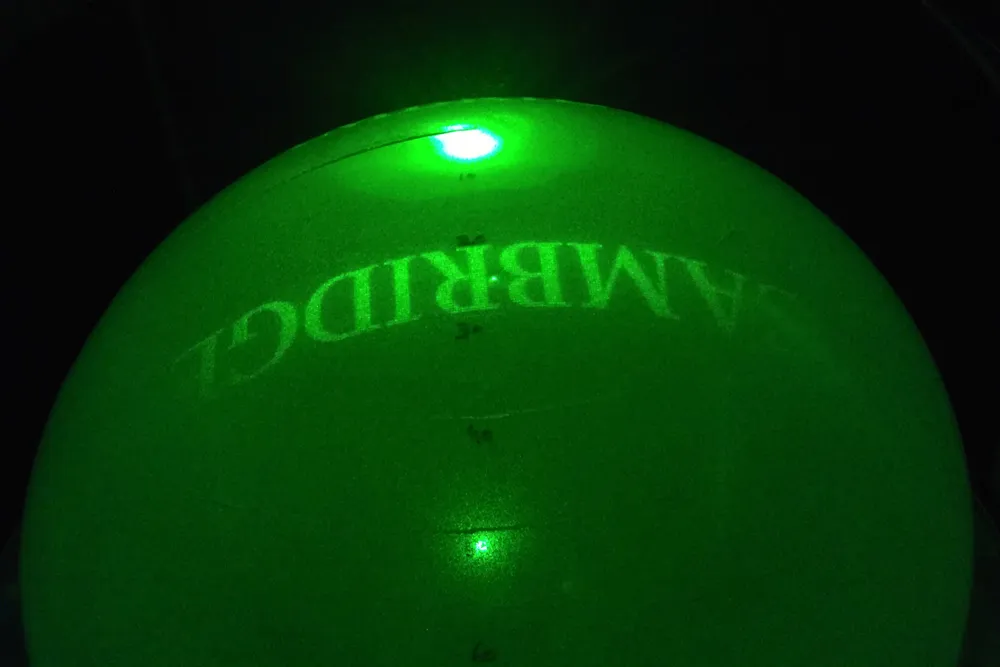
Carbon nanotubes — a manmade material many times thinner than a wavelength of visible light — can be used to create highly detailed holograms, researchers say.
These carbon tubes are hollow pipes only nanometers, or billionths of a meter, wide. They possess a range of extraordinary physical and electrical properties, such as being about 100 times stronger than steel at one-sixth the weight.
Industrial giants, government agencies and academic institutes worldwide are investigating carbon nanotubes as key ingredients for tomorrow's devices. This work includes researching a variety of applications regarding light — holograms, for instance.
[New Device Uses Nanotubes to Catch Cancer Cells]
Holograms are a special kind of 2D photograph that, when lit up, seem like windows onto 3D scenes. The pixels making up each hologram scatter light falling onto them in very specific ways, causing these light waves to interact with each other to generate images with depth.
The smaller the pixels making up the holograms are, the higher the resolution of the holograms and the more angles one can view them from.
"The size of pixels is one of the key limiting features in the state-of-the-art of holographic displays systems," said researcher Haider Butt, an optical scientist at the University of Cambridge in England.
Get the world’s most fascinating discoveries delivered straight to your inbox.
Now scientists have created holograms using the smallest pixels yet — carbon nanotubes.
"Due to the nanoscale dimensions of the carbon nanotube array, the image presented a wide field of view and high resolution," Butt told InnovationNewsDaily.
The researchers used multi-walled carbon nanotubes — tubes within tubes — that were on average 140 nanometers across, or about 700 times thinner than a human hair. These were grown on silicon surfaces like pillars rising from the ground, each reaching about 1,500 nanometers high. Their calculations let them know where these nanotubes should be placed and how wide they should be in order to generate a holographic image of the word "CAMBRIDGE."
These holographic displays and their pixels are very sensitive to changes in material properties and incoming light. As such, "a new class of highly sensitive holographic sensors can be developed that could sense distance, motion, tilt, density of biological materials," and features of light falling onto them, Butt said.
While promising, carbon nanotubes are still expensive to fabricate, so the team is investigating other materials that could generate holograms in similar ways. "Alternative materials should be explored and researched,” Butt said. “As a next step, we are going to try zinc oxide nanowires to achieve the same effects."
Also, these holograms are static, much like photographs are. In the future, the researchers hope to make the adjustable pixels that could perhaps lead to changeable pictures or even video displays. This might be possible by integrating these pixels with the kind of liquid crystals often seen in modern flat-screen displays. The liquid crystals might be able to shuffle around the location and other features of the pixels, thus altering the holographic image they create.
The scientists detailed their findings online Aug. 31 in the journal Advanced Materials.
This story was provided by InnovationNewsDaily, a sister site to LiveScience. Follow InnovationNewsDaily on Twitter @News_Innovation. We're also on Facebook & Google+.