
Largest Hailstone Confirmed in Hawaii
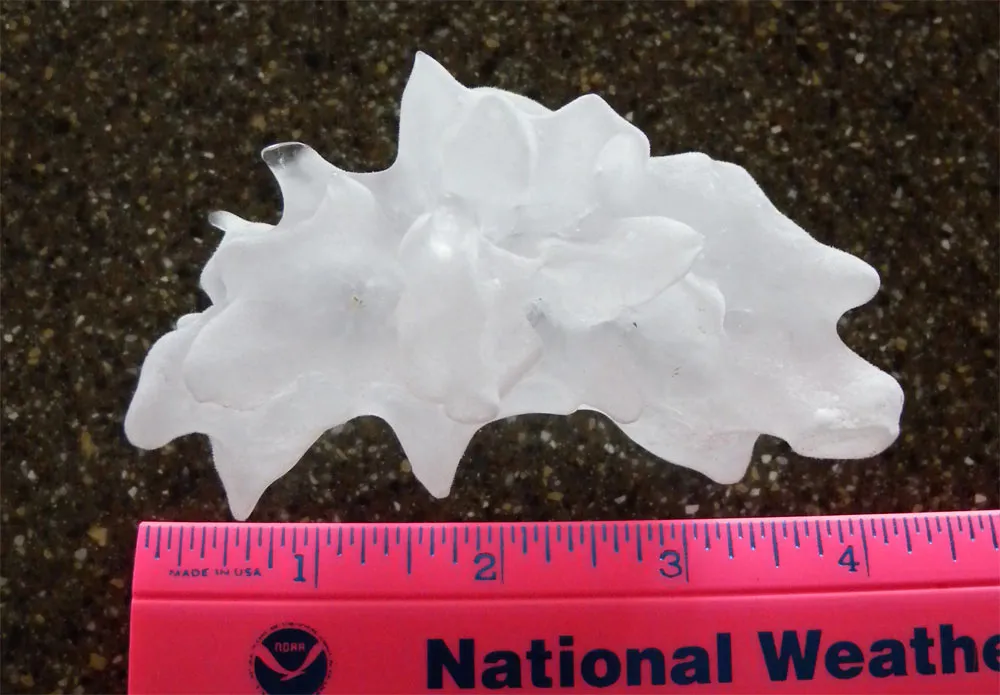
A grapefruit-size hailstone that pummeled Oahu during a hailstorm this month has now been confirmed as the largest on record for the state of Hawaii, announced officials with the National Oceanic and Atmospheric Administration (NOAA).
A final measurement of the hailstone, which dropped from the skies on March 9, places it at 4.25 inches long, 2.25 inches tall and 2 inches wide (10.8 by 5.7 by 5 centimeters).
"According to hail report records for Hawaii kept back to 1950, the previous state record hailstone was 1 inch in diameter," Michael Cantin, warning coordination meteorologist at NOAA's National Weather Service (NWS) in Honolulu, said in a statement. The NWS, along with NOAA's State Climate Extremes Committee confirmed the new state record.
Article continues belowThe record-setting hailstone was dropped by a so-called supercell thunderstorm on the windward side of Oahu that also produced large hail in Kaneohe and Kailua. Perhaps the most violent of all thunderstorm types, supercell thunderstorms can generate damaging winds large hail, and even tornadoes, according to NOAA. They are most common during the spring across the central United States.
NOAA received several reports of hail with diameters of 2 to 3 in. (5 to 7.6 cm) and greater in Hawaii during the storm. One such report, the new record breaker, came from a resident in the Aikahi neighborhood of Kailua, who reported a hailstone larger than 3 inches in diameter. Inspection by the NWS revealed the chunk was much larger, and has now been confirmed the largest on record.
In fact, since records began, there have been no reports of hail larger than an inch in diameter; penny-size (just under an inch) or quarter-size (1 inch in diameter) hailstones, have been reported just eight times in Hawaii. Conditions needed to produce supercell thunderstorms, and thus to form large hailstones, the size of golf balls and baseballs, are rare in Hawaii.
To form, supercells need warm, most air to rise, forming progressively colder and drier air; at the same time, winds that change direction and increase in speed with increasing height off the ground are needed. Both sets of conditions existed on March 9, an ideal day for a supercell storm, it seems.
Get the world’s most fascinating discoveries delivered straight to your inbox.
The same hail-spawning supercell also gave Hawaii another rarity — a tornado. The NWS confirmed an EF-0 tornado on the tornado damage scale with winds of 60-70 miles per hour (about 97-113 kilometers per hour) in Lanikai and Enchanted Lakes on Oahu that day. [The Tornado Damage Scale in Images]
A hailstone that hit Vivian, S.D., on July 23, 2010, holds the U.S. record for the largest diameter, reaching 8 in. (20 cm), and heaviest weight (1.938 pounds, or 0.879 kilograms). A hailstone that hit Aurora, Neb., on June 22, 2003, holds the U.S. record for the largest circumference, at 18.75 in. (47.63 cm).
Follow LiveScience for the latest in science news and discoveries on Twitter @livescience and on Facebook.
Jeanna Bryner is managing editor of Scientific American. Previously she was editor in chief of Live Science and, prior to that, an editor at Scholastic's Science World magazine. Bryner has an English degree from Salisbury University, a master's degree in biogeochemistry and environmental sciences from the University of Maryland and a graduate science journalism degree from New York University. She has worked as a biologist in Florida, where she monitored wetlands and did field surveys for endangered species, including the gorgeous Florida Scrub Jay. She also received an ocean sciences journalism fellowship from the Woods Hole Oceanographic Institution. She is a firm believer that science is for everyone and that just about everything can be viewed through the lens of science.