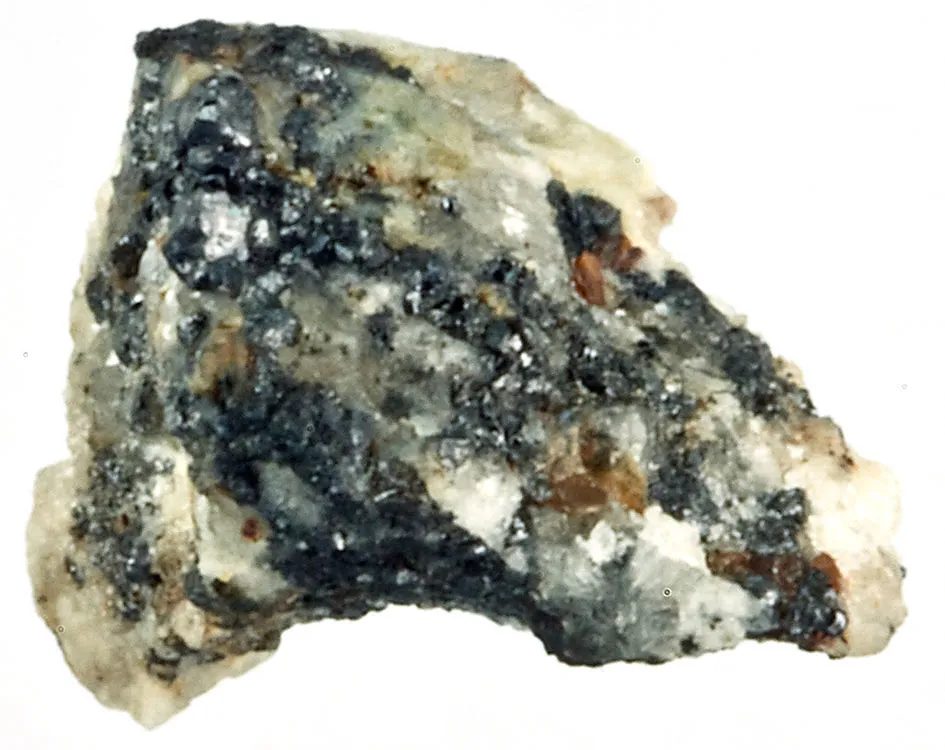
A rock fragment containing a previously unidentified natural quasicrystal may be the remnant of a meteorite that originated in the early solar system more than 4.5 billion years ago before Earth even existed.
Until now, researchers had assumed such quasicrystals, whose atoms are arranged in a quasi-regular pattern rather than the regular arrangement of atoms inside a crystal, were not feasible in nature. In fact, until now the only known quasicrystals were synthetic, formed in a laboratory under carefully controlled conditions. (This year's Nobel Prize in chemistry honored Dan Shechtman for his 1982 discovery of quasicrystals, which at the time were thought to break the laws of nature.)
"Many thought it had to be that way, because they thought quasicrystals are too delicate, too prone to crystallization, to form naturally," researcher Paul Steinhardt of Princeton University said. The new finding, described this week in the journal Proceedings of the National Academy of Sciences, suggests "quasicrystals are much more common in the universe than we thought," Steinhardt added.
Latest Videos From
The rock was discovered in the Koryak Mountains of Russia. Various features of the quasicrystal suggest a meteorite origin, including the shapes of the grains and its chemical composition of metallic copper and aluminum that resemble those found in so-called carbonaceous chondrites; these are primitive meteorites that scientists think were remnants shed from the original building blocks of planets. Most meteorites found on Earth fit into this group.
Analysis of the quasicrystals revealed they were intermeshed with silicates and crystalline metals, with one quasicrystalline grain encased in a silica mineral called stishovite.
"Stishovite is silicon dioxide, the same chemical that makes quartz and sand, but here it forms a different structure that only occurs at high pressures achieved in meteorite collisions and impacts," wrote Steinhardt in an email to LiveScience.
The fact that the metallic aluminum was found in its unoxidized form was also surprising, since the metal has such a strong affinity for oxygen and couldn't have remained in that form here on Earth, Steinhardt said.
"So, we have learned that extraterrestrial conditions enable a phase of matter not likely possible on Earth. This raises the question: What other materials have been made in space that would not form naturally on Earth. In particular, are there other quasicrystals?" Steinhardt said.
Follow LiveScience for the latest in science news and discoveries on Twitter @livescience and on Facebook.

 Live Science Plus