














Colliding Galaxies Form Exclamation Point in Space

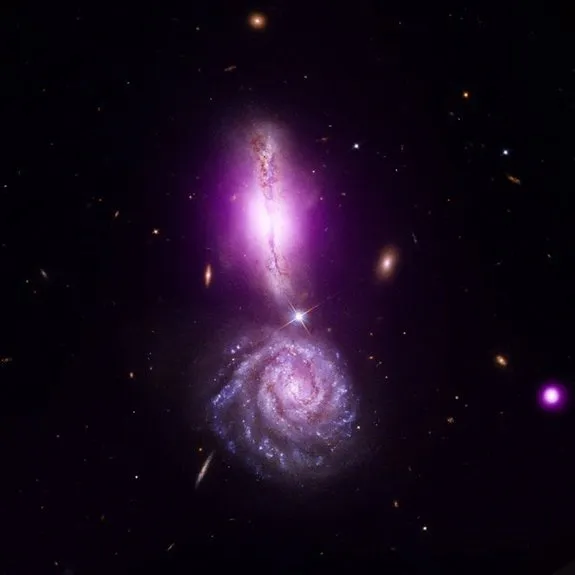
Two bright galaxies on a cosmic collision path appear to be marking the occasion with a giant exclamation point in space.
The spectacular new photo shows the galactic smash-up, called VV 340, in the early stages of collision. NASA released the cosmic crash scene and a video explaining the galaxy collision yesterday (Aug. 11).
In the photo, the edge-on galaxy near the top of the image is VV 340 North and the face-on galaxy at the bottom of the image is VV 340 South.
The colliding galaxies, which are also known as Arp 302,are located about 450 million light-years away from Earth. Over the course of millions of years, these two spiral galaxies will eventually merge in much the same way that the Andromeda galaxy is likely to merge with our Milky Way billions of years from now. [See the photo of the VV 340 galaxy crash]
Since VV 340 shines brightly in infrared light, it is classified as a Luminous Infrared Galaxy, NASA officials said. The image of the colliding galaxies uses data from NASA's Chandra X-ray observatory and optical data from the Hubble Space Telescope.
The observations are part of the Great Observatories All-Sky Luminous Infrared Galaxy Survey, which combines data from Chandra, Hubble, NASA's infrared Spitzer Space Telescope, the Galaxy Evolution Explorer (GALEX) observatory, and ground-based telescopes.
The survey will help astronomers understand why Luminous Infrared Galaxies emit so much infrared radiation. These galaxies generate energy at a rate that is tens to hundreds of times larger than what is usually emitted by a typical galaxy.
Get the world’s most fascinating discoveries delivered straight to your inbox.
An actively growing supermassive black hole or an intense burst of star formationis often invoked as the most likely source of the energy.
The Chandra data show that the center of VV 340 North likely contains a rapidly growing supermassive black hole that is heavily obscured by dust and gas. The infrared emissions of the galaxy pair, as observed by Spitzer, is dominated by VV 340 North, and also provides evidence for a growing supermassive black hole, NASA officials said.
But, only a small fraction of the infrared emission is generated by this black hole, they explained.
Instead, Hubble and GALEX observed that most of the ultraviolet and short wavelength optical emissions in the galaxy pair come from VV 340 South. This implies that VV 340 South contains a much higher level of star formation, astronomers said.
As a result, VV 340 is an example of a pair of colliding galaxies that are evolving at different rates.
The story was provided by SPACE.com, sister site to LiveScience.com. Follow SPACE.com for the latest in space science and exploration news on Twitter @Spacedotcom and on Facebook.
