Ancient Female Mites Called the Sexual Shots
Get the world’s most fascinating discoveries delivered straight to your inbox.
You are now subscribed
Your newsletter sign-up was successful
Want to add more newsletters?
Delivered Daily
Daily Newsletter
Sign up for the latest discoveries, groundbreaking research and fascinating breakthroughs that impact you and the wider world direct to your inbox.
Once a week
Life's Little Mysteries
Feed your curiosity with an exclusive mystery every week, solved with science and delivered direct to your inbox before it's seen anywhere else.
Once a week
How It Works
Sign up to our free science & technology newsletter for your weekly fix of fascinating articles, quick quizzes, amazing images, and more
Delivered daily
Space.com Newsletter
Breaking space news, the latest updates on rocket launches, skywatching events and more!
Once a month
Watch This Space
Sign up to our monthly entertainment newsletter to keep up with all our coverage of the latest sci-fi and space movies, tv shows, games and books.
Once a week
Night Sky This Week
Discover this week's must-see night sky events, moon phases, and stunning astrophotos. Sign up for our skywatching newsletter and explore the universe with us!
Join the club
Get full access to premium articles, exclusive features and a growing list of member rewards.
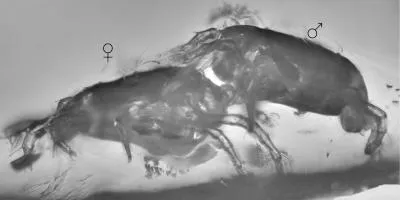
Talk about coitus interruptus: A pair of mites preserved in amber during the act of mating reveals that the female took the reins during sex.
The mites, an extinct species called Glaesacarus rhombeus, were getting busy 40 million years ago when they became trapped in sticky tree sap. The sap eventually hardened into amber, preserving the mite tableau inside. Compared with modern mites, a new study finds, G. rhombeus was sexually progressive.
"In this species, it is the female who has partial or complete control of mating," study researcher Pavel Klimov, of the University of Michigan Museum of Zoology, said in a statement. "This is in contrast to the present-day reproductive behavior of many mite species where almost all aspects of copulation are controlled by males."
All species undergo an evolutionary battle of the sexes, vying for the ability to choose their mates and thus maximize the potential for their genes to survive over time. In the case of the itsy-bitsy arthropods called mites, males take charge of mating, coercing females and guarding them from mating with others. Modern male mites have specialized organs made to cling to reluctant females.
That's not a great arrangement for female mites, who don't get to pick superior males to mate with (weaker males may still be able to coerce the females to mate). The females also have to put up with harassment by and frequent matings with pushy male mites, which can cause injury.
The ancient mites didn't have this problem, Klimov and his colleague Ekaterina Sidorchuk of the Russian Academy of Sciences found. The extinct male preserved in amber lacked specialized grasping organs. Instead, the female had a projection on her rear end that allowed her to control the male's clinging.
The researchers reported their results March 1 in the Biological Journal of the Linnean Society.
Get the world’s most fascinating discoveries delivered straight to your inbox.
You can follow LiveScience Senior Writer Stephanie Pappas on Twitter @sipappas.

Stephanie Pappas is a contributing writer for Live Science, covering topics ranging from geoscience to archaeology to the human brain and behavior. She was previously a senior writer for Live Science but is now a freelancer based in Denver, Colorado, and regularly contributes to Scientific American and The Monitor, the monthly magazine of the American Psychological Association. Stephanie received a bachelor's degree in psychology from the University of South Carolina and a graduate certificate in science communication from the University of California, Santa Cruz.