Get the world’s most fascinating discoveries delivered straight to your inbox.
You are now subscribed
Your newsletter sign-up was successful
Want to add more newsletters?
Join the club
Get full access to premium articles, exclusive features and a growing list of member rewards.
An account already exists for this email address, please log in.
A moon of Uranus could have a hidden ocean, James Webb Space Telescope finds
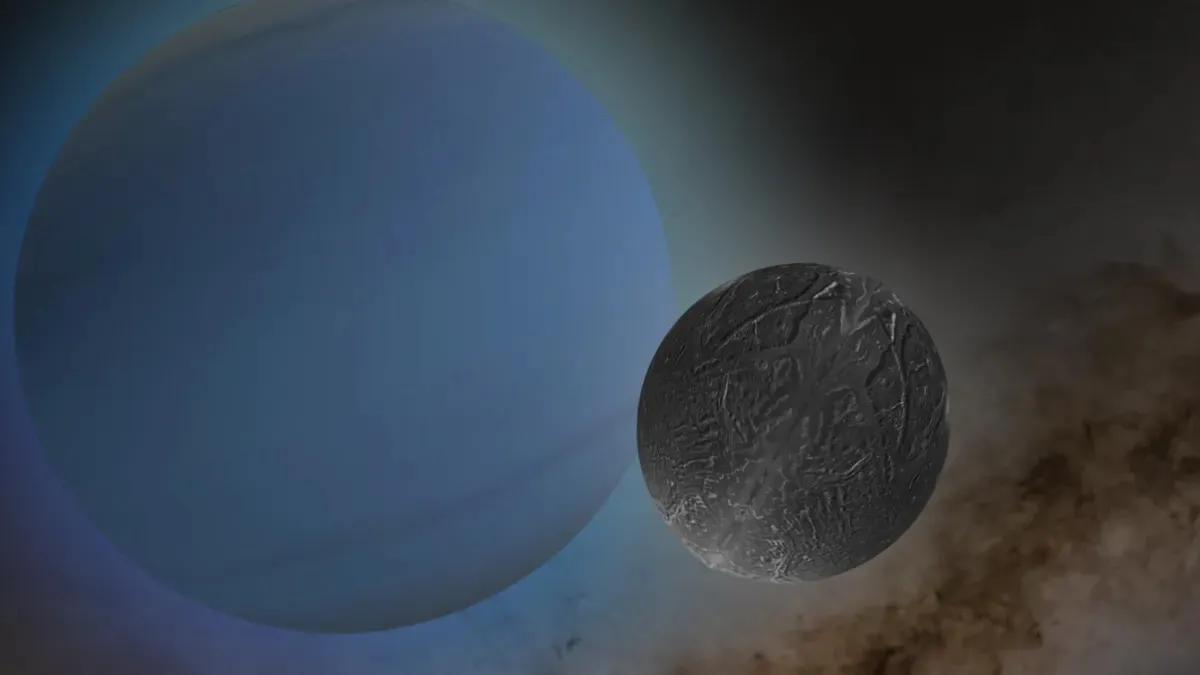
Astronomers using the James Webb Space Telescope have found that Ariel, a moon of Uranus, has some of the most carbon dioxide-rich deposits in the solar system, hinting at a buried water ocean.
Using the James Webb Space Telescope (JWST), astronomers discovered that Ariel, a moon of Uranus, could be hiding in a buried liquid water ocean.
The discovery could supply an answer to a mystery surrounding this Uranian moon that has perplexed scientists: the fact Ariel's surface is covered with a significant amount of carbon dioxide ice. This is puzzling because at the distance Uranus and its moons exist from the sun, 20 times further out from the sun than Earth, carbon dioxide turns to gas and is lost to space. This means some process must refresh the carbon dioxide at the surface of Ariel.
Previous theories have suggested this happens as a result of interactions between Ariel's surface and charged particles trapped in Uranus' magnetosphere that provide ionizing radiation, breaking down molecules and leaving carbon dioxide, a process called "radiolysis."
However, new evidence from the JWST suggests the source of this carbon dioxide could come not from outside Ariel but from its interior, possibly from a buried subsurface ocean.
Uranus and its rings as seen by the James Webb Space Telescope in 2023.
(Image credit: NASA, ESA, CSA, STScI)
Because chemical elements and molecules absorb and emit light at characteristic wavelengths, they leave individual "fingerprints" on spectra. The team behind this discovery used the JWST to gather spectra of light from Ariel, which helped them paint a picture of the chemical makeup of the Uranian moon.
Comparing this to simulated spectra from a chemical mix in the lab here on Earth revealed to the team that Ariel has some of the most carbon dioxide-rich deposits in the solar system. Not only did this add an extra 10 millimeters (0.4 inches) of thickness to the ice on the side of the tidally locked Ariel that permanently faces away from Uranus, but it also revealed clear deposits of carbon monoxide for the first time.
Sign up for the Live Science daily newsletter now
Get the world’s most fascinating discoveries delivered straight to your inbox.
"It just shouldn't be there. You've got to get down to 30 kelvins [minus 405 degrees Fahrenheit] before carbon monoxide's stable," team leader Richard Cartwright from the Johns Hopkins Applied Physics Laboratory (APL) said in a statement. "The carbon monoxide would have to be actively replenished, no question."
That's because Ariel's surface temperature is, on average, around 65 degrees Fahrenheit (18 degrees Celsius) warmer than this key temperature.
Cartwright acknowledges that radiolysis could account for some of this replenishment. However, observations from Voyager 2's 1986 flyby of Uranus and its moons and other recent findings have suggested that the interactions behind radiolysis could be limited because Uranus' magnetic field axis and the orbital plane of its moons are offset from each other by about 58 degrees.
That means that the majority of the carbon/oxygen compounds seen on Ariel's surface could be created by chemical processes in a liquid water ocean trapped under ice on Ariel.
Cool customer Ariel may have a volcanic temper
Once created in the seep water ocean of Ariel, these carbon oxides could then escape through cracks in the icy shell of the Uranian moon or could even be explosively ejected by powerful eruptive plumes.
The most detailed Voyager 2 picture of Ariel, a moon of Uranus, taken in 1986.
(Image credit: NASA/JPL-Caltech)
Scientists have suspected for some time that the cracked and scarred surface of Ariel may indicate the presence of active cryovolcanoes, volcanoes that erupt plumes of icy slush rather than lava. These plumes could be so powerful that they launch material into Uranus's magnetic field.
The majority of the cracks and grooves seen on the surface of Ariel are located on the side of the moon that faces away from Uranus. If carbon dioxide and carbon monoxide are leaking from these features to the surface of the Uranian moon, this could explain why these compounds are found in greater abundance on this trailing side of the icy body.
The JWST also picked up more chemical evidence of a subsurface liquid water ocean. Spectral analysis hinted at the presence of carbonite minerals, salts created when rock meets and interacts with liquid water.
"If our interpretation of that carbonate feature is correct, then that is a pretty big result because it means it had to form in the interior," Cartwright explained. "That's something we absolutely need to confirm, either through future observations, modeling, or some combination of techniques."
Uranus and its moons haven't been visited by a spacecraft since Voyager 2 almost four decades ago, and this wasn't even the spacecraft's primary mission. In 2023, the Planetary Science and Astrobiology decadal survey emphasized the need to prioritize a dedicated mission to the Uranian system.
Cartwright believes such a mission would present an opportunity to collect valuable information about Uranus and Neptune, the solar system's other ice giant. Such a mission could also deliver vital data about the other potentially ocean-bearing moons of these systems. This information could then be applied to extrasolar planets, or "exoplanets," beyond the solar system.
"All these new insights underscore how compelling the Uranian system is," team member and NASA Applied Physics Laboratory scientist Ian Cohen said. "Whether it's to unlock the keys to how the solar system formed, better understand the planet’s complex magnetosphere, or determine whether these moons are potential ocean worlds, many of us in the planetary science community are really looking forward to a future mission to explore Uranus."
Robert Lea is a science journalist in the U.K. who specializes in science, space, physics, astronomy, astrophysics, cosmology, quantum mechanics and technology. Rob's articles have been published in Physics World, New Scientist, Astronomy Magazine, All About Space and ZME Science. He also writes about science communication for Elsevier and the European Journal of Physics. Rob holds a bachelor of science degree in physics and astronomy from the U.K.’s Open University