It's quick and easy to access Live Science Plus, simply enter your email below. We'll send you a confirmation and sign you up for our daily newsletter, keeping you up to date with the latest science news.
Get the world’s most fascinating discoveries delivered straight to your inbox.
You are now subscribed
Your newsletter sign-up was successful
Want to add more newsletters?
Join the club
Get full access to premium articles, exclusive features and a growing list of member rewards.
An account already exists for this email address, please log in.
James Webb Space Telescope spies strange shapes above Jupiter's Great Red Spot
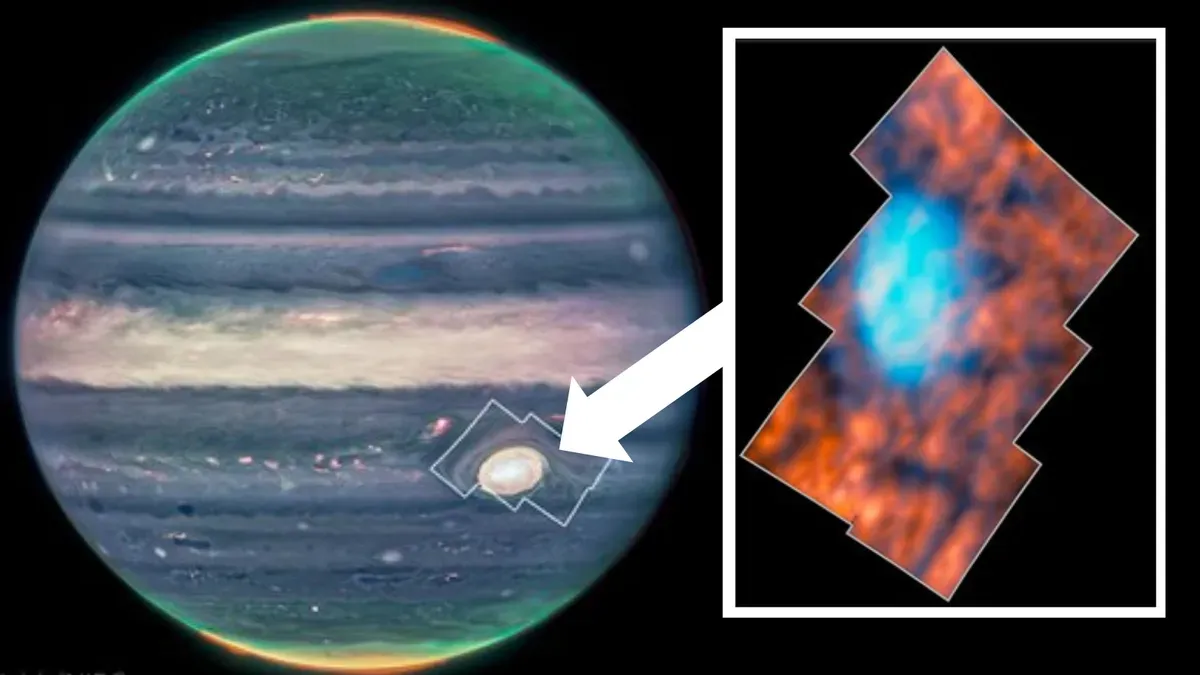
Astronomers using the James Webb Space Telescope (JWST) have spotted a previously unseen structure in the atmosphere above Jupiter's famous Great Red Spot.
Using the James Webb Space Telescope (JWST), astronomers have found previously unseen structures and activity in Jupiter's atmosphere above the Great Red Spot. These odd features seem to be caused by powerful atmospheric gravity waves.
The Great Red Spot is the largest storm in the solar system, twice as big as Earth, and is believed to have been raging for at least 300 years, according to NASA. The winds of the Great Red Spot rage at around 270 to 425 miles per hour (430 to 680 kilometers per hour), up to 3.5 times as fast as a tornado here on Earth.
Yet, despite the storm's age, size, and power, scientists had actually suspected that the atmosphere of Jupiter above the Great Red Spot wasn't all that interesting. However, these new observations delivered by the JWST's Near InfraRed Spectrograph (NIRSpec) instrument, which observed the massive scarlet storm in July 2022, show that this assumption couldn't have been more wrong.
"We thought this region, perhaps naively, would be really boring," team leader Henrik Melin of the University of Leicester said in a statement. "It is, in fact, just as interesting as the northern lights, if not more so. Jupiter never ceases to surprise."
What secrets has the Great Red Spot been hiding?
Jupiter's upper atmosphere is the point at which the planet's lower atmosphere meets its magnetic field. This leads to bright northern and southern lights, powered by bombardment by charged particles from the sun and fueled by sprays of volcanic material erupting from the Jovian moon Io, the most active volcanic body in the solar system.
Jupiter may be one of the brightest objects in the night sky over Earth, easily seen in clear skies. Yet, apart from its northern and southern lights, the atmosphere of the solar system's largest planet only glows weakly, making it difficult for ground-based telescopes to see in detail through Earth's atmosphere.
Sign up for the Live Science daily newsletter now
Get the world’s most fascinating discoveries delivered straight to your inbox.
From the JWST's position a million miles away from Earth, our planet's atmosphere is no hindrance to this $10 billion space telescope. In addition to this, the JWST's sensitivity in the infrared spectrum allows it to see the gas giant's atmosphere in intricate detail, including the region over the Great Red Spot.
Aiming to discover if this region is a bit dull, Melin and colleagues targeted it with NIRSpec, the main instrument of the JWST. This led to the discovery of a variety of intricate structures across the JWST's field of view, including dark arcs and bright spots.
The Great Red Spot as seen by the JWST showing infrared light emitted by hydrogen in Jupiter's ionosphere.
(Image credit: ESA/Webb, NASA & CSA, H. Melin, M. Zamani (ESA/Webb))
Though incident sunlight is responsible for the majority of the light seen from Jupiter's atmosphere, the team thinks there must be another that is giving rise to changes in the shape and structure of the upper Jovian atmosphere.
"One way in which you can change this structure is by gravity waves - similar to waves crashing on a beach, creating ripples in the sand," Melin explained. "These waves are generated deep in the turbulent lower atmosphere, all around the Great Red Spot, and they can travel up in altitude, changing the structure and emissions of the upper atmosphere."
These gravity waves are very different from gravitational waves, the latter of which are tiny ripples in space and time predicted by Albert Einstein in his 1915 theory of general relativity. Gravity waves propagate through an atmosphere, as opposed to the fabric of spacetime as gravitationalwaves do.
These atmospheric gravity waves are also seen on Earth occasionally, but these Earthbound waves are much less intense and powerful than the same phenomenon occurring over Jupiter.
The team now hopes to follow up on the detection of these newly found Great Red Spot features and the intricate wave patterns underlying them with the JWST. This future investigation could reveal how the waves flow through the gas giant's upper atmosphere and how this causes the observed structures to move.
JUICE launched on 14 April 2023 and will reach Jupiter and its moons in 2031 when it makes detailed observations of Jupiter and its three large ocean moons, Ganymede, Callisto, and Europa.
The team's results are published in the journal Nature Astronomy.
Robert Lea is a science journalist in the U.K. who specializes in science, space, physics, astronomy, astrophysics, cosmology, quantum mechanics and technology. Rob's articles have been published in Physics World, New Scientist, Astronomy Magazine, All About Space and ZME Science. He also writes about science communication for Elsevier and the European Journal of Physics. Rob holds a bachelor of science degree in physics and astronomy from the U.K.’s Open University

 Live Science Plus