













An interstellar object exploded over Earth in 2014, declassified government data reveal
Classified data prevented scientists from verifying their discovery for 3 years.

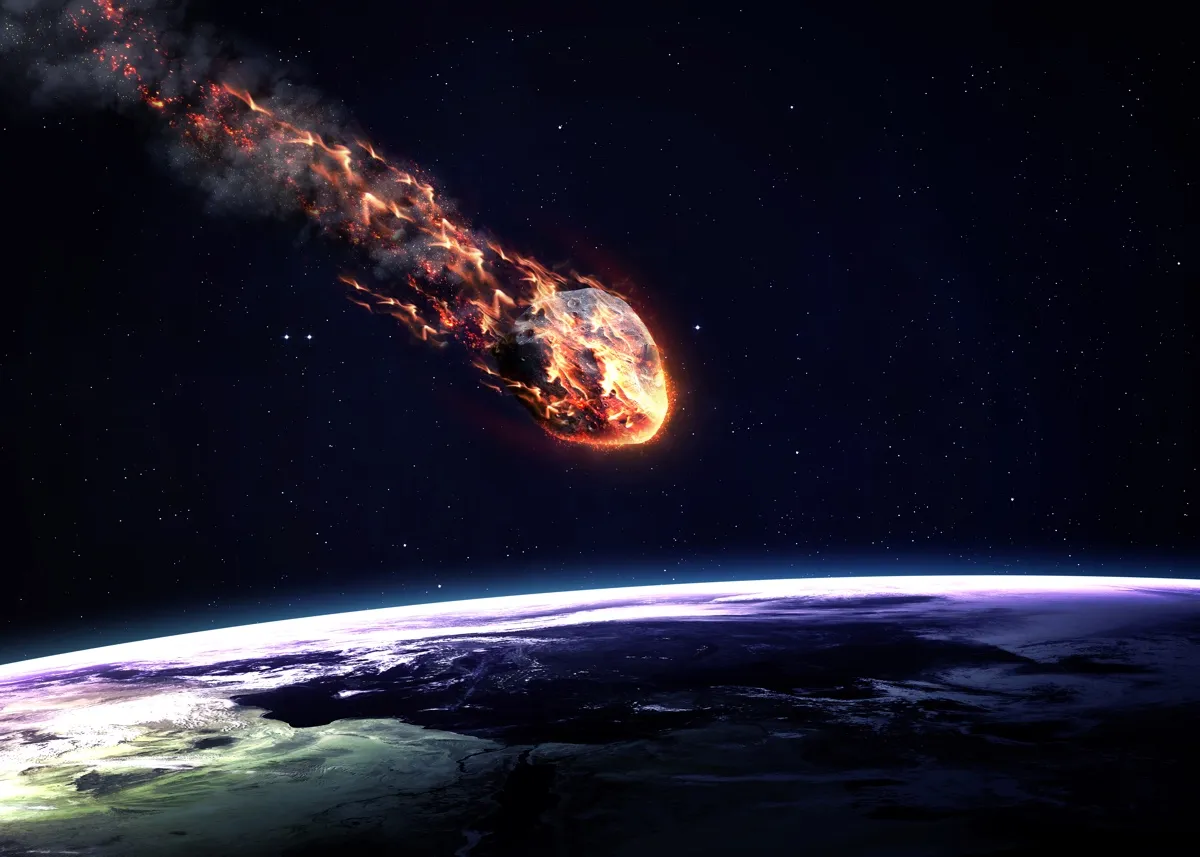
A fireball that blazed through the skies over Papua New Guinea in 2014 was actually a fast-moving object from another star system, according to a recent memo released by the U.S. Space Command (USSC).
The object, a small meteorite measuring just 1.5 feet (0.45 meter) across, slammed into Earth's atmosphere on Jan. 8, 2014, after traveling through space at more than 130,000 mph (210,000 km/h) — a speed that far exceeds the average velocity of meteors that orbit within the solar system, according to a 2019 study of the object published in the preprint database arXiv.
That 2019 study argued that the wee meteor's speed, along with the trajectory of its orbit, proved with 99% certainty that the object had originated far beyond our solar system — possibly "from the deep interior of a planetary system or a star in the thick disk of the Milky Way galaxy," the authors wrote. But despite their near certainty, the team's paper was never peer-reviewed or published in a scientific journal, as some of the data needed to verify their calculations was considered classified by the U.S. government, according to Vice.
Related: What happens in intergalactic space?
Now, USSC scientists have officially confirmed the team's findings. In a memo dated March 1 and shared on Twitter on April 6, Lt. Gen. John E. Shaw, deputy commander of the USSC, wrote that the 2019 analysis of the fireball was "sufficiently accurate to confirm an interstellar trajectory."
This confirmation retroactively makes the 2014 meteor the first interstellar object ever detected in our solar system, the memo added. The object's detection predates the discovery of 'Oumuamua — a now-infamous, cigar-shaped object that is also moving far too fast to have originated in our solar system — by three years, according to the USSC memo. (Unlike the 2014 meteor, 'Oumuamua was detected far from Earth and is already speeding out of the solar system, according to NASA.)
RELATED CONTENT
Amir Siraj, a theoretical astrophysicist at Harvard University and the lead author of the 2019 paper, told Vice that he still intends to get the original study published, so that the scientific community can pick up where he and his colleagues left off. Because the meteorite ignited over the South Pacific Ocean, it's possible that shards of the object landed in the water and have since nestled on the seafloor, he added.
Get the world’s most fascinating discoveries delivered straight to your inbox.
While locating these scraps of interstellar debris might be a nigh-impossible task, Siraj said he is already consulting with experts about the possibility of mounting an expedition to recover them.
"The possibility of getting the first piece of interstellar material is exciting enough to check this very thoroughly and talk to all the world experts on ocean expeditions to recover meteorites," Siraj told Vice.
Read more about the 2014 meteor at Vice.com.
Originally published on Live Science.

Brandon is the space / physics editor at Live Science. With more than 20 years of editorial experience, his writing has appeared in The Washington Post, Reader's Digest, CBS.com, the Richard Dawkins Foundation website and other outlets. He holds a bachelor's degree in creative writing from the University of Arizona, with minors in journalism and media arts. His interests include black holes, asteroids and comets, and the search for extraterrestrial life.