

-
 Why was the name 'Brontosaurus' brought back from the dead?
The dinosaur Brontosaurus was canceled but then resurrected. What happened?
dinosaurs -
 When did Australia become a continent?
After the supercontinent Panagea broke up around 200 million years ago, how long did it take for Australia to emerge as its own continent?
geology -
 What does space smell like?
Outer space has a particular stench. But why?
space -
 Why do dogs chase their tails?
Why are dogs, especially puppies, in endless pursuit of their tails?
dogs -
 How do mountains form?
Mountains form in a variety of ways, some of which geologists are now just starting to understand.
planet-earth -
 Skulls stolen from Africa a century ago have been genetically linked with living people
Skulls housed in a German hospital's collection for a century were stolen from Africa during the colonial period. They have now been genetically matched with living relatives.
archaeology -
 Alien life may evolve from radically different elements than human life did
Radioactive metals and even certain gases may be capable of the kinds of reactions needed to spur life, new research suggests.
extraterrestrial-life -
 Humans faced a 'close call with extinction' nearly a million years ago
The human population may have lingered at about 1,300 for more than 100,000 years, and that population bottleneck could have fueled the divergence between modern humans, Neanderthals and Denisovans.
neanderthals -
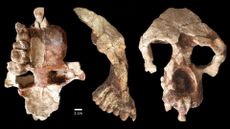 Human and ape ancestors arose in Europe, not in Africa, controversial study claims
A newly described fossil suggests that the ancestor of humans and apes arose in Europe, not in Africa.
primates -
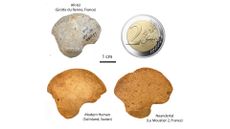 Unknown 'anatomically modern human lineage' discovered from 40,000-year-old hip bone
Fossil found in France is not quite modern human and not quite Neanderthal.
human-evolution -
 What's the earliest evidence of humans in the Americas?
Previously, researchers thought that humans arrived in North America 13,000 years ago, but now they're finding much older evidence.
americas -
 Why is gold so soft?
Gold is the most malleable element, but what's the science behind it?
chemistry -
 How do sandcastles stay together?
How can you get the right mixture of sand, water and air for your sandcastle?
physics-mathematics -
 The 10 biggest explosions in history
Explosions, both natural and man-made, have caused awe and terror for centuries. Here are 10 of the biggest recorded blasts.
planet-earth -
 'Building blocks of life' discovered on Mars in 10 different rock samples
NASA's Perseverance rover has found an intriguing menagerie of organic molecules in a Martian crater, but their source remains unclear.
mars -
 Mushroom-shaped superplume of scorching hot rock may be splitting Africa in 2
Strange, never-before-seen movements in the East Africa Rift Valley appear to be driven by super-heated rock from deep beneath Earth's surface.
geology -
 What did the last common ancestor between humans and apes look like?
Did our last common ancestor swing from trees or walk on all fours in the savanna?
primates -
 Is Africa splitting into two continents?
Will the East African Rift split the continent and create a new ocean, or will it fizzle out?
geology -
 Why does hair turn gray?
Hair grays because pigment-producing cells get stuck within the hair follicle, research suggests.
aging -
 Why do cats knead?
If a cat kneads on your lap, it's likely because it feels safe around you. But why do they knead in the first place?
cats -
 New York City may be sinking under its own weight because the buildings are too heavy, scientists warn
Scientists estimate the mass of the 1,084,954 buildings within the five boroughs of New York City is 1.68 trillion pounds.
climate-change -
 Modern humans arose after 2 distinct groups in Africa mated over tens of thousands of years
Modern humans may descend from two or more genetically distinct streams that split but continued to occasionally mix over time in Africa.
archaeology -
 Some of the 1st ice age humans who ventured into Americas came from China, DNA study suggests
The first wave of humans into the Americas during the last ice age may have hailed partly from northern China, according to a DNA study of ancient and modern Indigenous people.
americas -
 Modern humans migrated into Europe in 3 waves, 'ambitious and provocative' new study suggests
Modern humans migrated into Europe in three waves: 54,000, 45,000 and 42,000 years ago, a new study claims.
archaeology


