It's quick and easy to access Live Science Plus, simply enter your email below. We'll send you a confirmation and sign you up for our daily newsletter, keeping you up to date with the latest science news.
Scientists discovered the "fingerprints" of mysterious viruses hidden in an ancient group of microbes that may have helped fuel the rise of all complex life on Earth: from fungi to plants to humans.
These microbes — known as Asgard archaea after the abode of the gods in Norse mythology — lurk in the frigid sediments deep in the ocean and in boiling hot springs, and existed on Earth prior to the first eukaryotic cells, which carry their DNA inside a nucleus. By infecting Asgard archaea, viruses may have influenced how such life-forms first came to be, and may even have given rise to some of the first precursors to the nucleus, some scientists hypothesize. But before now, no Asgard-infecting viruses had been discovered.
Now, in a trio of studies published Monday (June 27) in the journal Nature Microbiology, scientists have identified a slew of viruses that can infect the ancient archaea.
"These are the first studies investigating Asgard archaeal viruses; there was nothing known before," said Susanne Erdmann, group leader of the archaeal virology research group at the Max Planck Institute for Marine Microbiology in Bremen, Germany, who was not involved in the studies. In the future, this line of research may reveal if and how viruses were involved in the emergence of eukaryotic cells on Earth, Erdmann told Live Science in an email.
In the new research, scientists searched for evidence of viral infection embedded in the DNA of Asgard archaea. This embedded evidence comes in the form of short snippets of viral DNA, called "CRISPR spacers."
Most people who hear the term CRISPR think of the famous gene-editing tool that allows scientists to easily manipulate genetic sequences, said Ian Rambo, a former doctoral candidate at the University of Texas at Austin Marine Science Institute and first author of one of the Nature Microbiology studies. However, this gene-editing tool was originally adapted from the natural defense mechanisms of bacteria and archaea, he told Live Science.
Sign up for the Live Science daily newsletter now
Get the world’s most fascinating discoveries delivered straight to your inbox.
The acronym "CRISPR" stands for "clusters of regularly interspaced short palindromic repeats" and refers to a region of DNA made up of short, repeated sequences with "spacers" sandwiched between each repeat. Bacteria and archaea swipe these spacers from viruses that infect them, and thus, the cells maintain a memory bank of viral DNA that helps them recognize the viruses, should they attack again. "It's an adaptive immune system that remembers these previous infections," said Rambo, who is now a postdoctoral scholar with the USDA's Agricultural Research Service.
Rambo and his colleagues hunted in the Guaymas Basin in the Gulf of California — the body of water between Baja California and mainland Mexico — for such DNA spacers in Asgard archaea specimens collected from sediments near hydrothermal vents, roughly 1.25 miles (2 kilometers) beneath the water's surface. The team matched the spacers they found to longer stretches of viral DNA gathered from the deep-sea environment.
"It is fairly easy to sequence viruses from deep-sea sediments … but the challenge is to recognize which hosts these viruses infect," said Mart Krupovic, head of the Archaeal Virology Unit at the Institut Pasteur in Paris and a co-author of the other twostudies. "CRISPR spacer matching is the most convenient and most convincing and reliable approach to assign the host."
In the end, Rambo's team uncovered six viruses that infect two types of Asgard archaea, named Lokiarchaeota and Helarchaeota for the Norse god Loki and goddess Hel, respectively. The researchers named the newfound viruses after Norse mythological creatures, including the giant wolf Fenrir and the dragon Nidhogg.
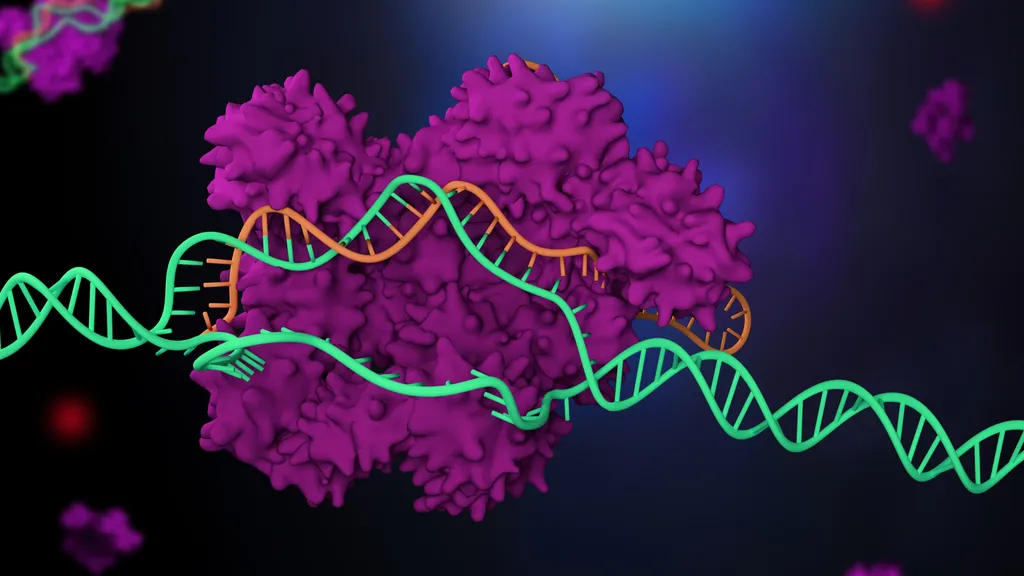
An illustration of the CRISPR-Cas9 system
(Image credit: Shutterstock)
Similarly, in one study, Krupovic and his colleagues discovered two viruses that they named Huginn and Muninn, after the two ravens that serve as scouts for the Norse god Odin; these viruses were uncovered in an Asgard genome sampled from a hot spring in Yellowstone National Park.
In the final study, Krupovic and his coauthors uncovered viruses in deep-sea sediments collected from the Shimokita Peninsula, the northeastern cape of the Japanese island of Honshū, as well as two other sites in the Pacific and one in the Indian Ocean. In these samples, they found three family-level groups of viruses, which they named after the three Norns — Wyrd, Verdandi and Skuld — which are supernatural beings that determine the destinies of gods and mortals in Norse mythology.
Working from the viral DNA, the researchers could infer what kinds of proteins the various genes code for, and therefore, how the viruses might look and function.
For example, the viruses named for the Norn Verdandi likely have tails that extend from their outer shells, or capsids, and the viruses named for Wyrd are likely lemon-shaped, Krupovic and his colleagues determined. Rambo's team also found evidence that Nidhogg viruses may be able to hijack key proteins in their host cells that would help the viruses pump out new copies of themselves. (Viruses that infect eukaryotic cells hijack their hosts in a similar fashion.)
Ultimately, the researchers could only figure out the functions of some of the viruses' genes; functions of the vast majority of the genes are still unknown, Erdmann said. In addition, because CRISPR doesn't work against all viruses, many more Asgard-infecting viruses are likely yet to be discovered, she said.
One way to find these hidden viruses would be to grow Asgard archaea in the lab and isolate any viruses found within their cells. "However, culturing Asgard archaea has been proven very difficult," Erdmann noted. To date, only one research group has successfully cultured Asgard archaea, and it took them 12 long years to do it. That's partially because archaeal cells take weeks to replicate. (By comparison, the bacterium Escherichia coli, for example, takes about 20 minutes, according to Science News).
Until more Asgards can be grown in the lab, CRISPR spacer matching is probably the most efficient way to find more viruses, Krupovic said. And as more and more viruses are found, their role in the emergence of eukaryotes — including humans — may become more clear, Rambo told Live Science.
Nicoletta Lanese is the health channel editor at Live Science and was previously a news editor and staff writer at the site. She is a recipient of the 2026 AHCJ International Health Study Fellowship, with a project focused on antibiotic stewardship practices in Japan and the U.S. They hold a graduate certificate in science communication from UC Santa Cruz and degrees in neuroscience and dance from the University of Florida. Beyond Live Science, Lanese's work has appeared in The Scientist, Science News, the Mercury News, Mongabay and Stanford Medicine Magazine, among other outlets. Based in NYC, she also remains involved in dance and performs in local choreographers' work.

 Live Science Plus