













Biggest bacterium ever discovered amazes scientists with its complexity
A newfound bacterium is bigger than a fruit fly.

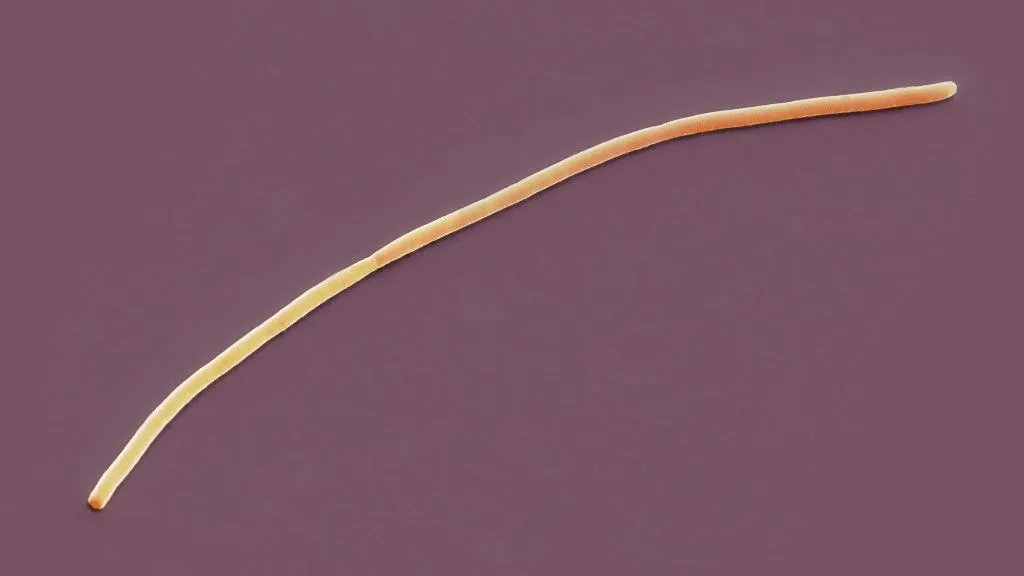
Scientists discovered an absolutely massive bacterium that can be seen without the aid of a microscope and lurks among the mangroves of Grande-Terre in the Caribbean, Science magazine reported.
The single-celled organism can grow up to 0.78 inches (2 centimeters) long and resembles a thin string, according to a report describing the discovery, posted Feb. 18 to the preprint database bioRxiv. The bacterium carries all its DNA inside a membranous pouch, unlike most bacteria, whose genetic material floats, unbound, within their cells. This feature not only sets the newfound microbe apart from other bacteria, but also distinguishes it from other prokaryotes — a group of organisms with very small, simple cell structures. The group includes organisms found in the Bacteria and Archaea domains.
In contrast to prokaryotes, eukaryotes, such as animals, plants and fungi, have more complex cells that contain a nucleus and other membrane-bound organelles. The newfound, enormous micobe toes the line between prokaryote and eukaryote in that it carries its DNA in a membrane-bound pouch, and it also carries a second, large pouch full of water, which takes up more than 70% of the cell's total volume, Science reported.
Related: 10 things we learned about microbes in 2021
Very excited to share our preprint on "A centimeter-long bacterium with DNA compartmentalized in membrane-bound organelles" #microbiology #chemosynthesis #CellBiology #bacteria https://t.co/OPYIrkqz8S pic.twitter.com/sA1RDn4zpxFebruary 18, 2022
This water-filled pouch squishes all the cell's contents up against its outermost edge, which may help life-sustaining molecules diffuse into the cell more easily, while toxins pass easily out, Science reported.
A large, sulfur-eating bacterium in the genus Thiomargarita carries the same kind of water-filled pouch, and based on this similarity, plus a genetic analysis, the researchers concluded that the newfound bacterium might belong to the same genus. They proposed that the humongous microbe be named T. magnifica.
RELATED CONTENT
The humongous bacterium "could be a missing link in the evolution of complex cells," Kazuhiro Takemoto, a computational biologist at Kyushu Institute of Technology, told Science.
Get the world’s most fascinating discoveries delivered straight to your inbox.
"All too often, bacteria are thought of as small, simple, 'unevolved' life-forms — so-called 'bags of proteins,'" Chris Greening, a microbiologist at Monash University who was not involved in the study, told Science. "But this bacterium shows this couldn't be much further from the truth."
Read more about the expectation-defying microbe in Science.
Originally published on Live Science.

Nicoletta Lanese is the health channel editor at Live Science and was previously a news editor and staff writer at the site. She is a recipient of the 2026 AHCJ International Health Study Fellowship, with a project focused on antibiotic stewardship practices in Japan and the U.S. They hold a graduate certificate in science communication from UC Santa Cruz and degrees in neuroscience and dance from the University of Florida. Beyond Live Science, Lanese's work has appeared in The Scientist, Science News, the Mercury News, Mongabay and Stanford Medicine Magazine, among other outlets. Based in NYC, she also remains involved in dance and performs in local choreographers' work.