













Magnificent Egyptian Catacomb Reveals Carvings of a 'Worthy' Woman and Her Pet

Almost 2,000 years ago, at a time when the Romans ruled Egypt, a woman named "Demetria" was laid to rest in a magnificently decorated catacomb at Saqqara in Egypt.
A carving found in the underground tomb appears to depict Demetria wearing an elaborate dress while carrying grapes. Some sort of pet looks up at her, with two of its paws on her dress.
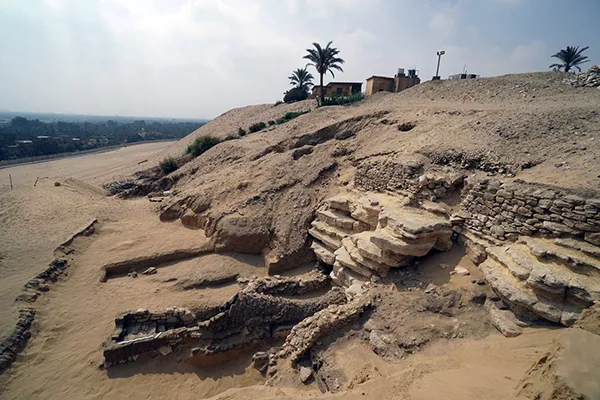
An Egyptian-Japanese team, led by Nozomo Kawai, an archaeology professor at Kanazawa University in Japan, discovered the catacomb at a site in Saqqara, a vast burial ground that served as a necropolis for royalty and other officials in the first capital of Egypt, Memphis.
Related: Photos: Exquisitely Preserved Ancient Tomb Discovered at Saqqara
The Egyptian Ministry of Antiquities announced the discovery Nov. 5 in a statement. Live Science asked Roger Bagnall, an expert on Roman Egypt, to translate the inscriptions found in the tomb and shown in images released by the Ministry of Antiquities.
The Greek inscription on the carving that depicts Demetria with a pet reads, "Demetria daughter of Menelaos, granddaughter of Ammonia, worthy, farewell," according to Bagnall, emeritus professor of ancient history at New York University. Ammonia appears to be Demetria's paternal grandmother, Bagnall said. Since the paternal grandfather isn't named, he may have been considered illegitimate, Bagnall said.


View Original
View Original
View Original
View Original
View Original
View Original
Another carving found in the catacomb shows the Egyptian gods Seth, Thoth and Anubis with wings appearing over them. The Greek inscription underneath the gods says "of Menelaos son of Philammon, servant and reverent," Bagnall told Live Science. The Greek name "Therapeutes," used to describe his servitude, is "very rare in Egyptian documents'" and indicates that he was likely a servant to a god rather than to a person, Bagnall said. Scholars debate the duties and lifestyle of a "Therapeutes."
Get the world’s most fascinating discoveries delivered straight to your inbox.
Two statues, each about 22 inches (55 centimeters) long and 7.5 inches (19 cm) high, were also found in the catacomb, the ministry said in the statement. The statues depict feline-like creatures, but the ministry statement didn't specify the animal type.
Related: The 25 Most Mysterious Archaeological Finds on Earth
The archaeologists also found figurines and the remains of mummies in the catacomb, the statement said.
The burial ground of Saqqara where the catacomb was found has divulged a wealth of secrets about ancient Egypt and is the spot where Pharaoh Djoser, the second king of the Third Dynasty, had a monument erected for him that became the first pyramid in ancient Egypt. Pyramids and tombs of kings from the Fifth and Sixth Dynasties can be found at Saqqara.
A number of archaeological discoveries have been made at Saqqara in recent years including a 2,500 year-old tomb containing a gilded silver face mask, a 4,400 year-old tomb built for a 'divine inspector' and another 4,400 year-old tomb built for a man named Khuwy who called himself the "sole friend" to a pharaoh.
The perhaps more well-known necropolis at Giza holds the remains of royalty from the Fourth Dynasty, while the pharaoh Tutankhamun, who lived during the 18th dynasty, was buried in the Valley of the Kings near Luxor.
- 30 of the World's Most Valuable Treasures That Are Still Missing
- Photos: Cat Mummies Discovered at Ancient Egyptian Burial Complex
- 7 Amazing Archaeological Discoveries from Egypt
Originally published on Live Science.

Want more science? Get a subscription of our sister publication "How It Works" magazine, for the latest amazing science news.

Owen Jarus is a regular contributor to Live Science who writes about archaeology and humans' past. He has also written for The Independent (UK), The Canadian Press (CP) and The Associated Press (AP), among others. Owen has a bachelor of arts degree from the University of Toronto and a journalism degree from Ryerson University.