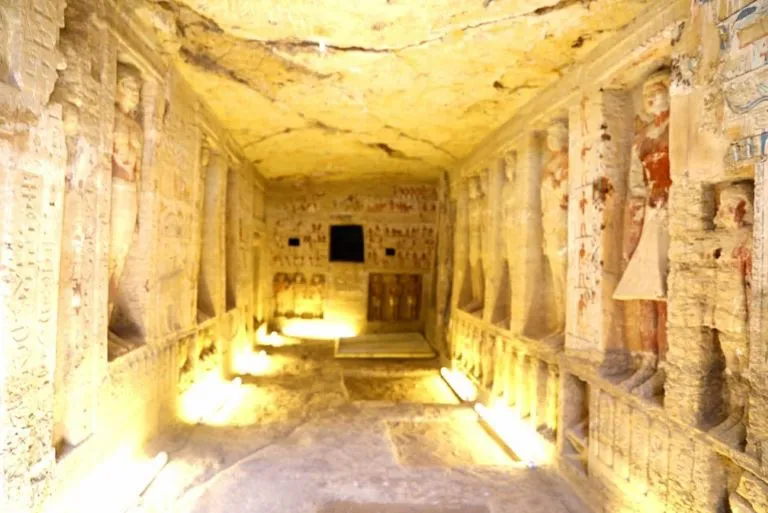
A 4,400-year-old tomb constructed for a "divine inspector" named "Wahtye" and holding at least 55 statues has been discovered at Saqqara in Egypt, the Egyptian Ministry of Antiquities announced this morning (Dec 15).
The tomb is "exceptionally well preserved and [colorful] with sculptures inside," Egyptian antiquities minister Khaled El-Enany said at the press conference. Beneath the tomb, archaeologists found five hidden shafts, one of which, they said, could hold Wahtye's sarcophagus.
Wahtye was a high-ranking priest who carried the title of divine inspector, said Mostafa Waziri, the general secretary of Egypt's Supreme Council of Antiquities who led the Egyptian team that discovered the tomb. Wahtye worked for a pharaoh named Neferirkare (reign ca. 2446–2438 B.C.), Waziri said. [See Photos of the Divine Inspector's Tomb at Saqqara]
Neferirkare's pyramid is about 1.9 miles (3 kilometers) north of Saqqara at a site called Abusir.
Tomb statues
The tomb contains two levels with 24 statues on the upper level and 31 statues on the lower level, Waziri said. Most, if not all, of the statues, show humans or deities, with some appearing life-size and others appearing to be less than about 3 feet (1 meter) tall.
The hieroglyphs discovered in the tomb often mention Wahtye's mother "Merit Meen," a name that means "the lover of the god Min, the god of fertility in ancient times," Waziri said. The hieroglyphs also mention Wahtye's wife "Nin Winit Ptah," a name that means "the greatest of the god Ptah," Waziri said. Ptah was a creator god associated with Memphis, an ancient Egyptian capital near Saqqara.
This painting found in the tomb also appears to show Wahtye and his wife Nin Winit Ptah
(Image credit: Photo courtesy Egyptian Ministry of Antiquities)
The tomb also contains numerous paintings, their colors still preserved despite the passage of millennia of time. The paintings show Egyptians engaged in a variety of activities, including cooking, drinking and construction work. [Photos: Ancient Egyptian General's Tomb Discovered in Saqqara]
Sign up for the Live Science daily newsletter now
Get the world’s most fascinating discoveries delivered straight to your inbox.
The team will start excavating the five shafts on Dec. 17, said Waziri, adding that he believes one of the shafts will lead to the sarcophagus of Wahtye and artifacts buried with him.
Owen Jarus is a regular contributor to Live Science who writes about archaeology and humans' past. He has also written for The Independent (UK), The Canadian Press (CP) and The Associated Press (AP), among others. Owen has a bachelor of arts degree from the University of Toronto and a journalism degree from Ryerson University.