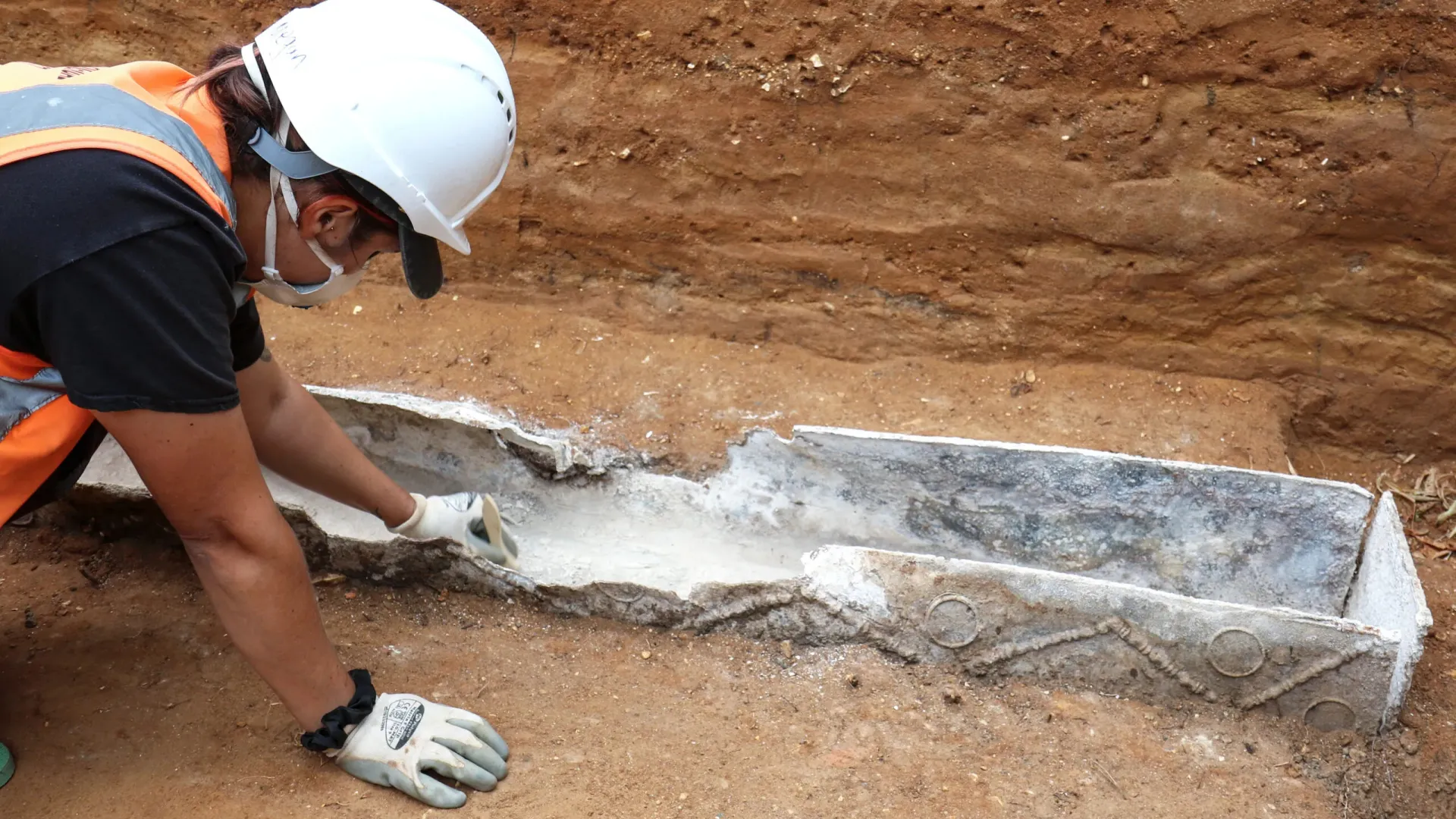
An elaborate Roman-era coffin containing the remains of a woman who appears to have been buried with gypsum and exotic resins has been discovered in the city of Colchester in the U.K.
"This is one of the most fascinating Roman burials we have worked on in Colchester in recent years," Adam Wightman, director of archaeology at Colchester Archaeological Trust, said in a statement. The combination of the coffin, grave goods and scientific evidence make it a compelling burial, he said.
The elite Roman woman was in her late 20s or 30s when she died, and she lived at a time when the Roman Empire controlled England. Exactly when she was buried is unclear, but it was likely during the late Roman period, which lasted from roughly the late third century to early fifth century A.D., archaeologists said in the statement.
"The high-status woman was buried in a decorated lead coffin accompanied by a rich group of grave goods," according to Colchester Archaeological Trust. "She was buried with objects including jet hairpins, a group of rare glass flasks, and other grave goods. This indicates a carefully staged and richly furnished burial."
The woman was also buried with exotic resins, including frankincense, dried sap from trees in the Boswellia genus, many of which grow in Africa, the Middle East and India. Frankincense can be burned as incense and was thought to have medicinal properties.
Her coffin also had gypsum, meaning the woman's body may have been covered in liquid gypsum, a plaster-like paste, before her burial. "This suggests usage of valuable imported substances in the treatment of the body after death," according to the statement.
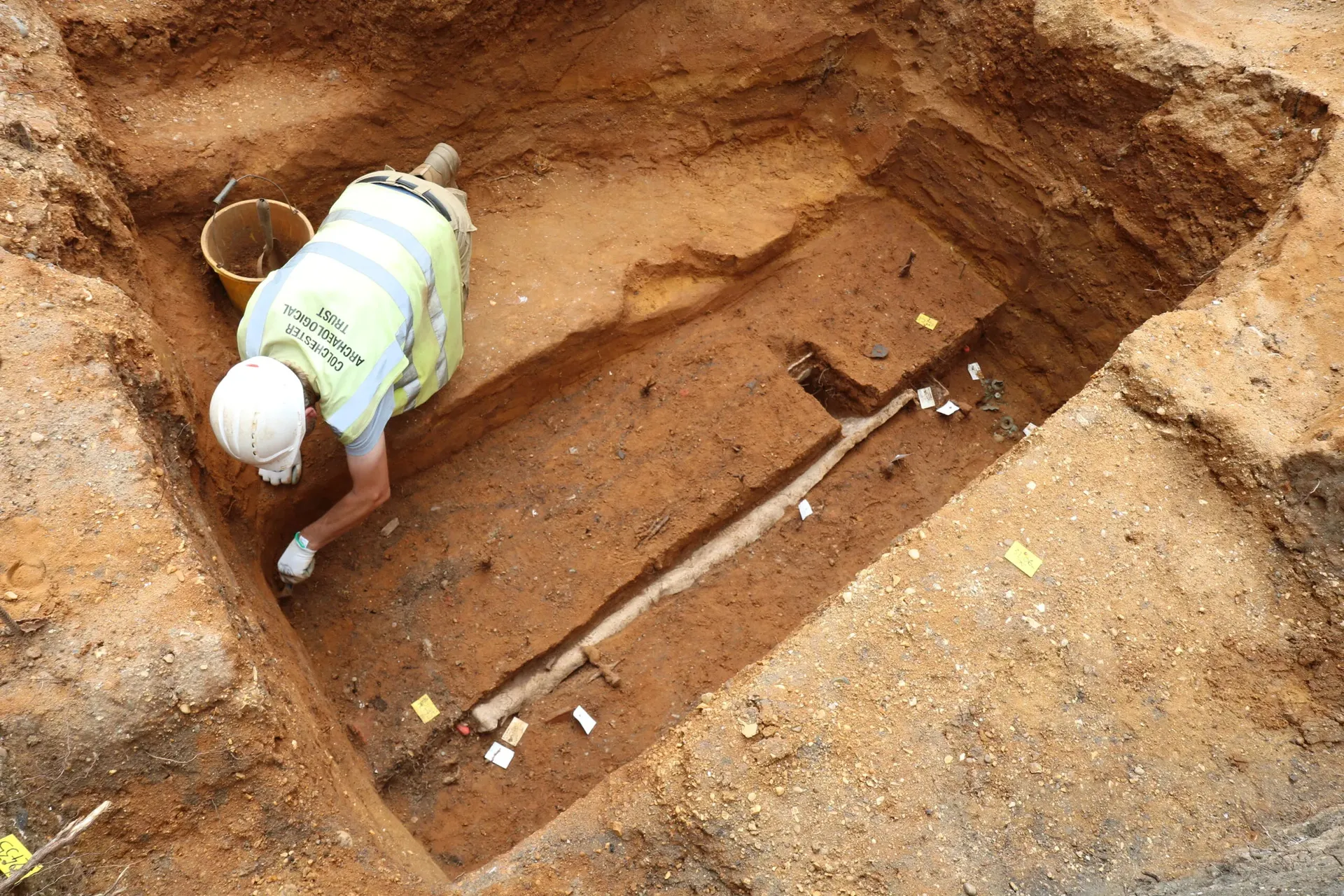
A man excavates the site of a Roman-era coffin in Colchester.
(Image credit: Colchester Archaeological Trust)
In Roman Britain, elite individuals sometimes had liquid gypsum poured on them after they died. In cases where the gypsum is well preserved, it can leave a haunting image of the deceased. Inone case, the outline of a deceased baby was preserved in a liquid gypsum burial found in York.
Sign up for the Live Science daily newsletter now
Get the world’s most fascinating discoveries delivered straight to your inbox.
"Over decades of working with Colchester Archaeological Trust on excavations of the Roman burial grounds around the Roman town, this is certainly the most spectacular I have seen," Robert Masefield, the archaeology director at Tetra Tech Consulting Limited, the company the carried out the excavation, said in the statement. "The young woman was clearly cherished by her family and by her community."
The burial was discovered in 2023 when archaeologists were excavating the site of a defunct hospital that was being redeveloped for housing but only recently announced byColchester Archaeological Trust. The coffin and its contents will be put on display at Colchester'sRoman Circus Visitor Centre starting May 16, 2026.
What do you know about the Empire's conquest of the British Isles? Find out with our Roman Britain quiz!
Owen Jarus is a regular contributor to Live Science who writes about archaeology and humans' past. He has also written for The Independent (UK), The Canadian Press (CP) and The Associated Press (AP), among others. Owen has a bachelor of arts degree from the University of Toronto and a journalism degree from Ryerson University.
You must confirm your public display name before commenting
Please logout and then login again, you will then be prompted to enter your display name.