













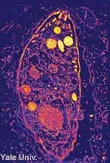
A parasitic microbe commonly found in cats might have helped shape entire human cultures by manipulating the personalities of infected individuals, according to a new study.
Infection by a Toxoplasma gondii could make some individuals more prone to some forms of neuroticism and could lead to differences among cultures if enough people are infected, says Kevin Lafferty, a U.S. Geological Survey scientist at the University of California, Santa Barbara.
In a survey of different countries, Lafferty found that people living in those with higher rates of T. gondii infection scored higher on average for neuroticism, defined as an emotional or mental disorder characterized by high levels of anxiety, insecurity or depression.
His finding is detailed in the Aug. 2 issue of the journal for Proceedings of the Royal Society, Biology.
Manipulating behavior
T. gondii infects both wild and domestic cats, but it is carried by many warm-blooded mammals. One recent study showed that the parasite makes normally cautious rats outgoing and more prone to engage in reckless behavior, such as hanging around areas frequently marked by cat urine, making the rats easy targets.
Scientists estimate that the parasite has infected about 3 billion people, or about half of the human population. Studies by researchers in the Czech Republic have suggested T. gondii might have subtle but long-term effects on its human hosts. The parasite is thought to have different, and often opposite effects in men versus women, but both genders appear to develop a form of neuroticism called "guilt proneness."
Get the world’s most fascinating discoveries delivered straight to your inbox.
Other studies have also found links between the parasite and schizophrenia. T. gondii infection is known to damage astrocytes, support cells in the brain that are also affected during schizophrenia. Pregnant women with high levels of antibodies to the parasite are also more likely to give birth to children who will develop the disorder.
In light of such studies, Lafferty wondered whether high rates of T. gondii infection in a culture could shift the average personality of its individuals.
"In populations where this parasite is very common, mass personality modification could result in cultural change," Lafferty said.
The distribution of T. gondii could explain differences in cultural aspects that relate to ego, money, material possessions, work and rules, Lafferty added. In some countries, infections by the cat parasite are very rare, while in others nearly all adults are infected.
Adding to cultural diversity
To test his hypothesis, Lafferty looked at published data on cultural dimensions and average personalities for different countries. The countries examined also kept records of the prevalence of T. gondii antibodies in women of childbearing age. Countries with high prevalence of T. gondii infection also had higher average neuroticism scores.
"There could be a lot more to this story," Lafferty said. "Different responses to the parasite by men and women could lead to many additional cultural effects that are, as yet, difficult to analyze."
Lafferty thinks that climate could be an important factor in determining which human populations are infected by T. gondii. The parasite's eggs can survive longer in humid, low-altitude regions, especially at mid latitudes that have infrequent freezing and thawing.
Other factors could also influence infection rates, including how a culture's attitudes about having cats as pets and the hygiene practices of its people.
Despite its association with neuroticism, Lafferty doesn't think all of the cat parasite's effects on human culture are bad.
"After all, they add to our cultural diversity," he said.
- Mind Control by Parasites
- Humans Gave Big Cats Ulcers
- Case Closed: Apes Got Culture
- Dying Wishes Vary by Culture and Gender
- Fine Line Revealed Between Creativity and Insanity
- Top 10 Mysterious Diseases