













Cybugs: Military Mulls Army of Cyborg Insects
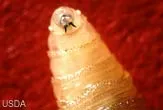
Cyborg bug armies? Our friends at DARPA seem to have cyborgs on the brain. Hot on the heels of last week's presentation of the Naval Undersea Warfare Center's progress on shark cyborgs comes a solicitation notice for Hybrid Insect Micro-Electro-Mechanical Systems (HI-MEMS).
In their solicitation notice BAA06-22, DARPA explicitly rejects research which merely results in "evolutionary improvement upon existing state-of-the-art." They are looking for more innovative proposals, suggesting that it should be possible to integrate microsystems within insects during the early stages of metamorphoses. Specifically, DARPA believes that "healing processes from one metamorphic stage to the next stage are expected to yield more reliable" implantation results. Hopefully, this will result in more sophisticated (and more reliable) bio-electromechanical interfaces, as opposed to those cheap "adhesively-bonded systems" sometimes used on adult insects.
The final demonstration goal of the HI-MEMS program is the controlled arrival of an insect within five meters of a specified target located one hundred meters from the insect's starting point. It must then remain stationary indefinitely, unless otherwise instructed. It must also be able to transmit data from DOD sensors providing information about the local environment.
Tired of working with flying insects? No problem; DARPA says that "hopping and swimming insects could also meet final demonstration goals."
Effort is required in the following areas:
- Demonstrate reliable bio-electromechanical interfaces to insects
- Demonstrate locomotion control using MEMS platforms
- Demonstrate technologies to scavenge power from insects.
DARPA has tried to make use of insects before. In their Detection of Biological and Chemical Warfare Agents by Honey Bees program, it was hoped that the natural foraging behavior of honeybees could be harnessed for military applications. However, after some initial success, it appears that "Instinctive behaviors for feeding and mating -- and also for responding to temperature changes -- prevented them from performing reliably."
It also appears that honey bees can be trained to recognize individuals; whether or not they can be trained to salute and obey orders is another matter.
Get the world’s most fascinating discoveries delivered straight to your inbox.
Entomologists are skeptical. According to the BBC, Dr George McGavin of the Oxford University Museum of Natural History said it appeared impossible to connect the technology to the right places during the metamorphic phase, particularly with regard to flight.
Museum entomology expert Stuart Hine added, "I feel that the reality of such cyborg fusion between insect and machine lies squarely in the realms of fiction."
That may be true, but I can't find the reference. I can think of various examples of implants made after birth, like Jones the cyborg dolphin and implanted microprocessor monitors for executives. Anyone?
Read more about it at the BBC site. Thanks to alert reader Masa Thavia for the story tip.
(This Science Fiction in the News story used with permission from Technovelgy.com - where science meets fiction.)