













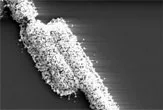
Fully merging microbe and machine for the first time, scientists have created gold-plated bacteria that can sense humidity.
The breakthrough is the first "cellborg" in what might become an array of devices that could sense dangerous gases or other hazardous substances.
The bioelectronic device swells and contracts in response to how much water vapor is in the air. It’s called a cellborg humidity sensor, and it is at least four times more sensitive than those that are solely electronic. It even works even when its biological parts are long dead.
How it was made
Scientists first coated a silicon chip with a layer of live Bacillus cereus bacteria. Some of the long, rod-shaped microbes lodged between two etched electrodes on the chip’s surface, forming a bridge. The chip was then washed in a solution containing tiny gold particles, each one about 30 nanometers across.
A nanometer is one billionth of a meter. A human hair is roughly 100,000 nanometers wide.
The gold nanoparticles attached to long hair-like proteins on the surface of the bacteria, transforming them into gold-plated bridges that completed an electronic circuit.
Get the world’s most fascinating discoveries delivered straight to your inbox.
The hair-like proteins are called teichoic acid molecules. They are negatively charged and provide a surface for the positively-charged gold nanoparticles to attach to. Without them, the gold nanoparticles would repel one another due to their like-charges and no bridge between the two electrodes could ever form.
By wrapping themselves around the gold nanoparticles, the teichoic acid molecules therefore act as metal insulators, creating what engineers call a “dielectric barrier.”
“To any electronic person, that’s a field day,” said Ravi Saraf, a University of Nebraska chemical engineer who led the discovery. “You can go nuts with it.”
First of its kind
The bodies of the gold-plated bacteria swell as humidity increases and they absorb moisture; they contract when humidity decreases. The swelling causes the gold nanoparticles on the bacteria’s surface to grow farther apart, like stickers on an inflating balloon.
Even a tiny separation of 0.2 nanometers between the gold nanoparticles was enough to interfere with the flow of electric current between the circuit’s two electrodes. That’s because the farther apart the gold particles on the bacteria’s surface, the harder it becomes for electrons to “hop” between particles and get from one electrode to the other.
The cellborg sensor is extremely sensitive: a drop from 20 percent to zero humidity results in a 40-fold decrease in current flow. In humidity sensors that are solely electronic, the decrease is only 10-fold.
According to Saraf, their hybrid sensor is the first to incorporate microorganisms into an electronic device.
In the past, researchers have programmed bacteria to behave like biological computers or created electronic circuits that respond to glowing bacteria as a way to detect chemicals, but in those cases, the line separating microbe and machine was still distinct.
The nearest other attempt to merge the two occurred in March, when researchers at the University of Wisconsin-Madison reported using electrodes to trap and examine bacteria. One researcher from that team essentially predicted the experiment by Saraf and his graduate student, Vikas Berry, saying that it might be possible to attach microscopic gold particles to the shell of the bacteria to form “nanoscale gold wire.”
Bacteria zombies
Once assimilated, the gilded bacteria can survive for only about two days, but even when dead, their bodies still swell and contract in response to changes in humidity. They can go on working this way for months, Saraf said.
If scientists could coat bacteria with gold nanoparticles without killing them, it might be possible to make cellborg sensors that could power an electronic circuit instead of just completing one, Saraf told LiveScience.
Another possibility may be to tweak the bacteria so they respond to things other than humidity. They could be made to swell or contract, for example, when they feed on certain gases or hazardous chemicals.
The study was detailed in the Oct. 21 issue of the journal Angewandte Chemie.
- Scientists Make Bacteria Behave Like Computers
- Brain Power: Mind Control of External Devices
- Printable Skin: 'Inkjet' Breakthrough Makes Human Tissue
- Jolted Bacteria Make Hydrogen from Human Waste
- Talking Bacteria, and How to Shut Them Up