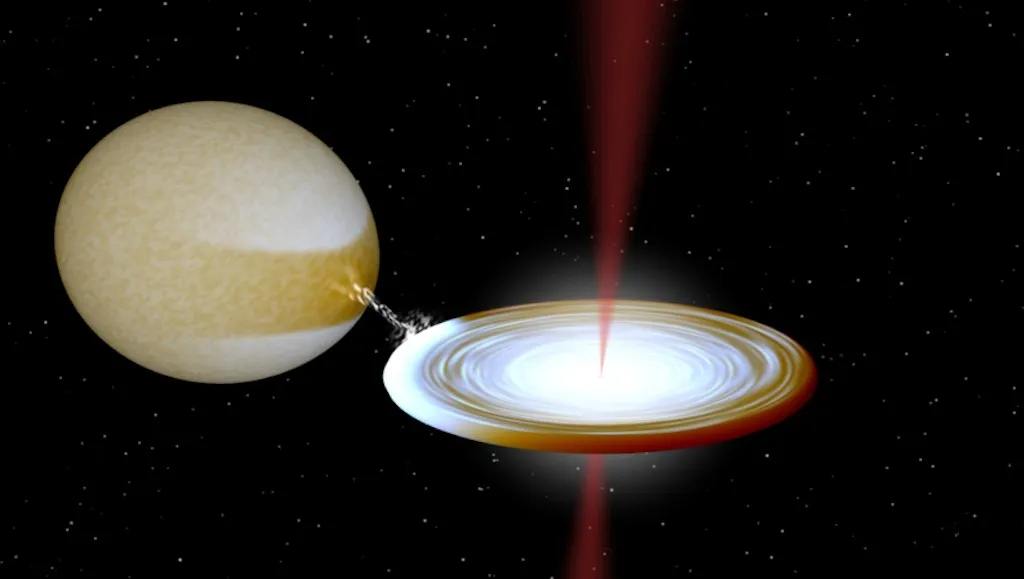
In this artist's illustration of a microquasar, gas from a donor star falls toward a black hole and spreads to form an accretion disk on the way in, releasing gravitational energy that helps span powerful jets that can travel for hundreds of light-years before slowing down enough to transfer energy to surrounding gas. Image released Feb. 27, 2014.
(Image credit: T.D. Russell (ICRAR-Curtin), using BINSIM visualization code by R. Hynes (LSU))
Black holes can blast their surroundings with much stronger winds than previously thought, scientists say.
The discovery will help better model the evolution of black holes over time, and help uncover the huge influence they can have on their host galaxies.
This view of the microquasar MQ1, a black hole in the galaxy M83, shows the strange object as it appeared to the Hubble Space Telescope's Wide Field Camera 3. Two lobes of hot gas, created by the pair of jets, are clearly visible on either side of the central source. Image released Feb. 27, 2014.
(Image credit: W.P. Blair (JHU) & R. Soria (ICRAR-Curtin))
Black holes are objects with gravitational pulls so powerful, not even light can escape. Black holes grow when gas and dust in space flows or accretes onto them — this matter gets so hot it glows hot with radiation such as X-rays. [Strangest Black Holes in the Universe]
The amount of radiation flowing out from a black hole cannot exceed a certain level known as the Eddington limit or this radiation will blow gas flowing inward away. This limit is based on the black hole's mass.
However, whether the amount of kinetic energy from a black hole, in the form of jets and winds, was constrained by the same limit was unclear. Insights on these jets and winds is crucial for understanding the critical role black holes can play in their host galaxies — for instance, they could blow on gas hard enough to keep stars from forming.
To help solve this mystery, scientists investigated the black hole called MQ1 at the center of its host galaxy, M83, for more than a year. The galaxy lies about 15 million light-years away from Earth in the constellation Hydra, and is one of the closest and brightest spiral galaxies in the sky, visible with only binoculars.
"This powerful black hole is in a famous nearby galaxy that has been looked at gazillions of times, but was never spotted or never noticed,"study lead author Roberto Soria, an astrophysicist at the International Center for Radio Astronomy Research located in Perth, Australia, told Space.com.
Sign up for the Live Science daily newsletter now
Get the world’s most fascinating discoveries delivered straight to your inbox.
It took a combination of optical, X-ray and radio observations from the Hubble Space Telescope, the Chandra X-ray Observatory and the Australia Telescope Compact Array to find MQ1. "Only when you put all three images together does this black hole really stand out," Soria said.
By analyzing the gas flowing into the black hole, they inferred its weight as less than 100 times that of the sun. The
This Hubble Space Telescope view of the spiral galaxy M83 shows location of the microquasar MQ1 marked by a blue circle. Image released Feb. 27, 2014.
(Image credit: Hubble Heritage Project)
researchers compared the mass of the black hole with its outgoing kinetic power, which they estimated by looking at how bright its surroundings are with infrared and radio waves — the brighter the surroundings, the more kinetic energy jets and winds from the black holes must be slamming them with.
The same physical processes that power microquasars such as MQ1 are also at work in active galaxies and quasars (at much larger scales). Here we can see the same structure (powerful central black hole, jets, lobes) in the active galaxy Hercules A. In both classes of systems, the energy comes from the infall of gas towards the central black hole.
(Image credit: NASA, ESA, S. Baum and C. O'Dea (RIT), R. Perley and W. Cotton (NRAO/AUI/NSF), and the Hubble Heritage Team (STScI/AURA))
The scientists discovered the amount of kinetic energy flowing out from this black hole was perhaps two to five times higher than the Eddington limit for a black hole of this mass. "The little mass that is squirting out travels at a speed approaching the speed of light," Soria said.
Scientists had suspected that even small black holes such as MQ1 could produce huge amounts of kinetic energy. Now they have proof.
"We have finally shown that even a small one can be so powerful," Soria said. "In our models, we will have to pay more attention to the huge influence black hole jets have in the evolution of young galaxies, even small black holes that maybe would have been ignored in the past."
Black holes with such a huge jet power are very rare in the nearby universe "so finding one is exciting and helps us understand them better," Soria said. "We will look at more galaxies a bit further away, up to 50 million light years, to try and discover more of those."
The scientists detailed their findings online Feb. 27 in the journal Science.
Charles Q. Choi is a contributing writer for Live Science and Space.com. He covers all things human origins and astronomy as well as physics, animals and general science topics. Charles has a Master of Arts degree from the University of Missouri-Columbia, School of Journalism and a Bachelor of Arts degree from the University of South Florida. Charles has visited every continent on Earth, drinking rancid yak butter tea in Lhasa, snorkeling with sea lions in the Galapagos and even climbing an iceberg in Antarctica.