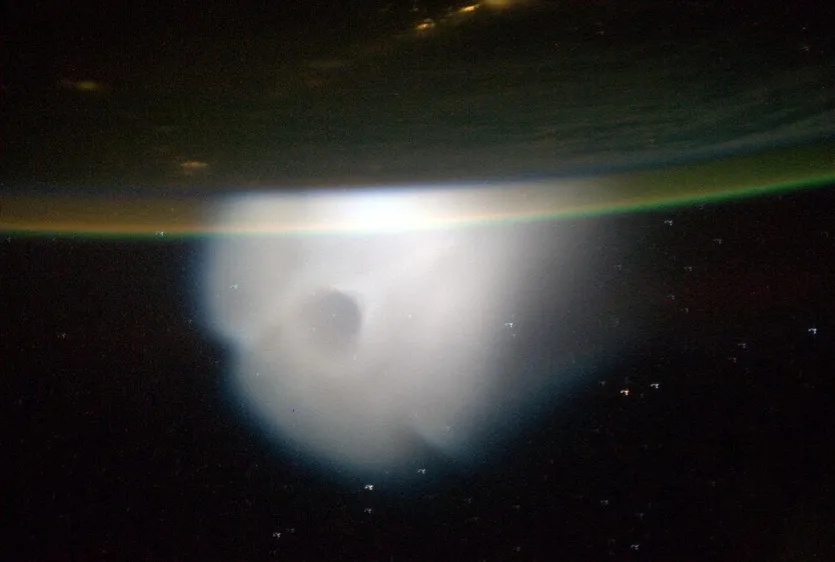
NASA Astronaut Mike Hopkins took this photo from the International Space Station on Oct. 10. “Saw something launch into space today. Not sure what it was but the cloud it left behind was pretty amazing,” the Expedition 37/38 Flight Engineer tweeted.
(Image credit: Mike Hopkins (via Twitter as @AstroIllini))
Astronauts on the International Space Station have beamed home photos of an eerie space cloud outside their orbital home, a strange sight apparently created by a recent missile launch.
The astronaut photos were captured on Oct. 10 by NASA astronaut Mike Hopkins and European Space Agency astronaut Luca Parmitano who took to Twitter under their pen names (@AstroIllini and @astro_luca, respectively) to share the unnatural looking space cloud formation with Earth.
"Saw something launch into space today," Hopkins wrote. "Not sure what it was but the cloud it left behind was pretty amazing." At first, Hopkins wasn't sure what created the odd looking cloud outside the window of the orbiting laboratory, but Parmitano cleared up the confusion with a Twitter post of his own. [Amazing Space Photos by Astronaut Luca Parmitano]
"A missile launch seen from space: an unexpected surprise!" Parmitano wrote in a post on Oct. 11. One of the Italian astronaut's photos shows a curving contrail left in the missile's wake and another features a wispy cloud formed in space after the missile disintegrated.
Russia's Strategic Rocket Forces launched the missile, according to a blog post on RussianForces.org. The Topol/SS-25 missile launched from Kapustin Yar to the Sary Shagan test site in Kazakhstan.
"According to a representative of the Rocket Forces, the test was used to confirm characteristics of the Topol missile, to test the systems of the Sary Shagan test site, and 'to test new combat payload for intercontinental ballistic missiles,'" RussianForces.org wrote on Oct. 10.
Russia also conducted a similar test from Kapustin Yar to Sary Shagan in June 2012, RussiaForces.org said.
Sign up for the Live Science daily newsletter now
Get the world’s most fascinating discoveries delivered straight to your inbox.
Astronaut Luca Parmitano of Italy tweeted this photo of a missile launch seen from the International Space Station on Oct. 11, 2013.
(Image credit: Luca Parmitano (via Twitter as @astro_luca))
Parmitano and Hopkins are joined by four other spaceflyers on the International Space Station. NASA's Karen Nyberg and Russian cosmonauts Fyodor Yurchikhin, Oleg Kotov and Sergey Ryazanskiy round out the Expedition 37 crew. Ryazanskiy, Hopkins and Kotov launched to the station at the end of September. Current station commander Yurchikhin, Nyberg and Parmitano are scheduled to fly back to Earth on Nov. 11.
Although NASA is currently closed due to the government shutdown, astronauts on the station are apparently still able to post photos on social media websites.
Twitter is just one of the ways that astronauts are able to communicate with people on the ground. Nyberg actively posts post photos on the website Pinterest and Parmitano blogs about his adventures in spaceflight through ESA. The station astronauts can also video chat with their loved ones on the surface of Earth.
The $100 billion orbiting laboratory is the size of a five-bedroom house with the wingspan of a football field. It is the largest structure ever built in space and has been continually staffed by a rotating crew of astronauts and cosmonauts since 2000.
Miriam Kramer joined Space.com as a staff writer in December 2012. Since then, she has floated in weightlessness on a zero-gravity flight, felt the pull of 4-Gs in a trainer aircraft and watched rockets soar into space from Florida and Virginia. She also serves as Space.com's lead space entertainment reporter, and enjoys all aspects of space news, astronomy and commercial spaceflight. Miriam has also presented space stories during live interviews with Fox News and other TV and radio outlets. She originally hails from Knoxville, Tennessee where she and her family would take trips to dark spots on the outskirts of town to watch meteor showers every year. She loves to travel and one day hopes to see the northern lights in person.